
双靶点 CD19/CD20 CAR 慢病毒载体驱动白血病细胞系的靶抗原调节和非靶抗原调节。
A tandem CD19/CD20 CAR lentiviral vector drives on-target and off-target antigen modulation in leukemia cell lines.
机构信息
Lentigen Technology, Inc., 910 Clopper Rd., Gaithersburg, MD 20878 USA.
Miltenyi Biotec GmbH, Bergisch Gladbach, Germany.
出版信息
J Immunother Cancer. 2017 May 16;5:42. doi: 10.1186/s40425-017-0246-1. eCollection 2017.
BACKGROUND
Clinical success with chimeric antigen receptor (CAR)- based immunotherapy for leukemia has been accompanied by the associated finding that antigen-escape variants of the disease are responsible for relapse. To target hematologic malignancies with a chimeric antigen receptor (CAR) that targets two antigens with a single vector, and thus potentially lessen the chance of leukemic escape mutations, a tandem-CAR approach was investigated.
METHODS
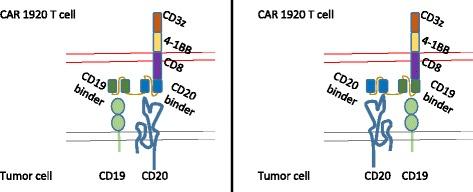
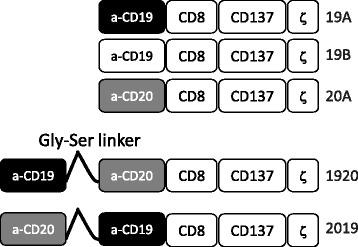
Antigen binding domains from the FMC63 (anti-CD19) and Leu16 (anti-CD20) antibodies were linked in differing configurations to transmembrane and T cell signaling domains to create tandem-CARs. Expression on the surface of primary human T cells was induced by transduction with a single lentiviral vector (LV) encoding the tandem-CAR. Tandem-CARs were compared to single antigen targeting CARs in vitro and in vivo, and to an admixture of transduced cells expressing each CAR in vivo in immunodeficient (NSG) disease-bearing mice.
RESULTS
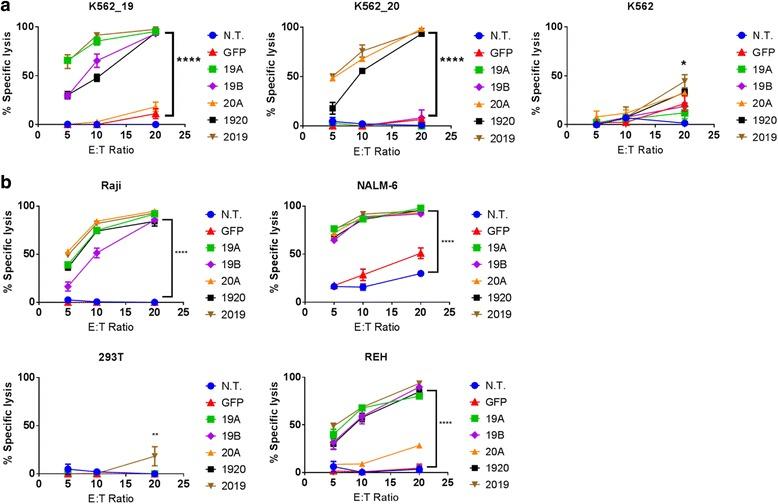
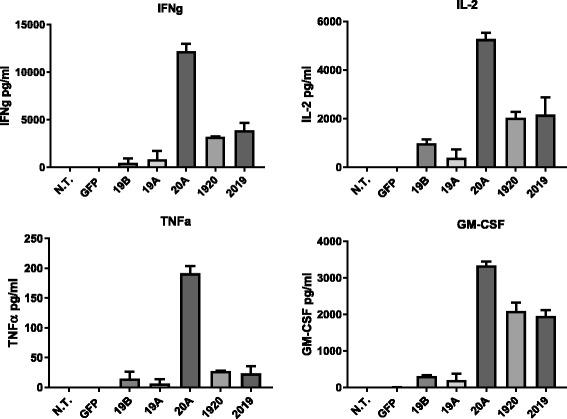
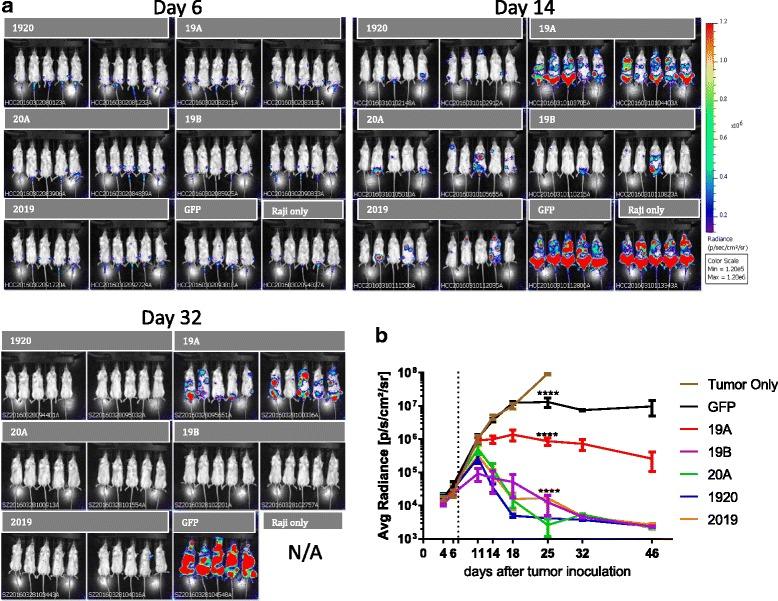
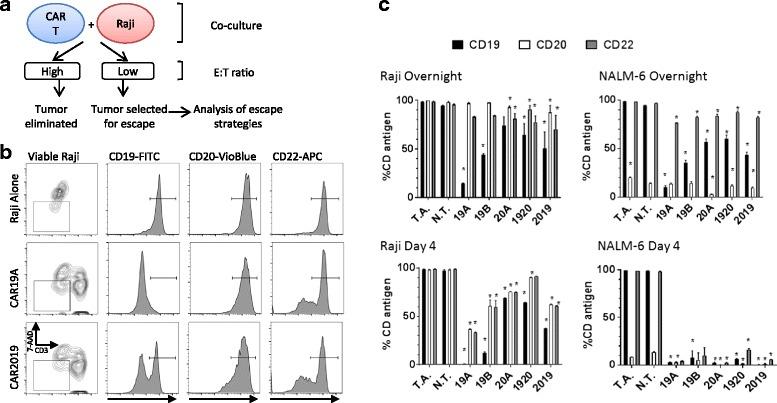
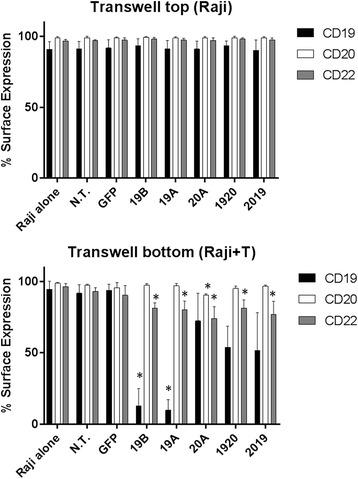
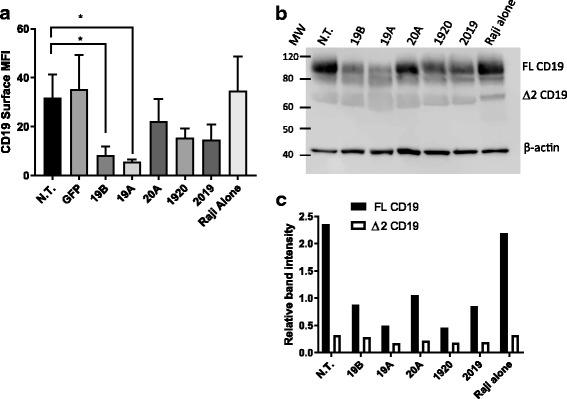
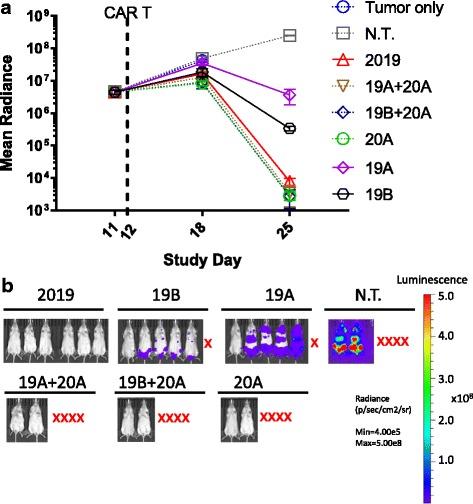
Tandem constructs efficient killed the Raji leukemia cell line both in vitro and in vivo. Tandem CARs generated less cytokine than the CD20 CAR, but similar to CD19 CARs, on their own. In co-culture experiments at low effector to target ratios with both single- and tandem- CAR-T cells, a rapid down-modulation of full-length CD19 expression was seen on leukemia targets. There also was a partial down-modulation of CD22, and to a lesser degree, of CD20. Our data also highlight the extreme sensitivity of the NALM-6 cell line to general lymphocyte-mediated cytotoxicity. While single and tandem constructs were effective in vivo in a standard setting, in a high-disease burden setting, the tandem CAR proved both effective and less toxic than an admixture of transduced T cell populations expressing single CARs.
CONCLUSION
Tandem CARs are equally effective in standard disease models to single antigen specificity CARs, and may be both more effective and less toxic in a higher disease burden setting. This may be due to optimized cell killing with more moderate cytokine production. The rapid co-modulation of CD19, CD20, and CD22 may account for the ability to rapidly evolve escape mutants by selecting for leukemic clones that not require these target antigens for continued expansion.
背景
嵌合抗原受体 (CAR) 为基础的免疫疗法治疗白血病取得了临床成功,但随之而来的是发现疾病的抗原逃逸变体是导致复发的原因。为了用一种嵌合抗原受体 (CAR) 靶向两种抗原,从而有可能减少白血病逃逸突变的机会,研究了串联 CAR 方法。
方法
将 FMC63(抗 CD19)和 Leu16(抗 CD20)抗体的抗原结合域以不同的构型连接到跨膜和 T 细胞信号域,以创建串联-CAR。通过转导单个编码串联-CAR 的慢病毒载体 (LV) 诱导原发性人 T 细胞表面表达。在体外和体内将串联-CAR 与单抗原靶向 CAR 进行比较,并在免疫缺陷 (NSG) 荷瘤小鼠体内与表达每种 CAR 的转导细胞混合物进行比较。
结果
串联结构在体外和体内都有效地杀死了 Raji 白血病细胞系。与 CD20 CAR 相比,串联 CAR 本身产生的细胞因子较少,但与 CD19 CAR 相似。在与单和串联-CAR-T 细胞以低效应器与靶标比例的共培养实验中,白血病靶标上的全长 CD19 表达迅速下调。CD22 也有部分下调,程度较轻的是 CD20。我们的数据还突出了 NALM-6 细胞系对一般淋巴细胞介导的细胞毒性的极端敏感性。虽然单和串联构建物在标准设置中在体内有效,但在高疾病负担设置中,串联 CAR 既有效又比表达单 CAR 的转导 T 细胞群体混合物毒性更小。
结论
串联 CAR 在标准疾病模型中与单抗原特异性 CAR 同样有效,在更高疾病负担的情况下可能更有效且毒性更小。这可能是由于更适度的细胞因子产生导致优化的细胞杀伤。CD19、CD20 和 CD22 的快速共调节可能解释了为什么通过选择不需要这些靶抗原继续扩增的白血病克隆,能够快速进化逃逸突变体。
 Zotero 插件