
信号识别颗粒可防止细菌膜蛋白的 N 端加工。
Signal recognition particle prevents N-terminal processing of bacterial membrane proteins.
机构信息
Department of Physical Biochemistry, Max Planck Institute for Biophysical Chemistry, 37077 Göttingen, Germany.
出版信息
Nat Commun. 2017 May 18;8:15562. doi: 10.1038/ncomms15562.
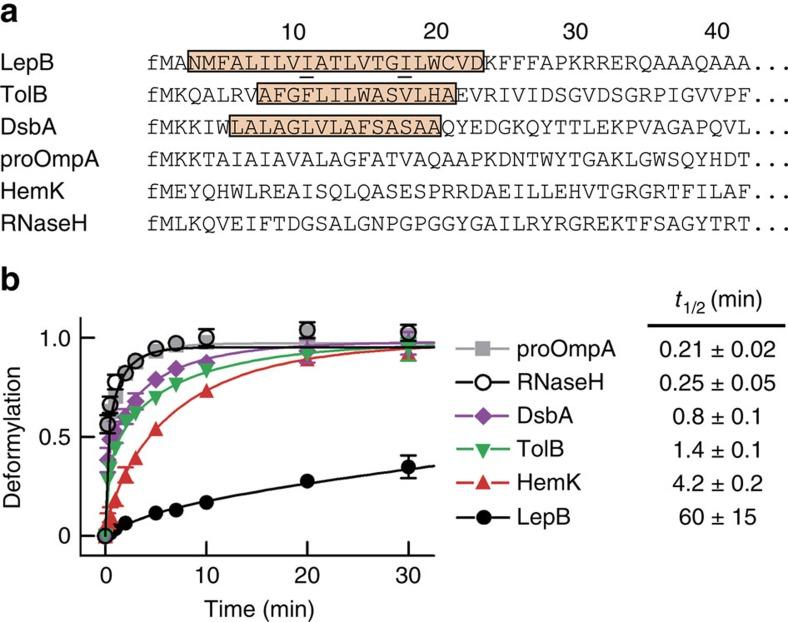
Bacterial proteins are synthesized with an N-formylated amino-terminal methionine, and N-formylated peptides elicit innate-immunity responses against bacterial infections. However, the source of these formylated peptides is not clear, as most bacterial proteins are co-translationally deformylated by peptide deformylase. Here we develop a deformylation assay with translating ribosomes as substrates, to show that the binding of the signal recognition particle (SRP) to signal sequences in nascent proteins on the ribosome prevents deformylation, whereas deformylation of nascent proteins without signal sequence is not affected. Deformylation and its inhibition by SRP are not influenced by trigger factor, a chaperone that interacts with nascent chains on the ribosome. We propose that bacterial inner-membrane proteins, in particular those with N-out topology, can retain their N-terminal formyl group during cotranslational membrane insertion and supply formylated peptides during bacterial infections.
细菌蛋白的 N 端甲硫氨酸起始位带有甲酰化修饰,N 甲酰化肽可引发针对细菌感染的固有免疫反应。然而,这些甲酰化肽的来源尚不清楚,因为大多数细菌蛋白在翻译过程中会被肽酰甲硫氨酸氨肽酶(Peptide deformylase)脱甲酰化。在这里,我们开发了一种以翻译核糖体为底物的脱甲酰化检测实验,结果表明信号识别颗粒(Signal recognition particle,SRP)与核糖体上新生肽的信号序列结合可阻止脱甲酰化,而没有信号序列的新生肽的脱甲酰化则不受影响。SRP 并不影响脱甲酰化及其对脱甲酰化的抑制作用,触发因子(Trigger factor)是一种与核糖体上新生肽相互作用的伴侣蛋白,它也不影响脱甲酰化。我们提出,细菌内膜蛋白,特别是那些具有 N 端外排拓扑结构的蛋白,在共翻译插入膜的过程中可以保留其 N 端甲酰基,并在细菌感染期间提供甲酰化肽。



 Zotero 插件