
SRP、SR 与结合在翻译核糖体上的易位子之间的四元复合物结构。
Structure of the quaternary complex between SRP, SR, and translocon bound to the translating ribosome.
机构信息
Department of Biology, Institute of Molecular Biology and Biophysics, Otto-Stern-Weg 5, ETH, Zurich CH-8093, Switzerland.
Division of Chemistry and Chemical Engineering, California Institute of Technology, Pasadena, California 91125, USA.
出版信息
Nat Commun. 2017 May 19;8:15470. doi: 10.1038/ncomms15470.
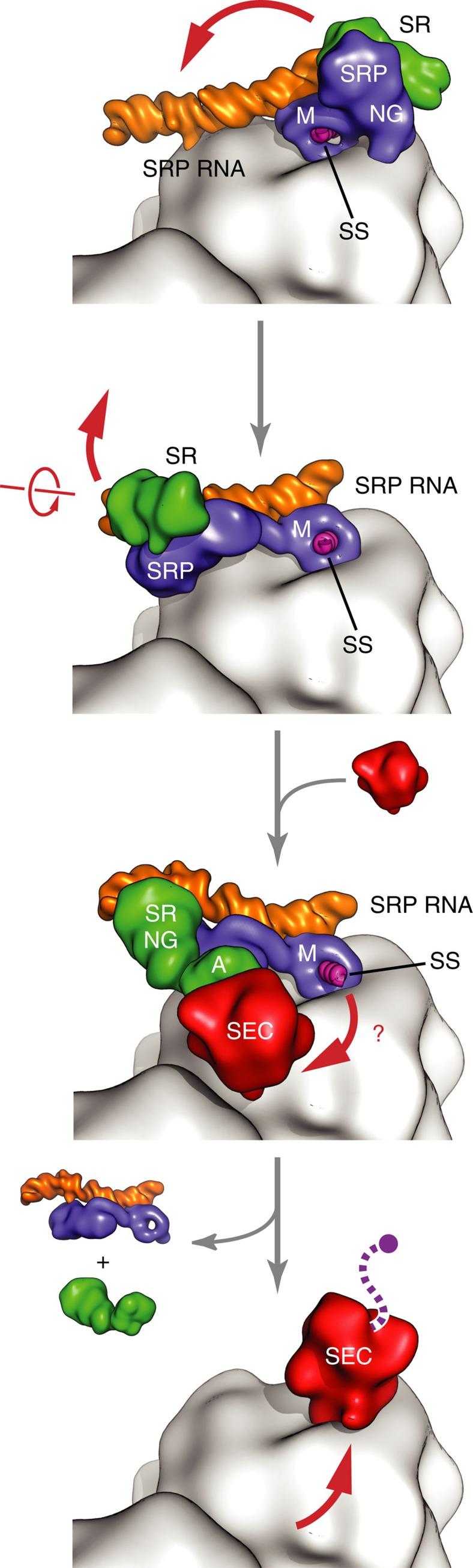
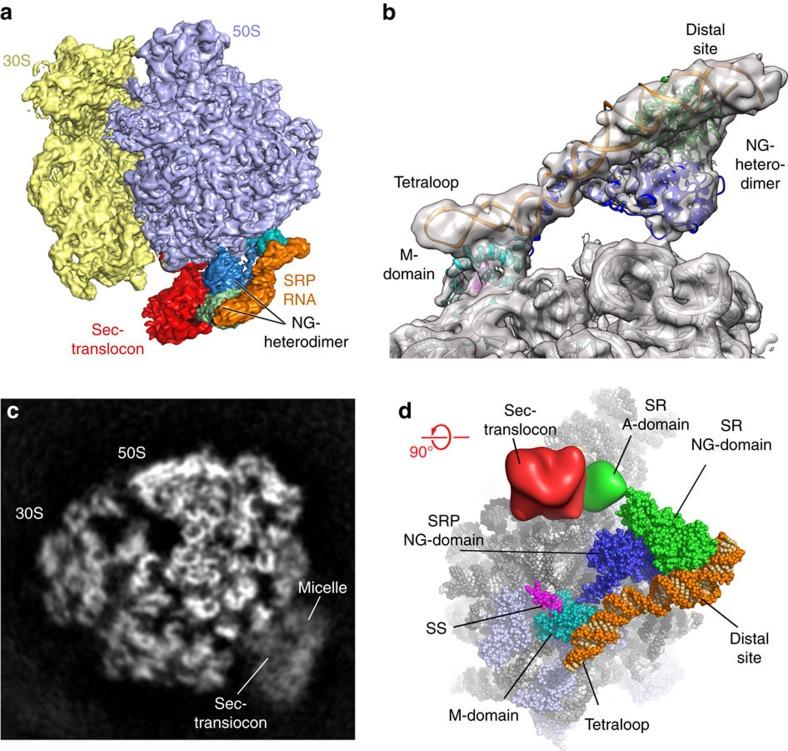
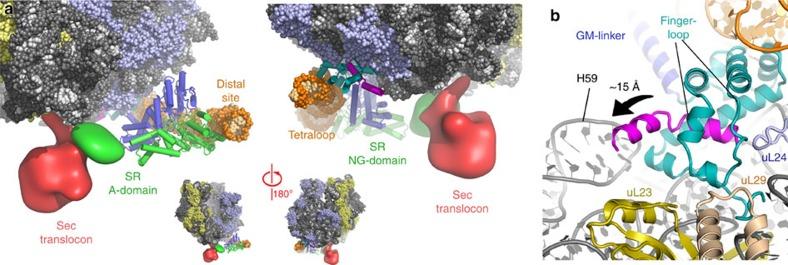
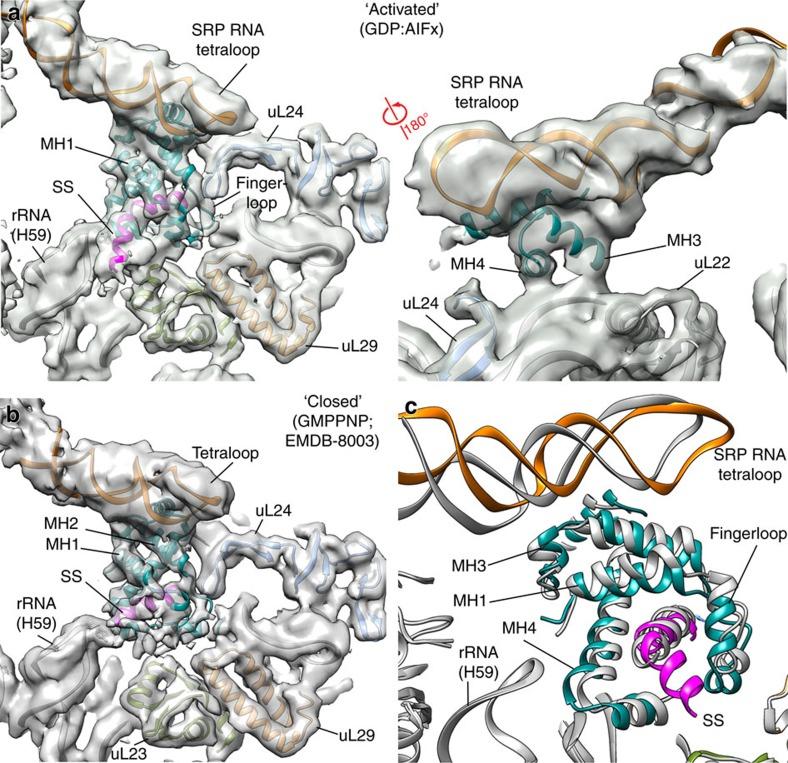
During co-translational protein targeting, the signal recognition particle (SRP) binds to the translating ribosome displaying the signal sequence to deliver it to the SRP receptor (SR) on the membrane, where the signal peptide is transferred to the translocon. Using electron cryo-microscopy, we have determined the structure of a quaternary complex of the translating Escherichia coli ribosome, the SRP-SR in the 'activated' state and the translocon. Our structure, supported by biochemical experiments, reveals that the SRP RNA adopts a kinked and untwisted conformation to allow repositioning of the 'activated' SRP-SR complex on the ribosome. In addition, we observe the translocon positioned through interactions with the SR in the vicinity of the ribosome exit tunnel where the signal sequence is extending beyond its hydrophobic binding groove of the SRP M domain towards the translocon. Our study provides new insights into the mechanism of signal sequence transfer from the SRP to the translocon.
在共翻译蛋白靶向过程中,信号识别颗粒(SRP)结合到展示信号序列的翻译核糖体,将其递送至膜上的 SRP 受体(SR),在此将信号肽转移至移位子。我们通过电子 cryo 显微镜确定了处于“激活”状态的翻译大肠杆菌核糖体、SRP-SR 和移位子的四元复合物的结构。我们的结构得到了生化实验的支持,揭示了 SRP RNA 采用扭曲和未扭曲的构象,以允许“激活”的 SRP-SR 复合物在核糖体上重新定位。此外,我们观察到移位子通过与 SR 的相互作用定位在核糖体出口隧道附近,信号序列从 SRP M 结构域的疏水性结合槽延伸到移位子。我们的研究为信号序列从 SRP 转移到移位子的机制提供了新的见解。

 Zotero 插件