
一项提高首次受邀接受宫颈癌筛查的年轻女性筛查率策略的整群随机试验:战略试验。
A cluster randomized trial of strategies to increase uptake amongst young women invited for their first cervical screen: The STRATEGIC trial.
作者信息
Kitchener H, Gittins M, Cruickshank M, Moseley C, Fletcher S, Albrow R, Gray A, Brabin L, Torgerson D, Crosbie E J, Sargent A, Roberts C
机构信息
1 Institute of Cancer Sciences, The University of Manchester, St. Mary's Hospital, Manchester, UK.
2 Centre for Biostatistics, Institute of Population Health, The University of Manchester, Manchester, UK.
出版信息
J Med Screen. 2018 Jun;25(2):88-98. doi: 10.1177/0969141317696518. Epub 2017 May 22.
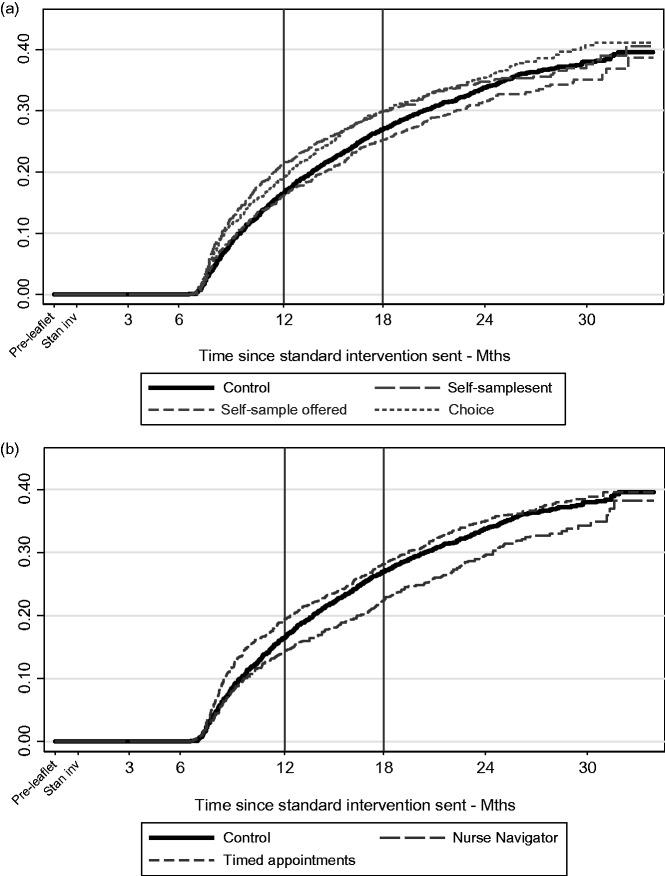
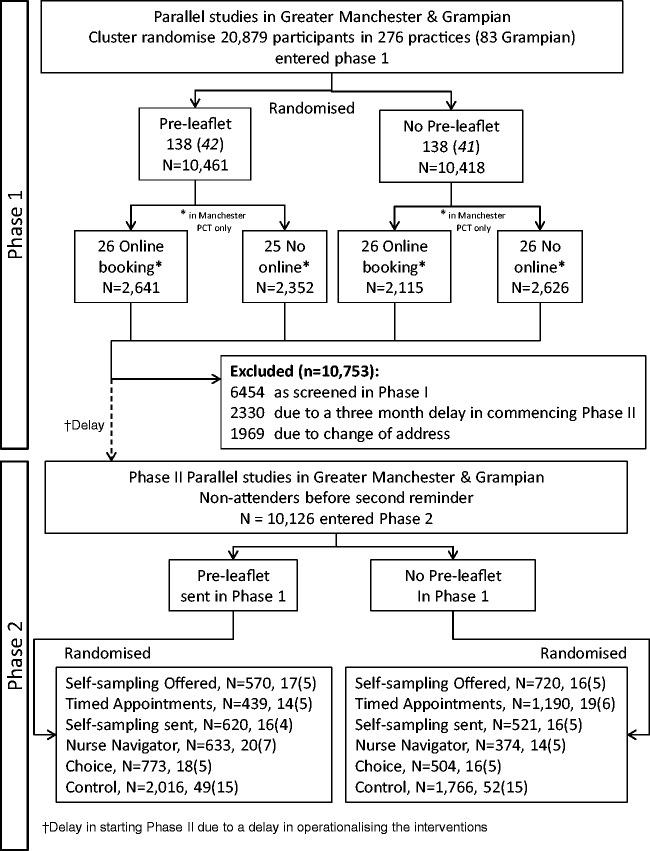
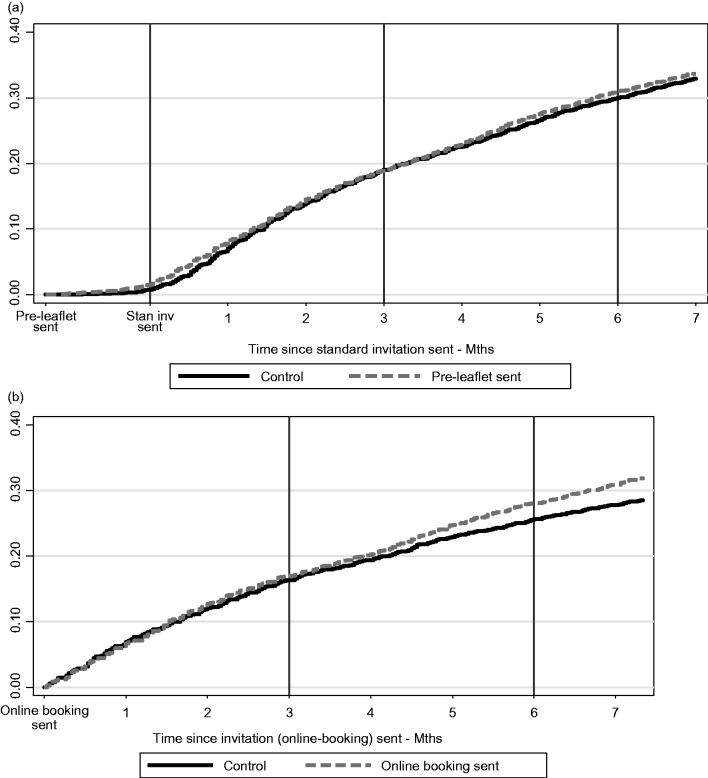
Objectives To measure the feasibility and effectiveness of interventions to increase cervical screening uptake amongst young women. Methods A two-phase cluster randomized trial conducted in general practices in the NHS Cervical Screening Programme. In Phase 1, women in practices randomized to intervention due for their first invitation to cervical screening received a pre-invitation leaflet and, separately, access to online booking. In Phase 2, non-attenders at six months were randomized to one of: vaginal self-sample kits sent unrequested or offered; timed appointments; nurse navigator; or the choice between nurse navigator or self-sample kits. Primary outcome was uplift in intervention vs. control practices, at 3 and 12 months post invitation. Results Phase 1 randomized 20,879 women. Neither pre-invitation leaflet nor online booking increased screening uptake by three months (18.8% pre-invitation leaflet vs. 19.2% control and 17.8% online booking vs. 17.2% control). Uptake was higher amongst human papillomavirus vaccinees at three months (OR 2.07, 95% CI 1.69-2.53, p < 0.001). Phase 2 randomized 10,126 non-attenders, with 32-34 clusters for each intervention and 100 clusters as controls. Sending self-sample kits increased uptake at 12 months (OR 1.51, 95% CI 1.20-1.91, p = 0.001), as did timed appointments (OR 1.41, 95% CI 1.14-1.74, p = 0.001). The offer of a nurse navigator, a self-sample kits on request, and choice between timed appointments and nurse navigator were ineffective. Conclusions Amongst non-attenders, self-sample kits sent and timed appointments achieved an uplift in screening over the short term; longer term impact is less certain. Prior human papillomavirus vaccination was associated with increased screening uptake.
目的 评估提高年轻女性子宫颈癌筛查接受率的干预措施的可行性和有效性。方法 在英国国家医疗服务体系子宫颈癌筛查项目的全科医疗中进行了一项两阶段整群随机试验。在第1阶段,被随机分配到干预组、首次收到子宫颈癌筛查邀请的女性收到了一份预邀请传单,并且另外获得了在线预约服务。在第2阶段,6个月时未参加筛查的女性被随机分配到以下其中一组:主动发送或提供阴道自我采样试剂盒;定时预约;护士导航;或在护士导航和自我采样试剂盒之间进行选择。主要结局是在发出邀请后3个月和12个月时,干预组与对照组在筛查接受率上的提升情况。结果 第1阶段随机分配了20,879名女性。预邀请传单和在线预约在3个月时均未提高筛查接受率(预邀请传单组为18.8%,对照组为19.2%;在线预约组为17.8%,对照组为17.2%)。3个月时,人乳头瘤病毒疫苗接种者的接受率更高(比值比2.07,95%置信区间1.69 - 2.53,p < 0.001)。第2阶段随机分配了10,126名未参加筛查者,每种干预措施有32 - 34个整群,100个整群作为对照。主动发送自我采样试剂盒在12个月时提高了接受率(比值比1.51,95%置信区间1.20 - 1.91,p = 0.001),定时预约也是如此(比值比1.41,95%置信区间1.14 - 1.74,p = 0.001)。提供护士导航、应要求提供自我采样试剂盒以及在定时预约和护士导航之间进行选择均无效。结论 在未参加筛查者中,主动发送自我采样试剂盒和定时预约在短期内提高了筛查接受率;长期影响尚不确定。先前接种人乳头瘤病毒疫苗与筛查接受率增加有关。
 Zotero 插件