
微小隐孢子虫烯醇化酶的免疫定位及酶活性分析
Immunolocation and enzyme activity analysis of Cryptosporidium parvum enolase.
作者信息
Mi Rongsheng, Yang Xiaojiao, Huang Yan, Cheng Long, Lu Ke, Han Xiangan, Chen Zhaoguo
机构信息
State Key Laboratory of Veterinary Etiological Biology, Lanzhou, 730046, China.
Key Laboratory of Animal Parasitology of Ministry of Agriculture, Laboratory of Quality and Safety Risk Assessment for Animal Products on Biohazards (Shanghai) of Ministry of Agriculture, Shanghai Veterinary Research Institute, Chinese Academy of Agricultural Sciences, Shanghai, 200241, China.
出版信息
Parasit Vectors. 2017 May 31;10(1):273. doi: 10.1186/s13071-017-2200-y.
BACKGROUND
Enolase is an essential multifunctional glycolytic enzyme that is involved in many biological processes of apicomplexan protozoa, such as adhesion and invasion. However, the characteristics of enolase in Cryptosporidium parvum, including the location on the oocyst and the enzyme activity, remain unclear.
METHODS
The C. parvum enolase gene (cpeno) was amplified by RT-PCR and sequenced. The deduced amino acid sequence was analysed by bioinformatics software. The gene was expressed in Escherichia coli BL21 (DE3) and purified recombinant protein was used for enzyme activity analysis, binding experiments and antibody preparation. The localisation of enolase on oocysts was examined via immunofluorescence techniques.
RESULTS
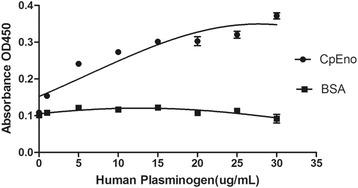
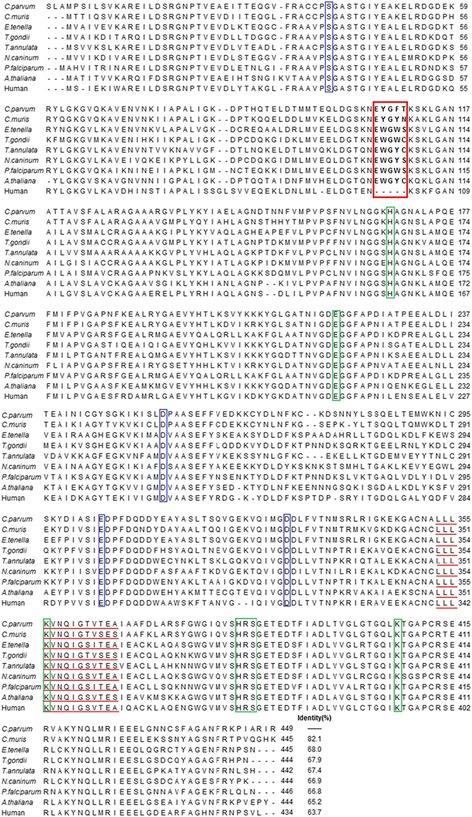
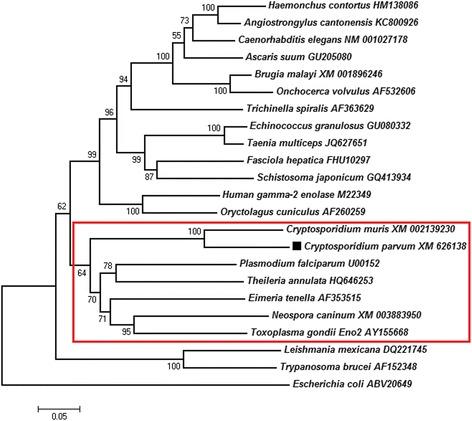
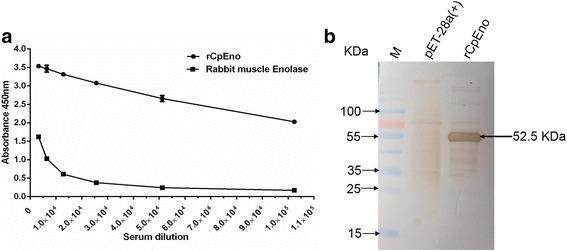
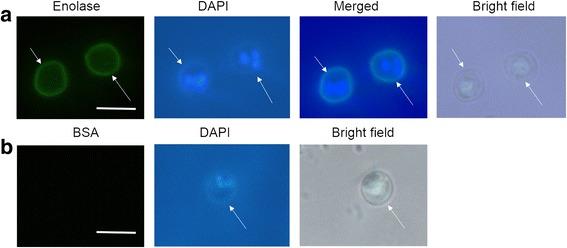
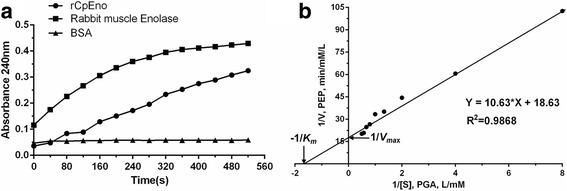
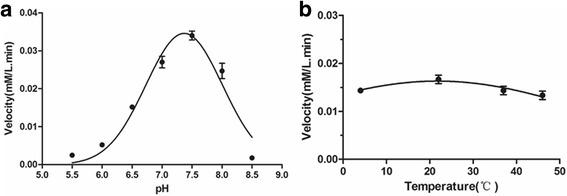
A 1,350 bp DNA sequence was amplified from cDNA taken from C. parvum oocysts. The deduced amino acids sequence of C. parvum enolase (CpEno) had 82.1% homology with Cryptosporidium muris enolase, and 54.7-68.0% homology with others selected species. Western blot analysis indicated that recombinant C. parvum enolase (rCpEno) could be recognised by C. parvum-infected cattle sera. Immunolocalization testing showed that CpEno was found to locate mainly on the surface of oocysts. The enzyme activity was 33.5 U/mg, and the Michaelis constant (K ) was 0.571 mM/l. Kinetic measurements revealed that the most suitable pH value was 7.0-7.5, and there were only minor effects on the activity of rCpEno with a change in the reaction temperature. The enzyme activity decreased when the Ca, K, Mg and Na concentrations of the reaction solution increased. The binding assays demonstrated that rCpEno could bind to human plasminogen.
CONCLUSION
This study is the first report of immunolocation, binding activity and enzyme characteristics of CpEno. The results of this study suggest that the surface-associated CpEno not only functions as a glycolytic enzyme but may also participate in attachment and invasion process of the parasite.
背景
烯醇化酶是一种重要的多功能糖酵解酶,参与顶复门原生动物的许多生物学过程,如黏附和侵袭。然而,微小隐孢子虫烯醇化酶的特性,包括在卵囊上的定位和酶活性,仍不清楚。
方法
通过逆转录聚合酶链反应(RT-PCR)扩增微小隐孢子虫烯醇化酶基因(cpeno)并进行测序。利用生物信息学软件分析推导的氨基酸序列。该基因在大肠杆菌BL21(DE3)中表达,纯化的重组蛋白用于酶活性分析、结合实验和抗体制备。通过免疫荧光技术检测烯醇化酶在卵囊上的定位。
结果
从微小隐孢子虫卵囊的cDNA中扩增出一段1350 bp的DNA序列。微小隐孢子虫烯醇化酶(CpEno)推导的氨基酸序列与鼠隐孢子虫烯醇化酶有82.1%的同源性,与其他选定物种有54.7%-68.0%的同源性。蛋白质免疫印迹分析表明,重组微小隐孢子虫烯醇化酶(rCpEno)能被微小隐孢子虫感染的牛血清识别。免疫定位检测显示,CpEno主要定位于卵囊表面。酶活性为33.5 U/mg,米氏常数(K )为0.571 mM/l。动力学测量表明,最适宜的pH值为7.0-7.5,反应温度变化对rCpEno活性影响较小。反应溶液中Ca、K、Mg和Na浓度增加时,酶活性降低。结合实验表明,rCpEno能与人纤溶酶原结合。
结论
本研究首次报道了CpEno的免疫定位、结合活性和酶学特性。本研究结果表明,与表面相关的CpEno不仅作为一种糖酵解酶发挥作用,还可能参与寄生虫的附着和侵袭过程。

 Zotero 插件