
多种癌症中微卫星不稳定性的分子特征。
A molecular portrait of microsatellite instability across multiple cancers.
机构信息
Department of Biomedical Informatics, Harvard Medical School, Boston, Massachusetts 02115, USA.
Ludwig Center at Harvard, Boston, Massachusetts 02115, USA.
出版信息
Nat Commun. 2017 Jun 6;8:15180. doi: 10.1038/ncomms15180.
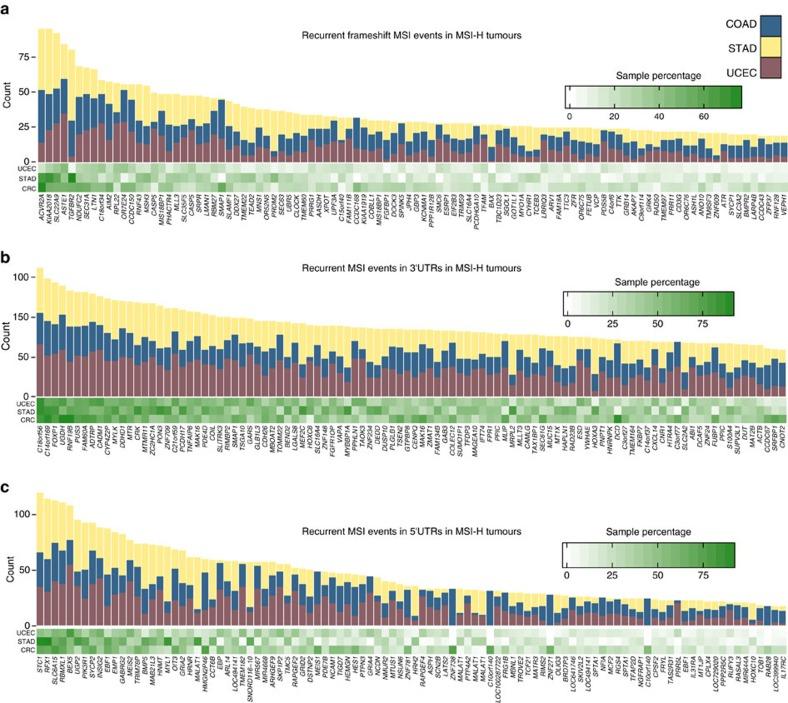
Microsatellite instability (MSI) refers to the hypermutability of short repetitive sequences in the genome caused by impaired DNA mismatch repair. Although MSI has been studied for decades, large amounts of sequencing data now available allows us to examine the molecular fingerprints of MSI in greater detail. Here, we analyse ∼8,000 exomes and ∼1,000 whole genomes of cancer patients across 23 cancer types. Our analysis reveals that the frequency of MSI events is highly variable within and across tumour types. We also identify genes in DNA repair and oncogenic pathways recurrently subject to MSI and uncover non-coding loci that frequently display MSI. Finally, we propose a highly accurate exome-based predictive model for the MSI phenotype. These results advance our understanding of the genomic drivers and consequences of MSI, and our comprehensive catalogue of tumour-type-specific MSI loci will enable panel-based MSI testing to identify patients who are likely to benefit from immunotherapy.
微卫星不稳定性(MSI)是指基因组中短重复序列的高突变性,由 DNA 错配修复受损引起。尽管 MSI 已经研究了几十年,但现在大量可用的测序数据使我们能够更详细地研究 MSI 的分子指纹。在这里,我们分析了来自 23 种癌症类型的大约 8000 个外显子组和大约 1000 个全基因组的癌症患者。我们的分析表明,MSI 事件的频率在肿瘤类型内和之间具有高度可变性。我们还鉴定了 DNA 修复和致癌途径中经常发生 MSI 的基因,并发现了经常显示 MSI 的非编码基因座。最后,我们提出了一种基于外显子组的 MSI 表型高度准确的预测模型。这些结果推进了我们对 MSI 的基因组驱动因素和后果的理解,我们全面的肿瘤类型特异性 MSI 基因座目录将使基于面板的 MSI 测试能够识别可能受益于免疫治疗的患者。




 Zotero 插件