
微小RNA-199b-5p减弱转化生长因子-β1诱导的肝细胞癌上皮-间质转化
MicroRNA-199b-5p attenuates TGF-β1-induced epithelial-mesenchymal transition in hepatocellular carcinoma.
作者信息
Zhou Shao-Jun, Liu Fu-Yao, Zhang An-Hong, Liang Hui-Fang, Wang Ye, Ma Rong, Jiang Yuan-Hui, Sun Nian-Feng
机构信息
Department of General Surgery, Qilu Hospital of Shandong University, 107 West Culture Road, Jinan 250012, China.
Department of Gastrointestinal Medical Oncology, Division of Cancer Medicine, The University of Texas MD Anderson Cancer Center, 7455 Fannin Street, Houston, Texas 77054, USA.
出版信息
Br J Cancer. 2017 Jul 11;117(2):233-244. doi: 10.1038/bjc.2017.164. Epub 2017 Jun 6.
BACKGROUND
Accumulating evidence indicates that N-cadherin is a cell adhesion molecule that has critical roles in tumour progression. However, the role of N-cadherin in hepatocellular carcinoma (HCC) remains controversial.
METHODS
This study aims to investigate the expression status of N-cadherin and its molecular mechanisms in HCC.
RESULTS
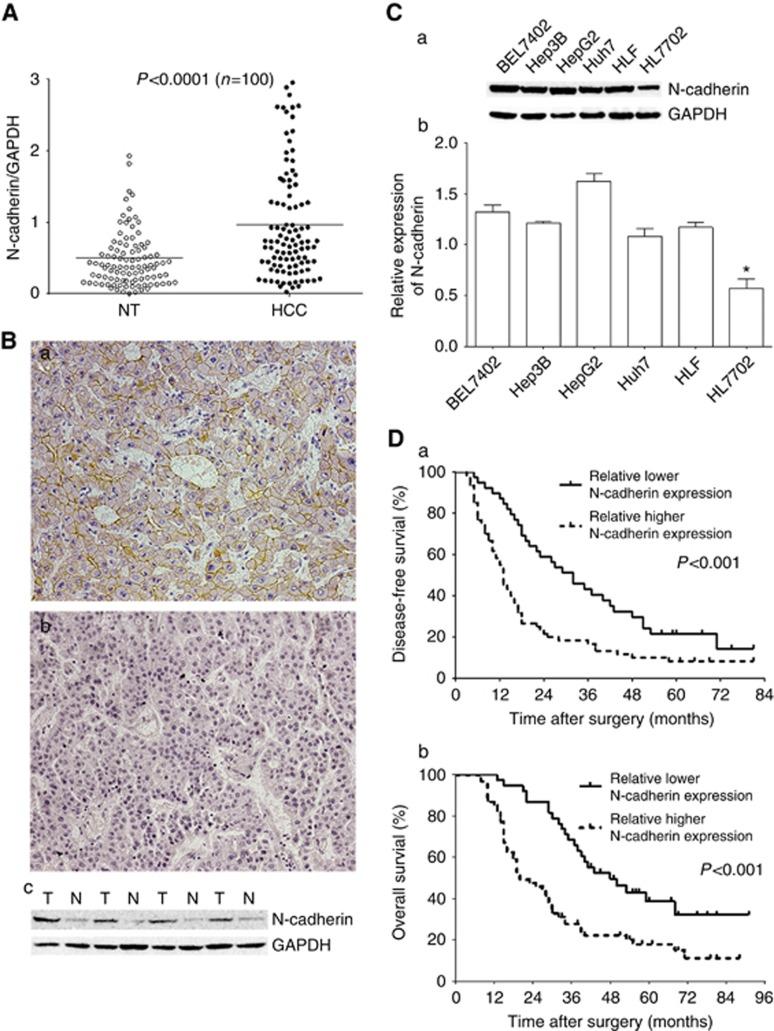
The expression of N-cadherin was markedly overexpressed in HCC tissues and cell lines. We identified that miR-199b-5p binds to the 3'-UTR of N-cadherin mRNA, thus decreasing N-cadherin expression in HCC cells. We also found the downregulation of miR-199b-5p in HCC specimens, which was inversely correlated with N-cadherin upregulation, predicted poor clinical outcomes in HCC patients. Next, we determined that miR-199b-5p overexpression promoted cell aggregation, suppressed cell migration and invasion in HCC cells, and inhibited xenografts tumour metastasis in nude mice. Moreover, we demonstrated that miR-199b-5p attenuated TGF-β1 induced epithelial-mesenchymal transition (EMT) -associated traits, while its effects could be partially reversed by N-cadherin restoration. Finally, we examined that N-cadherin downregulation or miR-199b-5p overexpression suppressed TGF-β1-induced Akt phosphorylation, and inhibition of PI3K/Akt pathway blocked TGF-β1-induced N-cadherin overexpression in HCC cells.
CONCLUSIONS
Our data demonstrate that N-Cadherin was markedly overexpressed and miR-199b-5p was significantly downregulated in HCC. MiR-199b-5p exerts inhibitory effects on EMT, and directly targets N-cadherin in HCC, supporting the potential utility of miR-199b-5p as a promising strategy to treat HCC. Also, a positive regulatory loop exists between N-cadherin and Akt signalling represents a novel mechanism of TGF-β1-mediated EMT in HCC cells.
背景
越来越多的证据表明,N-钙黏蛋白是一种在肿瘤进展中起关键作用的细胞黏附分子。然而,N-钙黏蛋白在肝细胞癌(HCC)中的作用仍存在争议。
方法
本研究旨在探讨N-钙黏蛋白在HCC中的表达状态及其分子机制。
结果
N-钙黏蛋白在HCC组织和细胞系中明显过表达。我们发现miR-199b-5p与N-钙黏蛋白mRNA的3'-UTR结合,从而降低HCC细胞中N-钙黏蛋白的表达。我们还发现HCC标本中miR-199b-5p下调,这与N-钙黏蛋白上调呈负相关,预示着HCC患者临床预后不良。接下来,我们确定miR-199b-5p过表达促进HCC细胞聚集,抑制细胞迁移和侵袭,并抑制裸鼠异种移植瘤转移。此外,我们证明miR-199b-5p减弱了TGF-β1诱导的上皮-间质转化(EMT)相关特征,而N-钙黏蛋白的恢复可部分逆转其作用。最后,我们检测到N-钙黏蛋白下调或miR-199b-5p过表达抑制TGF-β1诱导的Akt磷酸化,并且抑制PI3K/Akt途径可阻断TGF-β1诱导的HCC细胞中N-钙黏蛋白过表达。
结论
我们的数据表明,N-钙黏蛋白在HCC中明显过表达,而miR-199b-5p明显下调。miR-199b-5p对EMT具有抑制作用,并在HCC中直接靶向N-钙黏蛋白,支持将miR-199b-5p作为治疗HCC的一种有前景策略的潜在效用。此外,N-钙黏蛋白与Akt信号之间存在正调控环,这代表了TGF-β1介导的HCC细胞EMT的一种新机制。



 Zotero 插件