
BRAF抑制剂治疗诱导产生的活性氧(ROS)重编程代谢过程,影响黑色素瘤细胞的生长。
ROS production induced by BRAF inhibitor treatment rewires metabolic processes affecting cell growth of melanoma cells.
作者信息
Cesi Giulia, Walbrecq Geoffroy, Zimmer Andreas, Kreis Stephanie, Haan Claude
机构信息
Life Sciences Research Unit, University of Luxembourg, 6, Ave. du Swing, L-4367, Belvaux, Luxembourg.
出版信息
Mol Cancer. 2017 Jun 8;16(1):102. doi: 10.1186/s12943-017-0667-y.
BACKGROUND
Most melanoma patients with BRAF positive tumors respond well to a combination of BRAF kinase and MEK inhibitors. However, some patients are intrinsically resistant while the majority of patients eventually develop drug resistance to the treatment. For patients insufficiently responding to BRAF and MEK inhibitors, there is an ongoing need for new treatment targets. Cellular metabolism is such a promising new target line: mutant BRAF has been shown to affect the metabolism.
METHODS
Time course experiments and a series of western blots were performed in a panel of BRAF and BRAF/NRAS human melanoma cells, which were incubated with BRAF and MEK1 kinase inhibitors. siRNA approaches were used to investigate the metabolic players involved. Reactive oxygen species (ROS) were measured by confocal microscopy and AZD7545, an inhibitor targeting PDKs (pyruvate dehydrogenase kinase) was tested.
RESULTS
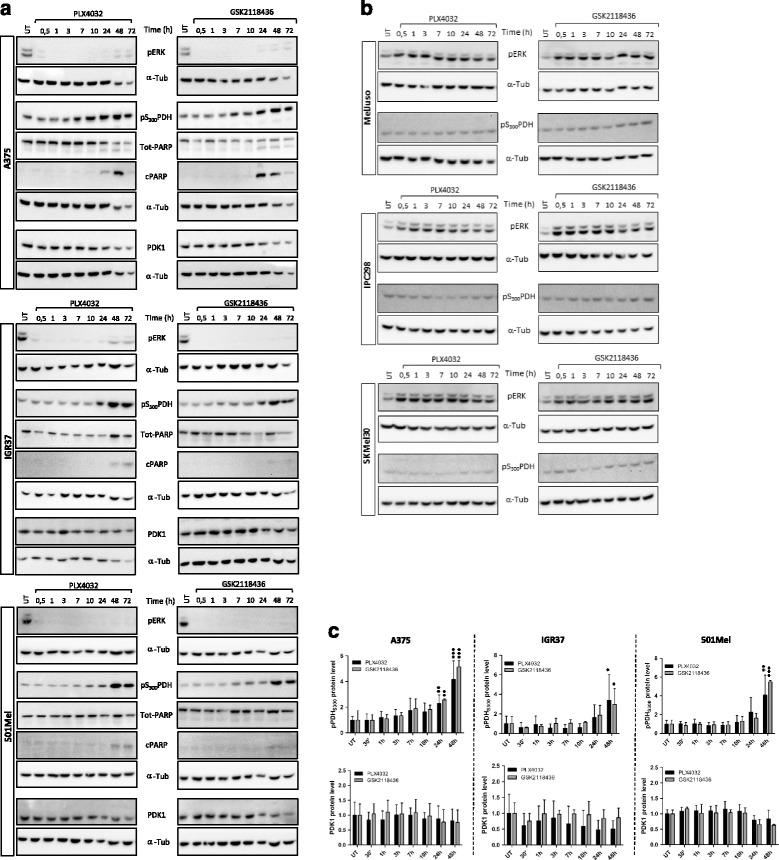
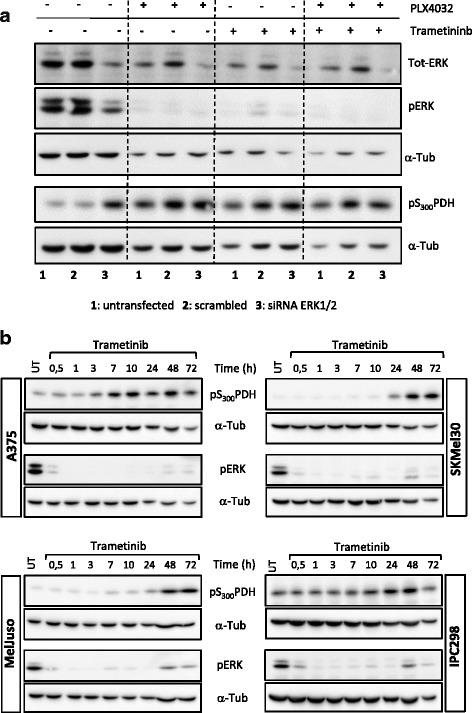
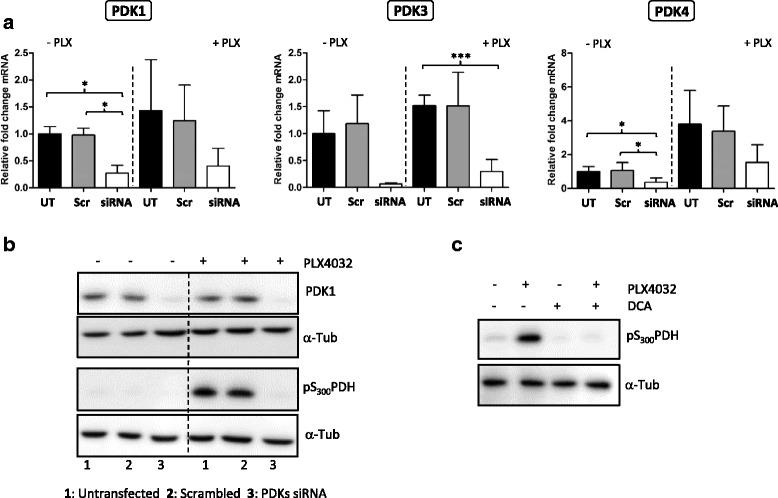
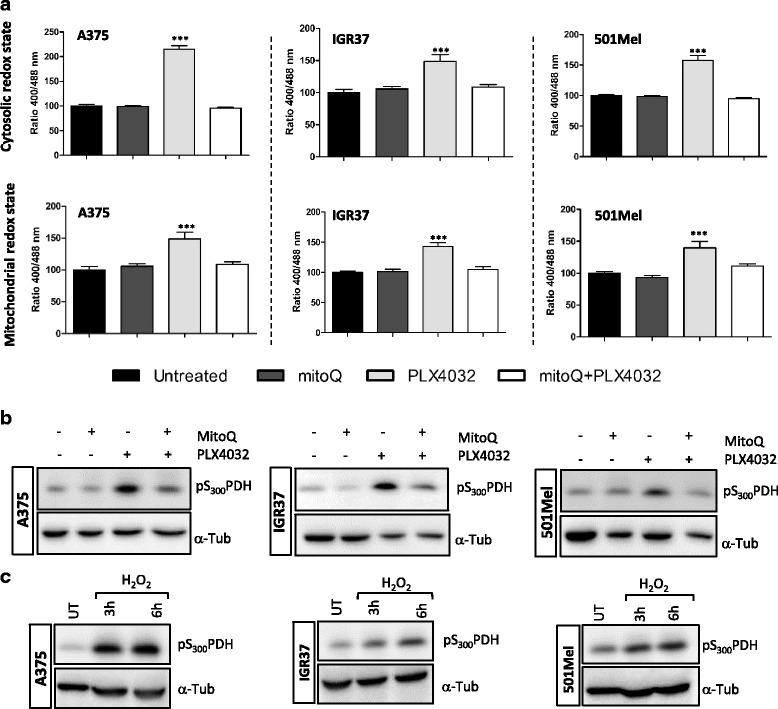
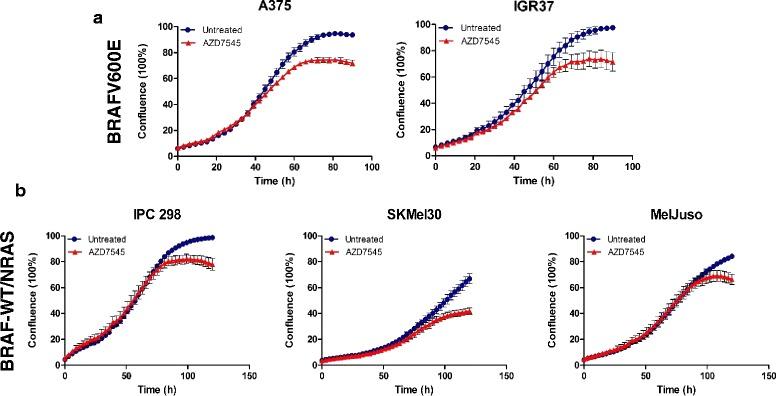
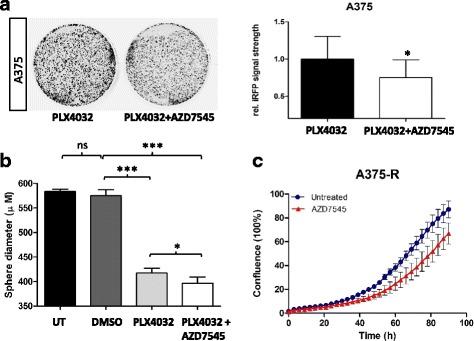
We show that inhibition of the RAS/RAF/MEK/ERK pathway induces phosphorylation of the pyruvate dehydrogenase PDH-E1α subunit in BRAF and in BRAF/NRAS harboring cells. Inhibition of BRAF, MEK1 and siRNA knock-down of ERK1/2 mediated phosphorylation of PDH. siRNA-mediated knock-down of all PDKs or the use of DCA (a pan-PDK inhibitor) abolished PDH-E1α phosphorylation. BRAF inhibitor treatment also induced the upregulation of ROS, concomitantly with the induction of PDH phosphorylation. Suppression of ROS by MitoQ suppressed PDH-E1α phosphorylation, strongly suggesting that ROS mediate the activation of PDKs. Interestingly, the inhibition of PDK1 with AZD7545 specifically suppressed growth of BRAF-mutant and BRAF inhibitor resistant melanoma cells.
CONCLUSIONS
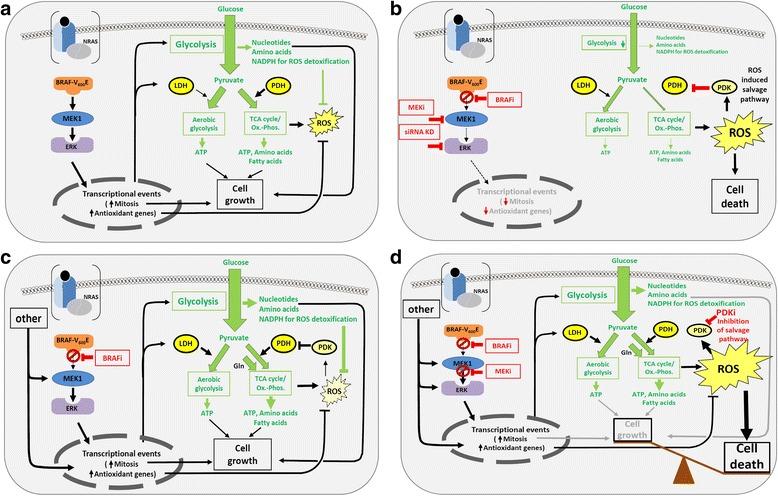
In BRAF and BRAF/NRAS melanoma cells, the increased production of ROS upon inhibition of the RAS/RAF/MEK/ERK pathway, is responsible for activating PDKs, which in turn phosphorylate and inactivate PDH. As part of a possible salvage pathway, the tricarboxylic acid cycle is inhibited leading to reduced oxidative metabolism and reduced ROS levels. We show that inhibition of PDKs by AZD7545 leads to growth suppression of BRAF-mutated and -inhibitor resistant melanoma cells. Thus small molecule PDK inhibitors such as AZD7545, might be promising drugs for combination treatment in melanoma patients with activating RAS/RAF/MEK/ERK pathway mutations (50% BRAF, 25% NRAS, 11.9% NF1).
背景
大多数BRAF阳性肿瘤的黑色素瘤患者对BRAF激酶和MEK抑制剂联合治疗反应良好。然而,一些患者天生耐药,而大多数患者最终会对该治疗产生耐药性。对于对BRAF和MEK抑制剂反应不足的患者,持续需要新的治疗靶点。细胞代谢就是这样一个有前景的新靶点:已证明突变型BRAF会影响代谢。
方法
在一组BRAF和BRAF/NRAS人黑色素瘤细胞中进行了时间进程实验和一系列蛋白质免疫印迹,这些细胞用BRAF和MEK1激酶抑制剂进行孵育。使用小干扰RNA(siRNA)方法研究其中涉及的代谢相关因子。通过共聚焦显微镜测量活性氧(ROS),并测试了一种靶向丙酮酸脱氢酶激酶(PDKs)的抑制剂AZD7545。
结果
我们发现,抑制RAS/RAF/MEK/ERK途径会诱导BRAF和携带BRAF/NRAS的细胞中丙酮酸脱氢酶(PDH)-E1α亚基的磷酸化。抑制BRAF、MEK1以及ERK1/2的小干扰RNA敲低介导了PDH的磷酸化。所有PDKs的小干扰RNA介导的敲低或使用二氯乙酸(DCA,一种泛PDK抑制剂)消除了PDH-E1α的磷酸化。BRAF抑制剂治疗还诱导了ROS的上调,同时伴有PDH磷酸化的诱导。用MitoQ抑制ROS可抑制PDH-E1α的磷酸化,强烈表明ROS介导了PDKs的激活。有趣的是,用AZD7545抑制PDK1可特异性抑制BRAF突变型和BRAF抑制剂耐药的黑色素瘤细胞的生长。
结论
在BRAF和BRAF/NRAS黑色素瘤细胞中,抑制RAS/RAF/MEK/ERK途径后ROS产生增加,这导致PDKs激活,进而使PDH磷酸化并失活。作为一种可能的挽救途径的一部分,三羧酸循环受到抑制,导致氧化代谢减少和ROS水平降低。我们发现用AZD7545抑制PDKs会导致BRAF突变型和抑制剂耐药的黑色素瘤细胞生长受抑制。因此,小分子PDK抑制剂如AZD7545,可能是治疗具有激活RAS/RAF/MEK/ERK途径突变(50% BRAF、25% NRAS、11.9% NF1)的黑色素瘤患者联合治疗的有前景药物。

 Zotero 插件