
1993年至2012年亚特兰大热浪与急诊科就诊情况的时间序列分析
Time-series Analysis of Heat Waves and Emergency Department Visits in Atlanta, 1993 to 2012.
作者信息
Chen Tianqi, Sarnat Stefanie E, Grundstein Andrew J, Winquist Andrea, Chang Howard H
机构信息
Department of Biostatistics and Bioinformatics, Emory University, Atlanta, Georgia, USA
Department of Environmental Health, Emory University, Atlanta, Georgia, USA
出版信息
Environ Health Perspect. 2017 May 31;125(5):057009. doi: 10.1289/EHP44.
BACKGROUND
Heat waves are extreme weather events that have been associated with adverse health outcomes. However, there is limited knowledge of heat waves' impact on population morbidity, such as emergency department (ED) visits.
OBJECTIVES
We investigated associations between heat waves and ED visits for 17 outcomes in Atlanta over a 20-year period, 1993-2012.
METHODS
Associations were estimated using Poisson log-linear models controlling for continuous air temperature, dew-point temperature, day of week, holidays, and time trends. We defined heat waves as periods of consecutive days with temperatures beyond the 98th percentile of the temperature distribution over the period from 1945-2012. We considered six heat wave definitions using maximum, minimum, and average air temperatures and apparent temperatures. Associations by heat wave characteristics were examined.
RESULTS
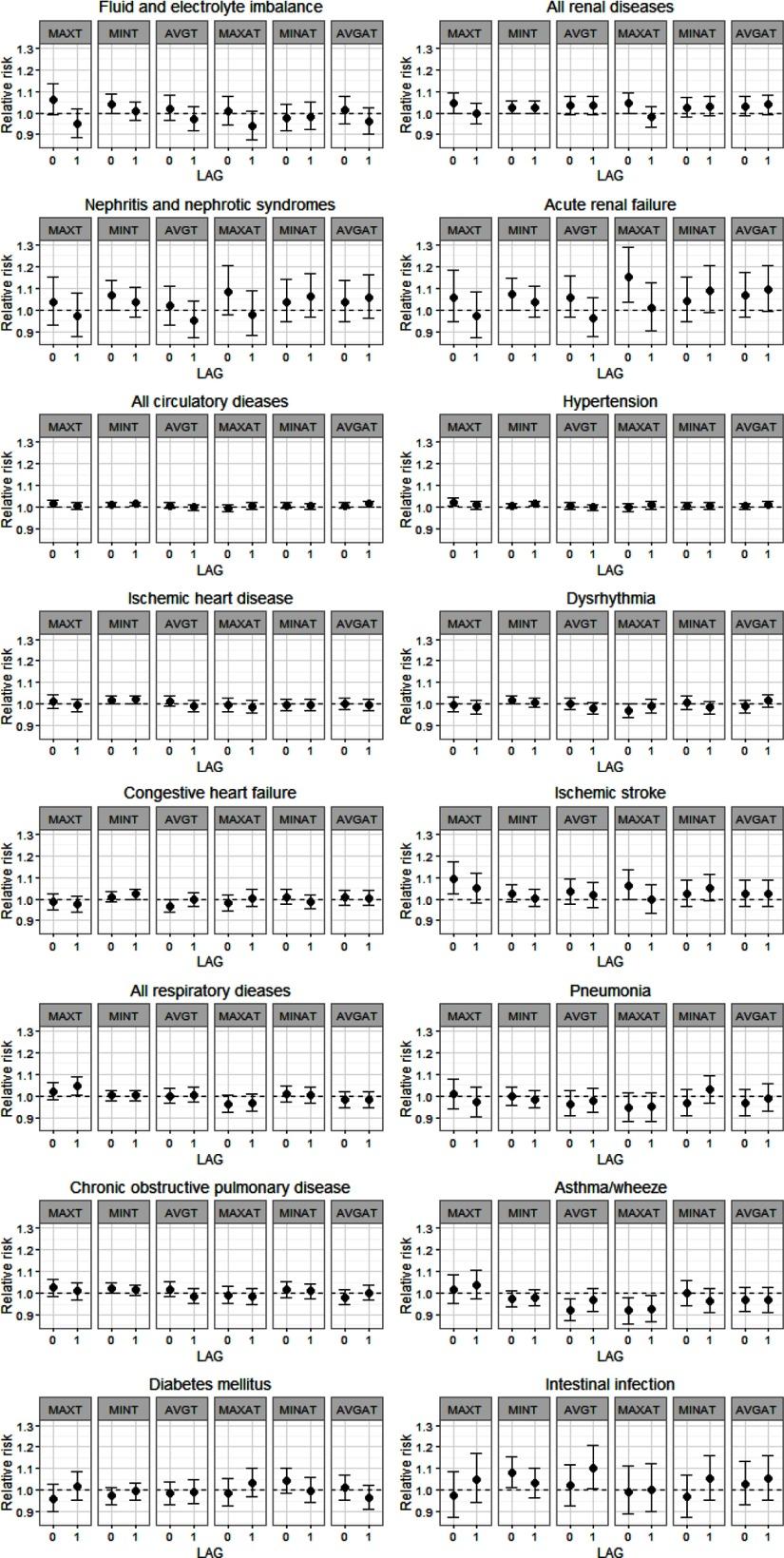
Among all outcome-heat wave combinations, associations were strongest between ED visits for acute renal failure and heat waves defined by maximum apparent temperature at lag 0 [relative risk (RR) = 1.15; 95% confidence interval (CI): 1.03-1.29], ED visits for ischemic stroke and heat waves defined by minimum temperature at lag 0 (RR = 1.09; 95% CI: 1.02-1.17), and ED visits for intestinal infection and heat waves defined by average temperature at lag 1 (RR = 1.10; 95% CI: 1.00-1.21). ED visits for all internal causes were associated with heat waves defined by maximum temperature at lag 1 (RR = 1.02; 95% CI: 1.00, 1.04).
CONCLUSIONS
Heat waves can confer additional risks of ED visits beyond those of daily air temperature, even in a region with high air-conditioning prevalence. https://doi.org/10.1289/EHP44.
背景
热浪是与不良健康后果相关的极端天气事件。然而,关于热浪对人群发病率(如急诊就诊)的影响,人们了解有限。
目的
我们调查了1993年至2012年这20年间亚特兰大热浪与17种结局的急诊就诊之间的关联。
方法
使用泊松对数线性模型估计关联,该模型控制了连续气温、露点温度、星期几、节假日和时间趋势。我们将热浪定义为1945年至2012年期间连续数天温度超过温度分布第98百分位数的时期。我们使用最高、最低和平均气温以及体感温度考虑了六种热浪定义。研究了热浪特征的关联。
结果
在所有结局-热浪组合中,急性肾衰竭急诊就诊与滞后0天的最高体感温度定义的热浪之间的关联最强[相对风险(RR)=1.15;95%置信区间(CI):1.03-1.29],缺血性中风急诊就诊与滞后0天的最低温度定义的热浪之间的关联(RR=1.09;95%CI:1.02-1.17),以及肠道感染急诊就诊与滞后1天的平均温度定义的热浪之间的关联(RR=1.10;95%CI:1.00-1.21)。所有内科病因的急诊就诊与滞后1天的最高温度定义的热浪相关(RR=1.02;95%CI:1.00,1.04)。
结论
即使在空调普及率高的地区,热浪也会带来超出每日气温的急诊就诊额外风险。https://doi.org/10.1289/EHP44
 Zotero 插件