
使用高敏肌钙蛋白对疑似急性冠脉综合征患者进行诊断策略的组织价值:一项基于试验的成本效益分析。
The organisational value of diagnostic strategies using high-sensitivity troponin for patients with possible acute coronary syndromes: a trial-based cost-effectiveness analysis.
作者信息
Jülicher Paul, Greenslade Jaimi H, Parsonage William A, Cullen Louise
机构信息
Health Economics and Outcomes Research, Medical Affairs, Abbott Laboratories, Wiesbaden, Germany.
Department of Emergency Medicine, Royal Brisbane and Women's Hospital, Herston, Australia.
出版信息
BMJ Open. 2017 Jun 9;7(6):e013653. doi: 10.1136/bmjopen-2016-013653.
OBJECTIVES
To evaluate hospital-specific health economic implications of different protocols using high-sensitivity troponin I for the assessment of patients with chest pain.
DESIGN
A cost prediction model and an economic microsimulation were developed using a cohort from a single centre recruited as part of the (ADAPT) trial, a prospective observational trial conducted from 2008 to 2011. The model was populated with 40 000 bootstrapped samples in five high-sensitivity troponin I-enabled algorithms versus standard care.
SETTING
Adult emergency department (ED) of a tertiary referral hospital.
PARTICIPANTS
Data were available for 938 patients who presented to the ED with at least 5 min of symptoms suggestive of acute coronary syndrome. The analyses included 719 patients with complete data.
MAIN OUTCOMES/MEASURES: This study examined direct hospital costs, number of false-negative and false-positive cases in the assessment of acute coronary syndrome.
RESULTS
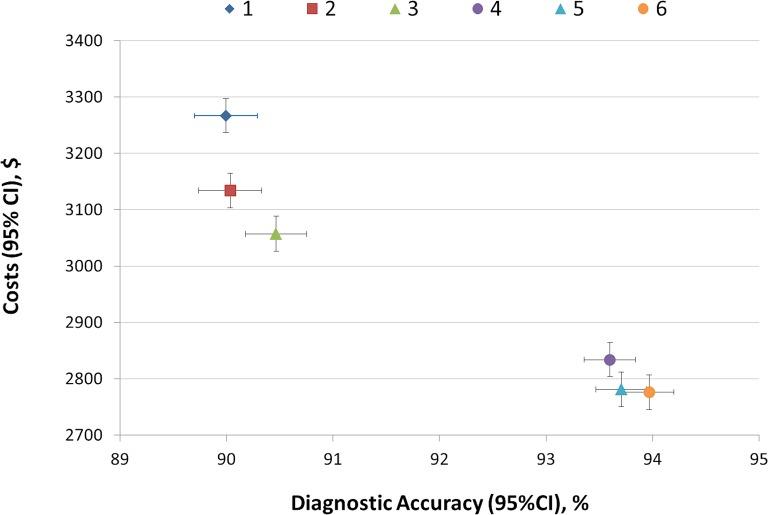
High-sensitivity troponin I-supported algorithms increased diagnostic accuracy from 90.0% to 94.0% with an average cost reduction per patient compared with standard care of $490. The inclusion of additional criteria for accelerated rule-out (limit of detection and the modified 2-hour ADAPT trial rules) avoided 7.5% of short-stay unit admissions or 25% of admissions to a cardiac ward. Protocols using high-sensitivity troponin I alone or high-sensitivity troponin I within accelerated diagnostic algorithms reduced length of stay by 6.2 and 13.6 hours, respectively. Overnight stays decreased up to 43%. Results were seen for patients with non-acute coronary syndrome; no difference was found for patients with acute coronary syndrome.
CONCLUSIONS
High-sensitivity troponin I algorithms are likely to be cost-effective on a hospital level compared with sensitive troponin protocols. The positive effect is conferred by patients not diagnosed with acute coronary syndrome. Implementation could improve referral accuracy or facilitate safe discharge. It would decrease costs and provide significant hospital benefits.
TRIAL REGISTRATION
The original ADAPT trial was registered with the Australia-New Zealand Clinical trials Registry, ACTRN12611001069943.
目的
评估使用高敏肌钙蛋白I的不同方案对胸痛患者进行评估时医院特定的健康经济影响。
设计
使用作为(ADAPT)试验一部分从单一中心招募的队列开发了成本预测模型和经济微观模拟,该试验是一项于2008年至2011年进行的前瞻性观察性试验。该模型在五种启用高敏肌钙蛋白I的算法与标准治疗方法中填充了40000个自抽样样本。
地点
一家三级转诊医院的成人急诊科。
参与者
有938例因至少5分钟提示急性冠状动脉综合征症状而到急诊科就诊的患者的数据可用。分析纳入了719例有完整数据的患者。
主要结局/指标:本研究考察了急性冠状动脉综合征评估中的直接医院成本、假阴性和假阳性病例数。
结果
与标准治疗相比,高敏肌钙蛋白I支持的算法将诊断准确性从90.0%提高到94.0%,每位患者平均成本降低490美元。纳入加速排除的额外标准(检测限和修改后的2小时ADAPT试验规则)避免了7.5%的短期住院病房入院或25%的心脏病房入院。单独使用高敏肌钙蛋白I或在加速诊断算法中使用高敏肌钙蛋白I的方案分别将住院时间缩短了6.2小时和13.6小时。过夜住院减少了43%。非急性冠状动脉综合征患者出现了这些结果;急性冠状动脉综合征患者未发现差异。
结论
与敏感肌钙蛋白方案相比,高敏肌钙蛋白I算法在医院层面可能具有成本效益。未被诊断为急性冠状动脉综合征的患者产生了积极影响。实施该算法可提高转诊准确性或促进安全出院。这将降低成本并为医院带来显著效益。
试验注册
最初的ADAPT试验在澳大利亚-新西兰临床试验注册中心注册,注册号为ACTRN12611001069943。

 Zotero 插件