
评估体重指数对帕金森病风险的因果影响:一项孟德尔随机化研究。
Estimating the causal influence of body mass index on risk of Parkinson disease: A Mendelian randomisation study.
作者信息
Noyce Alastair J, Kia Demis A, Hemani Gibran, Nicolas Aude, Price T Ryan, De Pablo-Fernandez Eduardo, Haycock Philip C, Lewis Patrick A, Foltynie Thomas, Davey Smith George, Schrag Anette, Lees Andrew J, Hardy John, Singleton Andrew, Nalls Mike A, Pearce Neil, Lawlor Debbie A, Wood Nicholas W
机构信息
Department of Molecular Neuroscience, UCL Institute of Neurology, University College London, London, United Kingdom.
Centre for Neuroscience and Trauma, Barts and The London School of Medicine and Dentistry, Queen Mary University of London, London, United Kingdom.
出版信息
PLoS Med. 2017 Jun 13;14(6):e1002314. doi: 10.1371/journal.pmed.1002314. eCollection 2017 Jun.
BACKGROUND
Both positive and negative associations between higher body mass index (BMI) and Parkinson disease (PD) have been reported in observational studies, but it has been difficult to establish causality because of the possibility of residual confounding or reverse causation. To our knowledge, Mendelian randomisation (MR)-the use of genetic instrumental variables (IVs) to explore causal effects-has not previously been used to test the effect of BMI on PD.
METHODS AND FINDINGS
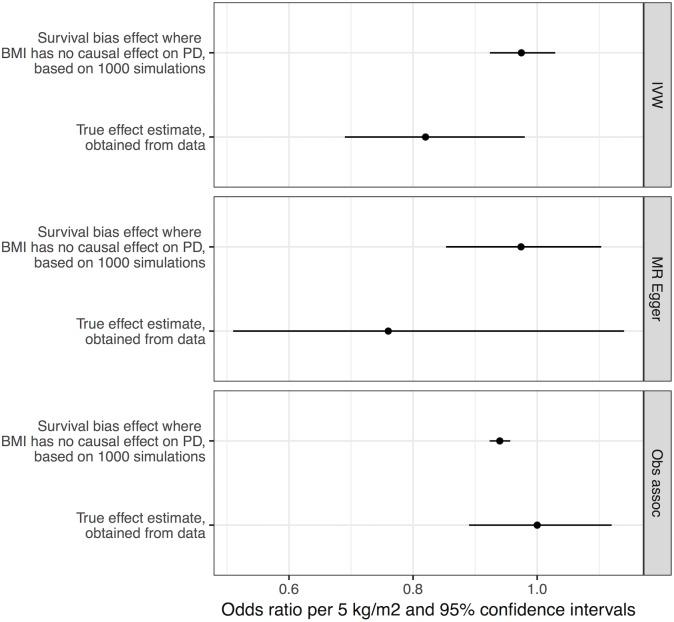
Two-sample MR was undertaken using genome-wide association (GWA) study data. The associations between the genetic instruments and BMI were obtained from the GIANT consortium and consisted of the per-allele difference in mean BMI for 77 independent variants that reached genome-wide significance. The per-allele difference in log-odds of PD for each of these variants was estimated from a recent meta-analysis, which included 13,708 cases of PD and 95,282 controls. The inverse-variance weighted method was used to estimate a pooled odds ratio (OR) for the effect of a 5-kg/m2 higher BMI on PD. Evidence of directional pleiotropy averaged across all variants was sought using MR-Egger regression. Frailty simulations were used to assess whether causal associations were affected by mortality selection. A combined genetic IV expected to confer a lifetime exposure of 5-kg/m2 higher BMI was associated with a lower risk of PD (OR 0.82, 95% CI 0.69-0.98). MR-Egger regression gave similar results, suggesting that directional pleiotropy was unlikely to be biasing the result (intercept 0.002; p = 0.654). However, the apparent protective influence of higher BMI could be at least partially induced by survival bias in the PD GWA study, as demonstrated by frailty simulations. Other important limitations of this application of MR include the inability to analyse non-linear associations, to undertake subgroup analyses, and to gain mechanistic insights.
CONCLUSIONS
In this large study using two-sample MR, we found that variants known to influence BMI had effects on PD in a manner consistent with higher BMI leading to lower risk of PD. The mechanism underlying this apparent protective effect warrants further study.
背景
在观察性研究中,较高的体重指数(BMI)与帕金森病(PD)之间既有正向关联也有负向关联,但由于存在残余混杂或反向因果关系的可能性,难以确定因果关系。据我们所知,孟德尔随机化(MR)——使用基因工具变量(IVs)来探索因果效应——此前尚未用于检验BMI对PD的影响。
方法和结果
使用全基因组关联(GWA)研究数据进行两样本MR。基因工具与BMI之间的关联来自GIANT联盟,由77个达到全基因组显著性的独立变异的平均BMI的每个等位基因差异组成。这些变异中每一个的PD对数优势的每个等位基因差异是从最近的一项荟萃分析中估计出来的,该分析包括13708例PD病例和95282例对照。采用逆方差加权法估计BMI每升高5kg/m²对PD影响的合并优势比(OR)。使用MR-Egger回归寻找所有变异平均的定向多效性证据。使用脆弱性模拟来评估因果关联是否受到死亡率选择的影响。一个预期会使终生暴露的BMI升高5kg/m²的联合基因IV与较低的PD风险相关(OR 0.82,95%CI 0.69-0.98)。MR-Egger回归给出了类似的结果,表明定向多效性不太可能使结果产生偏差(截距0.002;p = 0.654)。然而,较高BMI的明显保护作用可能至少部分是由PD GWA研究中的生存偏差引起的,脆弱性模拟证明了这一点。MR的这种应用的其他重要局限性包括无法分析非线性关联、进行亚组分析以及获得机制性见解。
结论
在这项使用两样本MR的大型研究中,我们发现已知影响BMI的变异对PD有影响,其方式与较高BMI导致较低的PD风险一致。这种明显保护作用的潜在机制值得进一步研究。

 Zotero 插件