
生命最后三个月的姑息治疗体验:从丧亲照料者角度对住院临终关怀机构、医院和家中提供的护理进行定量比较
Palliative Care Experience in the Last 3 Months of Life: A Quantitative Comparison of Care Provided in Residential Hospices, Hospitals, and the Home From the Perspectives of Bereaved Caregivers.
作者信息
Bainbridge Daryl, Seow Hsien
机构信息
1 Department of Oncology, McMaster University, Hamilton, Ontario, Canada.
2 Juravinski Cancer Centre, Hamilton, Ontario, Canada.
出版信息
Am J Hosp Palliat Care. 2018 Mar;35(3):456-463. doi: 10.1177/1049909117713497. Epub 2017 Jun 14.
OBJECTIVE
This study captured the end-of-life care experiences across various settings from bereaved caregivers of individuals who died in residential hospice.
METHODS
A retrospective, observational design using the CaregiverVoice survey with bereaved caregivers of patients in 22 hospices in Ontario, Canada. The survey assessed various dimensions of the patient's care experiences across multiple care settings in the last 3 months of life.
RESULTS
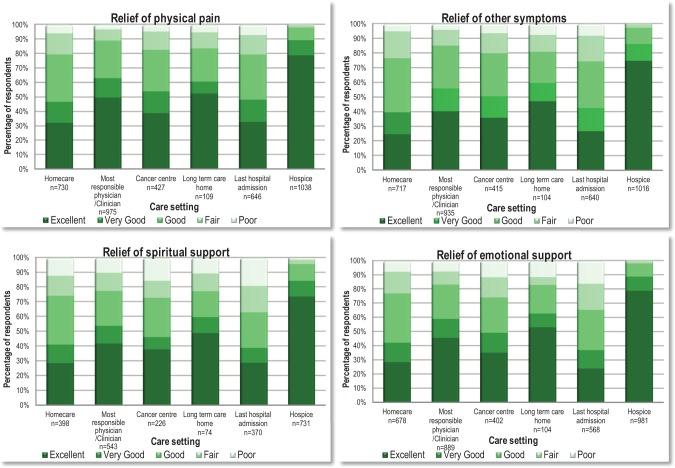
A total of 1153 caregivers responded to the survey (44% response rate). In addition to hospice care, caregivers reported that 74% of patients received home care, 61% had a hospitalization, 42% received care at a cancer center, and 10% lived in a nursing home. Most caregivers (84%-89%) rated the addressing of each support domain (relief of physical pain, relief of other symptoms, spiritual support, and emotional support) by hospice as either "excellent" or "very good." These proportions were less favorable for home care (40%-47%), cancer center (46%-54%), and hospital (37%-48%). Significantly, better experiences were reported for the last week of life where hospice was considered the main setting of care, opposed to other settings ( P < .0001 across domains). Overall, across settings pain management tended to be the highest-rated domain and spiritual support the lowest.
CONCLUSION
This is one of few quantitative examinations of the care experience of patients who accessed multiple care settings in the last months of life and died in a specialized setting such as residential hospice. These findings emphasize the importance of replicating the hospice approach in institutional and home settings, including greater attention to emotional and spiritual dimensions of care.
目的
本研究收集了在住院临终关怀机构去世患者的丧亲照料者在不同环境下的临终关怀经历。
方法
采用回顾性观察设计,对加拿大安大略省22家临终关怀机构中患者的丧亲照料者进行CaregiverVoice调查。该调查评估了患者在生命最后3个月中多个护理环境下护理经历的各个方面。
结果
共有1153名照料者回复了调查(回复率为44%)。除临终关怀护理外,照料者报告称,74%的患者接受了家庭护理,61%的患者曾住院治疗,42%的患者在癌症中心接受护理,10%的患者住在养老院。大多数照料者(84%-89%)将临终关怀机构对每个支持领域(缓解身体疼痛、缓解其他症状、精神支持和情感支持)的处理评为“优秀”或“非常好”。家庭护理(40%-47%)、癌症中心(46%-54%)和医院(37%-48%)的这些比例则较低。值得注意的是,与其他环境相比,在临终关怀机构被视为主要护理环境的生命最后一周,照料者报告的体验更好(各领域P<.0001)。总体而言,在各个环境中,疼痛管理往往是评分最高的领域,而精神支持则是评分最低的领域。
结论
这是对在生命最后几个月进入多个护理环境并在诸如住院临终关怀机构等专门环境中去世的患者护理经历进行的少数定量研究之一。这些发现强调了在机构和家庭环境中复制临终关怀方法的重要性,包括更加关注护理的情感和精神层面。

 Zotero 插件