
缺乏HLA C1或C2组KIR配体的患者在脐带血移植后预后更好。
Patients Lacking a KIR-Ligand of HLA Group C1 or C2 Have a Better Outcome after Umbilical Cord Blood Transplantation.
作者信息
Martínez-Losada Carmen, Martín Carmen, Gonzalez Rafael, Manzanares Bárbara, García-Torres Estefania, Herrera Concha
机构信息
Department of Hematology, Reina Sofía University Hospital/Instituto Maimónides de Investigación Biomédica (IMIBIC), University of Córdoba, Córdoba, Spain.
Department of Inmunology, Reina Sofía University Hospital, Córdoba, Spain.
出版信息
Front Immunol. 2017 Jul 13;8:810. doi: 10.3389/fimmu.2017.00810. eCollection 2017.
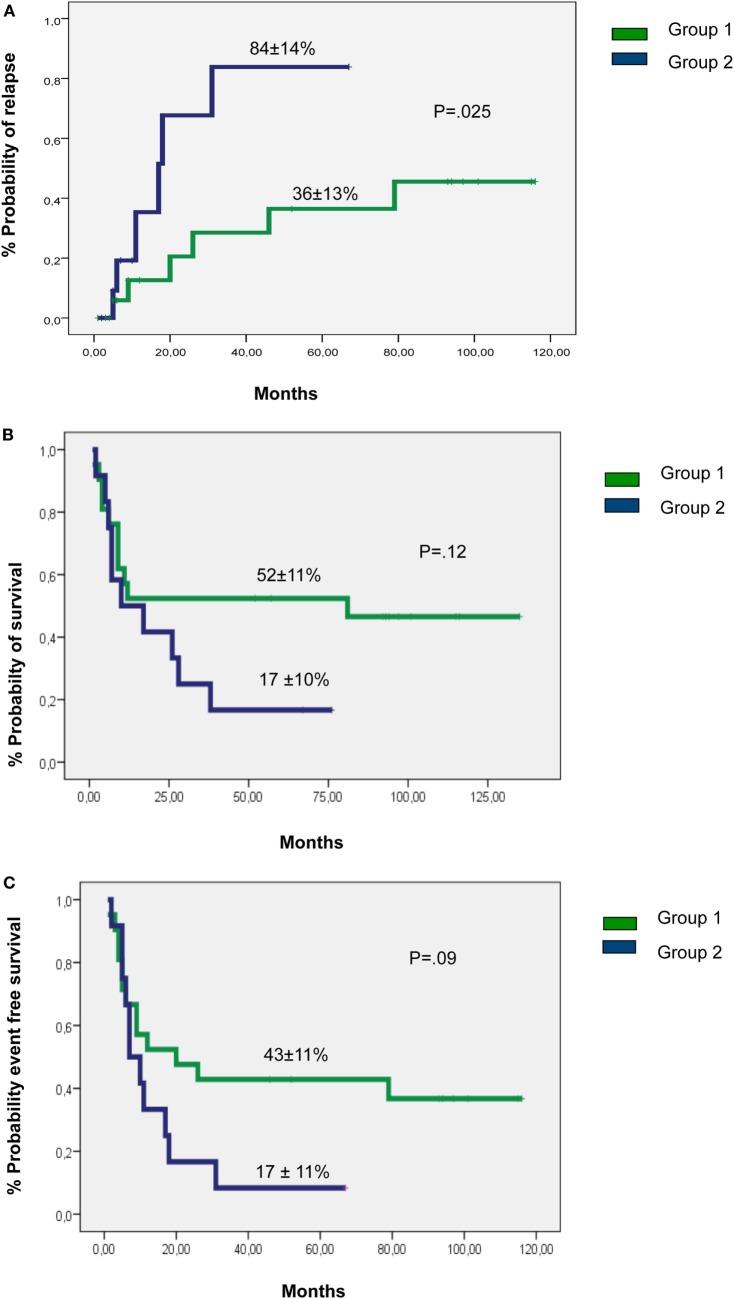
Donor natural killer (NK) cells can destroy residual leukemic cells after allogeneic hematopoietic stem cell transplantation. This effect is based on the interaction of killer-cell immunoglobulin-like receptors (KIR) of donor NK cells with ligands of the major histocompatibility complex found on the surface of the target cells. HLA-C1 subtypes provide the ligand for KIR2DL2 and KIR2DL3 and the HLA-C2 subtypes for KIR2DL1. We have studied the probability of relapse (PR) after single-unit unrelated cord blood transplantation (UCBT) in relation to the potential graft-vs.-leukemia effect mediated by NK cells present in the umbilical cord blood (UCB) by analyzing KIR-ligand and HLA-C typing of the receptor. Data from 33 consecutive patients given a single unit UCBT were included. We have considered two groups of patients based on the absence or the presence of one of the C-ligands for inhibitory KIR and the incompatibility HLA-C1/2 between UCB and patients. Group 1 ( = 21): the patient lacks a C-ligand for inhibitory KIR present in UCB NK cells, i.e., patients homozygous C1/C1 or C2/C2. Group 2 ( = 12): patients heterozygous C1/C2 in which KIR-mediated graft-vs.-leukemia effect is not expected (presence of both C ligands for inhibitory KIR in the receptor). With a median follow-up post-UCBT of 93 months, patients with absence of a C-ligand for inhibitory KIRs (Group 1) showed a lower actuarial PR than patients with both C-ligands (group 2): 21 ± 10 vs. 68 ± 18% at 2 year and 36 ± 13 vs. 84 ± 14% at 5 years ( = 0.025), respectively. In patients with acute lymphoblastic leukemia, the 2-year PR was 36 ± 21% for group 1 and 66 ± 26% for 2 ( = 0.038). Furthermore, group 1 had a lower incidence of grades II-IV acute graft-vs.-host disease ( = 0.04). In the setting of UCBT, the absence of a C-ligand (C1 or C2) of inhibitory KIR in the patient is associated with lower PR, which is probably due to the graft-vs.-host leukemia effect caused by UCB NK cells that lack a ligand for the inhibitory KIR 2DL1/2DL2/2DL3.
供体自然杀伤(NK)细胞可在异基因造血干细胞移植后破坏残留的白血病细胞。这种效应基于供体NK细胞的杀伤细胞免疫球蛋白样受体(KIR)与靶细胞表面主要组织相容性复合体配体之间的相互作用。HLA-C1亚型为KIR2DL2和KIR2DL3提供配体,而HLA-C2亚型为KIR2DL1提供配体。我们通过分析受体的KIR配体和HLA-C分型,研究了单单位非亲缘脐血移植(UCBT)后复发概率(PR)与脐血(UCB)中存在的NK细胞介导的移植物抗白血病效应之间的关系。纳入了33例接受单单位UCBT的连续患者的数据。我们根据抑制性KIR的C配体之一的缺失或存在以及UCB与患者之间的HLA-C1/2不相容性,将患者分为两组。第1组(n = 21):患者缺乏UCB NK细胞中存在的抑制性KIR的C配体,即纯合C1/C1或C2/C2患者。第2组(n = 12):C1/C2杂合患者,预计不存在KIR介导的移植物抗白血病效应(受体中存在两种抑制性KIR的C配体)。UCBT后的中位随访时间为93个月,缺乏抑制性KIR的C配体的患者(第1组)的实际PR低于具有两种C配体的患者(第2组):2年时分别为21±10%和68±18%,5年时分别为36±13%和84±14%(P = 0.025)。在急性淋巴细胞白血病患者中,第1组的2年PR为36±21%,第2组为66±26%(P = 0.038)。此外,第1组的II-IV级急性移植物抗宿主病发生率较低(P = 0.04)。在UCBT的情况下,患者中抑制性KIR的C配体(C1或C2)缺失与较低的PR相关,这可能是由于缺乏抑制性KIR 2DL1/2DL2/2DL3配体的UCB NK细胞引起的移植物抗宿主白血病效应。
 Zotero 插件