
COL1A1对宫颈癌细胞辐射诱导凋亡的调控作用。
Regulatory effects of COL1A1 on apoptosis induced by radiation in cervical cancer cells.
作者信息
Liu Shurong, Liao Gewang, Li Guowen
机构信息
Department of Gynecologic Oncology, Hunan Cancer Hospital, Tongzipo Road No. 283, Changsha, 410011 Hunan China.
Department of Interventional Radiology, Hunan Cancer Hospital, Tongzipo Road No. 283, Changsha, 410011 Hunan China.
出版信息
Cancer Cell Int. 2017 Jul 28;17:73. doi: 10.1186/s12935-017-0443-5. eCollection 2017.
BACKGROUND
Cervical cancer is a common cancer of women in developing countries, and radiotherapy still remains its predominant therapeutic treatment. Collagen type I alpha 1 (COL1A1) has been shown to have a radioresistance effect in previous studies. However, such effect of COL1A1 has not yet been revealed in cervical cancer.
METHODS
Expression of COL1A1 in cervical cancer tissues and normal tissues was assessed by qRT-PCR and immunohistochemistry. The effect of COL1A1 on radioresistance of human cervical cancer cell lines HeLa and CaSki was assessed using the colony formation assay. Apoptosis alterations were analyzed by flow cytometry. In addition, western blotting was used assessed the alterations of several critical apoptosis and signaling pathway related proteins.
RESULTS
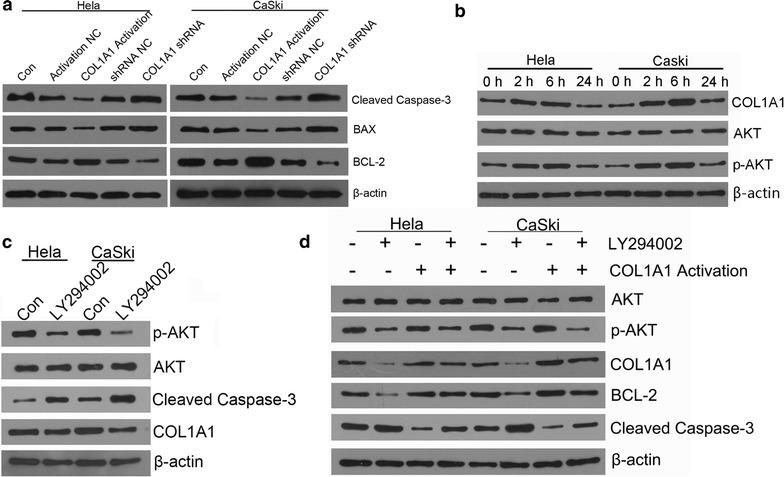
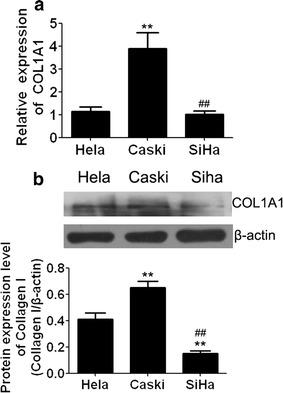
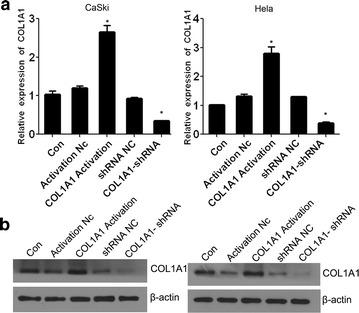
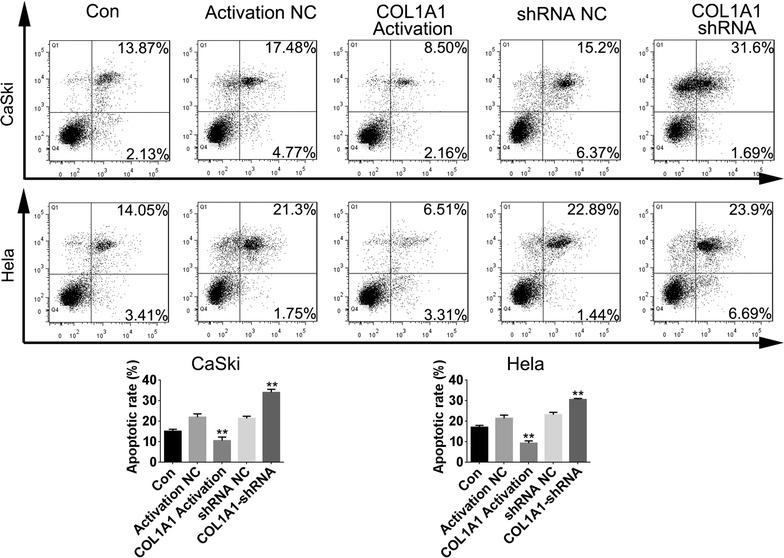
The expression of COL1A1 was significantly increased in cervical cancer tissues compared with normal tissues at the mRNA and protein level. Further, based on COL1A1 knock down and COL1A1 activation cell models, a negative correlation was observed between COL1A1 expression level and radiosensitivity. Moreover, the findings are further supported by apoptosis analysis that COL1A1 activation could inhibit the apoptosis of cervical cancer cells. Subsequently, a significantly decreased expression of p-AKT and Bcl-2, increased expression of Caspase-3 were observed in the LY294002 plus radiation group compared with radiation alone group, while these influences caused by LY294002 or X-ray radiation were reversed after COL1A1 activation.
CONCLUSIONS
To our knowledge, this is the only study to profile the mechanisms that COL1A1 plays a crucial role in cervical cells anti-apoptosis induced by radiation. Therefore, our identification of radioresistance-related COL1A1 in cervical cancer could be a starting point to explore the function of collagens, adding a new dimension to our understanding of the cervical cancer, assisting cancer biologists and clinical oncologists in novel therapeutic strategies.
背景
宫颈癌是发展中国家女性常见的癌症,放射治疗仍然是其主要的治疗方法。先前的研究表明,I型胶原蛋白α1(COL1A1)具有抗辐射作用。然而,COL1A1在宫颈癌中的这种作用尚未得到揭示。
方法
采用qRT-PCR和免疫组织化学方法评估COL1A1在宫颈癌组织和正常组织中的表达。使用集落形成试验评估COL1A1对人宫颈癌细胞系HeLa和CaSki放射抗性的影响。通过流式细胞术分析细胞凋亡变化。此外,采用蛋白质印迹法评估几种关键的凋亡和信号通路相关蛋白的变化。
结果
与正常组织相比,宫颈癌组织中COL1A1在mRNA和蛋白质水平上的表达均显著增加。此外,基于COL1A1敲低和COL1A1激活细胞模型,观察到COL1A1表达水平与放射敏感性之间呈负相关。此外,细胞凋亡分析进一步支持了这一发现,即COL1A1激活可抑制宫颈癌细胞的凋亡。随后,与单纯放疗组相比,LY294002联合放疗组中p-AKT和Bcl-2的表达显著降低,Caspase-3的表达增加,而COL1A1激活后,LY294002或X射线辐射所引起的这些影响得到了逆转。
结论
据我们所知,这是唯一一项描述COL1A1在辐射诱导的宫颈细胞抗凋亡中起关键作用机制的研究。因此,我们在宫颈癌中鉴定出与放射抗性相关的COL1A1可能是探索胶原蛋白功能的一个起点,为我们对宫颈癌的理解增添了新的维度,有助于癌症生物学家和临床肿瘤学家制定新的治疗策略。


 Zotero 插件