
从[植物名称1]、[植物名称2]和[植物名称3]水提取物合成的银纳米颗粒的表征、抗菌和抗氧化性能
Characterization, Antibacterial and Antioxidant Properties of Silver Nanoparticles Synthesized from Aqueous Extracts of , , and .
作者信息
Otunola Gloria Aderonke, Afolayan Anthony Jide, Ajayi Emmanuel Olusegun, Odeyemi Samuel Wale
机构信息
Medicinal Plants and Economic Development (MPED) Research Centre, Department of Botany, University of Fort Hare, Alice 5700, South Africa.
出版信息
Pharmacogn Mag. 2017 Jul;13(Suppl 2):S201-S208. doi: 10.4103/pm.pm_430_16. Epub 2017 Jul 11.
BACKGROUND
Herbal drug delivery is limited by poor solubility and bioavailability which can be overcome with suitable nanomaterials that will enhance their pharmacokinetics and performance.
OBJECTIVE
This study aimed to analyze the synthesis, characterization, and biological activities of silver nanoparticles (AgNPs) from three spices.
MATERIALS AND METHODS
AgNPs were prepared using 0.1 M silver nitrate and aqueous extracts of L. (garlic), Rosc. (ginger), and L. (cayenne pepper). The AgNPs were characterized using ultraviolet-visible (UV-Vis) spectroscopy, scanning electron microscopy (SEM), transmission electron microscopy (TEM), energy dispersive X-ray, X-ray diffraction (XRD), and Fourier transform infrared (FTIR) spectroscopy.
RESULTS
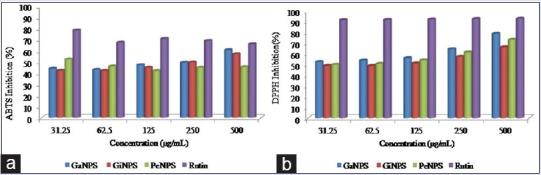
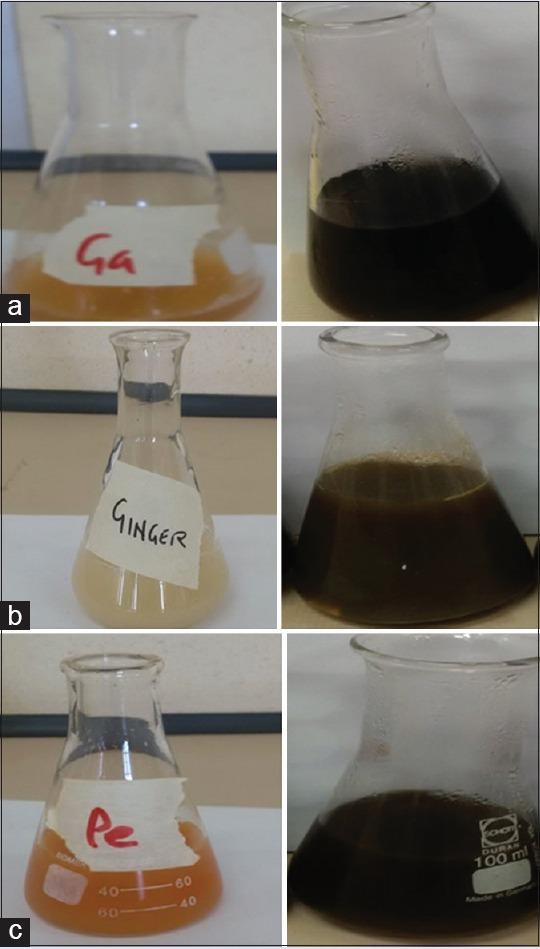
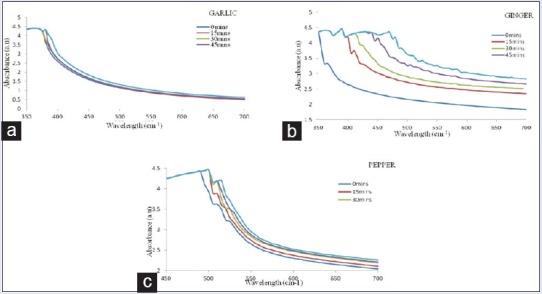
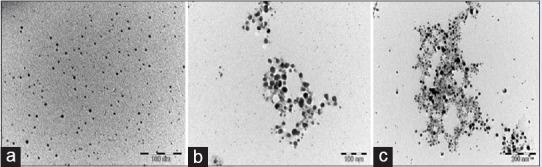
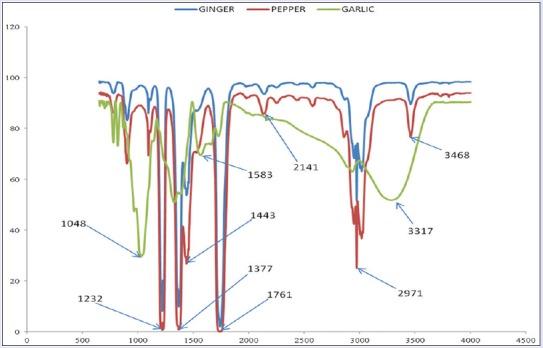
The AgNPs were formed within an hour of the reaction and showed maximum UV-Vis absorption in the 375-480 nm range. SEM and TEM revealed well-dispersed spherical particles with little agglomeration, average sizes of 3-6 nm, 3-22 nm, and 3-18 nm for garlic, ginger, and cayenne pepper, respectively. FTIR showed that amine, protein, phenolic, aromatic, and alkynes groups contributed to AgNP synthesis and XRD confirmed their crystalline and face-centered cubic nature. Antibacterial action of the AgNPs was in the following order: ginger (minimum inhibitory concentration [MIC] <25 μg/mL) > garlic> cayenne pepper (MIC 125 μg/mL). Antioxidant action showed cayenne pepper > ginger > garlic (inhibitory concentration 50% [IC50]: 40, 240, and 250 μg/mL, respectively) against 2,2-Azino-bis (3-ethylbenzthiazoline-6-sulfonic acid) and garlic > cayenne pepper > ginger (IC50: <31.25, 40, and 120 μg/mL, respectively) against 1,1-diphenyl-2-picrylhydrazyl.
CONCLUSION
Optimization of this green synthesis would support the production of AgNPs with great therapeutic potentials.
SUMMARY
The synthesis, characterization, and biological activities of silver nanoparticles (AgNPs) from garlic, ginger and cayenne pepper were evaluatedThe AgNPs formed were characterized using UV-Vis spectroscopy, SEM and TEM microscopy, as well as EDX, XRD and FTIR spectroscopy AgNPs were well dispersed with spherical shapes and average sizes of 3-6nm, 3-22nm and 3-18 nm for garlic, ginger and cayenne pepper respectivelyAmine, protein, phenolic and alkyne groups were revealed as the capping agents for the nanoparticlesThe silver nanoparticles were confirmed to be crystalline with characteristic face centred cubic natureThe antibacterial and antioxidant activities of the AgNPs confirmed the therapeutic potential of the AgNPs. AgNPs: Silver nanoparticles; UV-Vis: ultraviolet-visible; SEM: Scanning electron microscopy; TEM: Transmission electron microscopy; EDX: Energy dispersive X-ray; XRD: X-ray diffraction; FTIR: Fourier transform infrared; GaNPs: Garlic nanoparticles; GiNPs: Ginger nanoparticles; C.PeNPs: Cayenne pepper nanoparticles; FCC: Face centred cubic; SPR: Surface Plasmon resonance; ABTS-2: 2-Azino-bis (3-ethylbenzthiazoline-6-sulfonic acid); DPPH-1: 1-diphenyl-2-picrylhydrazyl.
背景
草药给药受限于其低溶解度和生物利用度,而合适的纳米材料可克服这些问题,提高其药代动力学和性能。
目的
本研究旨在分析从三种香料中合成银纳米颗粒(AgNP)、对其进行表征并检测其生物活性。
材料与方法
使用0.1M硝酸银以及大蒜、姜和辣椒的水提取物制备AgNP。采用紫外可见光谱(UV-Vis)、扫描电子显微镜(SEM)、透射电子显微镜(TEM)、能量色散X射线、X射线衍射(XRD)和傅里叶变换红外光谱(FTIR)对AgNP进行表征。
结果
反应在一小时内形成AgNP,其在375-480nm范围内呈现最大紫外可见吸收。SEM和TEM显示,大蒜、姜和辣椒的AgNP为分散良好的球形颗粒,团聚较少,平均粒径分别为3-6nm、3-22nm和3-18nm。FTIR表明,胺基、蛋白质、酚基、芳香基和炔基参与了AgNP的合成,XRD证实其具有晶体结构和面心立方性质。AgNP的抗菌活性顺序为:姜(最低抑菌浓度[MIC]<25μg/mL)>大蒜>辣椒(MIC为125μg/mL)。抗氧化活性方面,辣椒>姜>大蒜(对2,2-联氮-双-(3-乙基苯并噻唑啉-6-磺酸)的半数抑制浓度[IC50]分别为40、240和250μg/mL),对1,1-二苯基-2-苦基肼的抗氧化活性顺序为:大蒜>辣椒>姜(IC50分别为<31.25、40和120μg/mL)。
结论
优化这种绿色合成方法将有助于生产具有巨大治疗潜力的AgNP。
总结
评估了大蒜、姜和辣椒中银纳米颗粒(AgNP)的合成、表征及生物活性。使用紫外可见光谱、扫描电子显微镜和透射电子显微镜以及能谱、X射线衍射和傅里叶变换红外光谱对形成的AgNP进行表征。AgNP分散良好,呈球形,大蒜、姜和辣椒的AgNP平均粒径分别为3-6nm、3-22nm和3-18nm。胺基、蛋白质、酚基和炔基被揭示为纳米颗粒的封端剂。银纳米颗粒被确认为具有特征面心立方性质的晶体。AgNP的抗菌和抗氧化活性证实了其治疗潜力。AgNP:银纳米颗粒;UV-Vis:紫外可见;SEM:扫描电子显微镜;TEM:透射电子显微镜;EDX:能量色散X射线;XRD:X射线衍射;FTIR:傅里叶变换红外;GaNP:大蒜纳米颗粒;GiNP:姜纳米颗粒;C.PeNP:辣椒纳米颗粒;FCC:面心立方;SPR:表面等离子体共振;ABTS-2:2,2-联氮-双-(3-乙基苯并噻唑啉-6-磺酸);DPPH-1:1,1-二苯基-2-苦基肼




 Zotero 插件