
筛选美国食品药品监督管理局批准的用于抑制日本脑炎病毒感染的药物。
Screening of FDA-Approved Drugs for Inhibitors of Japanese Encephalitis Virus Infection.
作者信息
Wang Shaobo, Liu Yang, Guo Jiao, Wang Peilin, Zhang Leike, Xiao Gengfu, Wang Wei
机构信息
State Key Laboratory of Virology, Wuhan Institute of Virology, Chinese Academy of Sciences, Wuhan, China.
University of the Chinese Academy of Sciences, Beijing, China.
出版信息
J Virol. 2017 Oct 13;91(21). doi: 10.1128/JVI.01055-17. Print 2017 Nov 1.
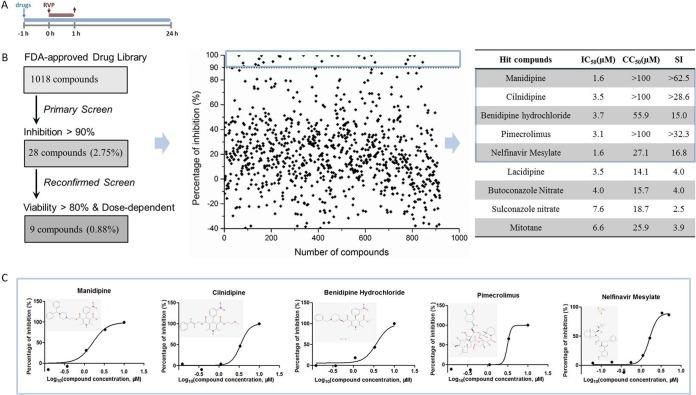
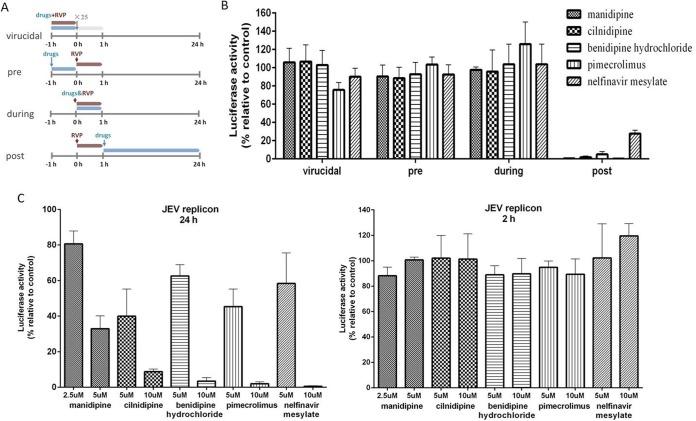
Japanese encephalitis virus (JEV), an arthropod-borne flavivirus, is a major cause of acute viral encephalitis in humans. No approved drug is available for the specific treatment of JEV infections, and the available vaccines are not effective against all clinical JEV isolates. In the study described here, a high-throughput screening of an FDA-approved drug library for inhibitors of JEV was performed. Five hit drugs that inhibited JEV infection with a selective index of >10 were identified. The antiviral activities of these five hit drugs against other flavivirus, including Zika virus, were also validated. As three of the five hit drugs were calcium inhibitors, additional types of calcium inhibitors that confirmed that calcium is essential for JEV infection, most likely during viral replication, were utilized. Adaptive mutant analysis uncovered that replacement of Q130, located in transmembrane domain 3 of the nonstructural NS4B protein, which is relatively conserved in flaviviruses, with R or K conferred JEV resistance to manidipine, a voltage-gated Ca channel (VGCC) inhibitor, without an apparent loss of the viral growth profile. Furthermore, manidipine was indicated to protect mice against JEV-induced lethality by decreasing the viral load in the brain, while it abrogated the histopathological changes associated with JEV infection. This study provides five antiflavivirus candidates and identifies cytoplasmic calcium to be a novel antiviral target for the treatment of JEV infection. The findings reported here provide therapeutic possibilities for combating infections caused by flaviviruses. No approved therapy for the treatment of Japanese encephalitis virus infection is currently available. Repurposing of approved drugs would accelerate the development of a therapeutic stratagem. In this study, we screened a library of FDA-approved drugs and identified five hit drugs, especially calcium inhibitors, exerting antiflavivirus activity that blocked viral replication. The efficacy and toxicity of manidipine were investigated with a mouse model of JEV infection, and the viral target was identified by generating an adaptive mutant.
日本脑炎病毒(JEV)是一种节肢动物传播的黄病毒,是人类急性病毒性脑炎的主要病因。目前尚无批准用于特异性治疗JEV感染的药物,现有的疫苗对所有临床JEV分离株均无效。在本研究中,我们对美国食品药品监督管理局(FDA)批准的药物库进行了高通量筛选,以寻找JEV抑制剂。我们鉴定出了五种对JEV感染具有抑制作用且选择性指数大于10的活性药物。这五种活性药物对包括寨卡病毒在内的其他黄病毒的抗病毒活性也得到了验证。由于这五种活性药物中有三种是钙抑制剂,我们还使用了其他类型的钙抑制剂,证实了钙对于JEV感染至关重要,这很可能发生在病毒复制过程中。适应性突变分析发现,将位于非结构NS4B蛋白跨膜结构域3中相对保守的Q130替换为R或K,可使JEV对电压门控钙通道(VGCC)抑制剂马尼地平产生抗性,且病毒生长特性无明显损失。此外,马尼地平通过降低脑中的病毒载量,显示出可保护小鼠免受JEV诱导的致死性,同时消除了与JEV感染相关的组织病理学变化。本研究提供了五种抗黄病毒候选药物,并确定细胞质钙是治疗JEV感染的新型抗病毒靶点。本研究结果为对抗黄病毒感染提供了治疗可能性。目前尚无批准用于治疗日本脑炎病毒感染的疗法。重新利用已批准的药物将加速治疗策略的开发。在本研究中,我们筛选了FDA批准的药物库,鉴定出五种活性药物,尤其是钙抑制剂,它们具有抗黄病毒活性,可阻断病毒复制。我们用JEV感染的小鼠模型研究了马尼地平的疗效和毒性,并通过产生适应性突变体确定了病毒靶点。




 Zotero 插件