
滤泡性淋巴瘤和慢性淋巴细胞白血病中N-糖基化的改变:与发病机制的关联及潜在治疗靶点
Altered N-Linked Glycosylation in Follicular Lymphoma and Chronic Lymphocytic Leukemia: Involvement in Pathogenesis and Potential Therapeutic Targeting.
作者信息
Hollander Nurit, Haimovich Joseph
机构信息
Department of Clinical Microbiology and Immunology, Tel Aviv University, Tel Aviv, Israel.
出版信息
Front Immunol. 2017 Aug 2;8:912. doi: 10.3389/fimmu.2017.00912. eCollection 2017.
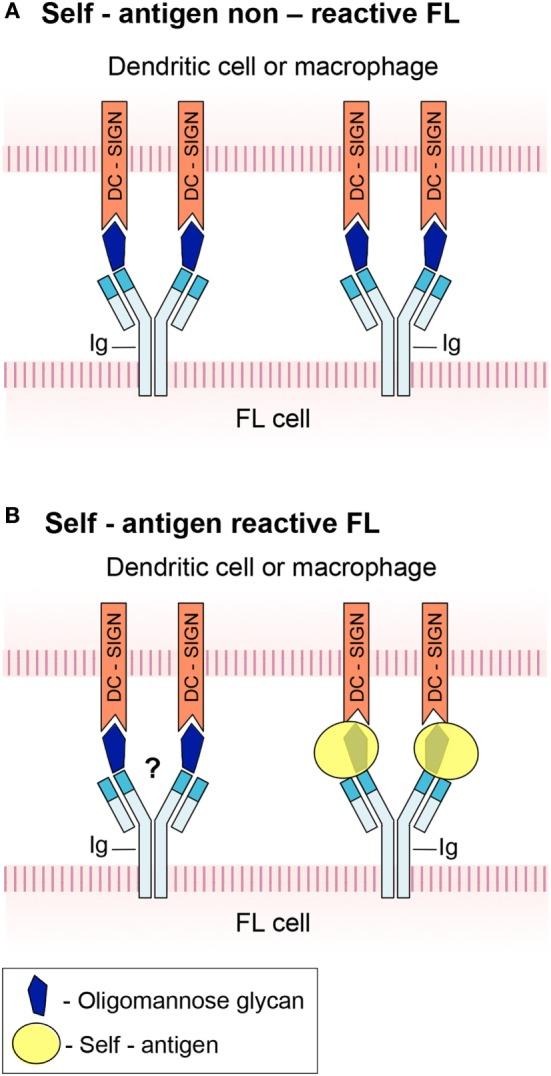
B-cell antigen receptor (BCR) expression is indispensable for survival of most B-cell malignancies. In follicular lymphoma (FL), N-linked glycosylation sites are introduced in the immunoglobulin (Ig) variable region genes. Oligosaccharides added to the acquired sites are unusually of the high-mannose type. These glycans interact with mannose-specific lectins, especially with dendritic cell-specific intercellular adhesion molecule-3-grabbing non-integrin (DC-SIGN). Lectin binding to FL triggers persistent activating signals, suggesting that lectins within the tumor microenvironment promote cell survival and proliferation. Insertion of N-glycosylation sites in Ig variable region genes has been detected in other germinal center-associated lymphomas, specifically in subsets of diffuse large B-cell lymphomas and Burkitt's lymphomas, suggesting involvement of altered glycans in pathogenesis of these malignancies as well. Furthermore, the BCR in chronic lymphocytic leukemia (CLL) carries high-mannose oligosaccharides, albeit in the heavy chain constant rather than variable region. The high expression level of the unique glycoform, particularly in the more aggressive unmutated CLL subset, suggests a functional significance for this glycan in CLL. As lectin interaction with the BCR is critical for FL and probably for some other lymphomas, targeting this interaction is considered to be an interesting therapeutic strategy. Reagents for blockade of lectin-BCR interaction may include antibodies against high-mannose glycans and mannose-based oligosaccharide mimics or non-carbohydrate glycomimetics. Moreover, as this interaction triggers signaling pathways similar to those demonstrated for BCR engagement by antigen, BCR signal transduction inhibitors may emerge as effective therapeutics for lectin-driven malignancies.
B细胞抗原受体(BCR)的表达对于大多数B细胞恶性肿瘤的存活至关重要。在滤泡性淋巴瘤(FL)中,N-连接糖基化位点被引入免疫球蛋白(Ig)可变区基因。添加到这些获得性位点的寡糖通常为高甘露糖型。这些聚糖与甘露糖特异性凝集素相互作用,特别是与树突状细胞特异性细胞间粘附分子3结合非整合素(DC-SIGN)相互作用。凝集素与FL的结合触发持续的激活信号,这表明肿瘤微环境中的凝集素促进细胞存活和增殖。在其他与生发中心相关的淋巴瘤中,特别是在弥漫性大B细胞淋巴瘤和伯基特淋巴瘤的亚组中,已检测到Ig可变区基因中N-糖基化位点的插入,这表明糖链改变也参与了这些恶性肿瘤的发病机制。此外,慢性淋巴细胞白血病(CLL)中的BCR携带高甘露糖寡糖,尽管是在重链恒定区而非可变区。这种独特糖型的高表达水平,特别是在更具侵袭性的未突变CLL亚组中,表明这种聚糖在CLL中具有功能意义。由于凝集素与BCR的相互作用对FL至关重要,可能对其他一些淋巴瘤也很重要,因此靶向这种相互作用被认为是一种有趣的治疗策略。阻断凝集素-BCR相互作用的试剂可能包括抗高甘露糖聚糖抗体、基于甘露糖的寡糖模拟物或非碳水化合物糖模拟物。此外,由于这种相互作用触发的信号通路与抗原与BCR结合所证明的信号通路相似,BCR信号转导抑制剂可能成为凝集素驱动的恶性肿瘤的有效治疗药物。
 Zotero 插件