
Sugarsquare,一个面向1型糖尿病患儿家长的基于网络的患者门户:多中心随机对照可行性试验。
Sugarsquare, a Web-Based Patient Portal for Parents of a Child With Type 1 Diabetes: Multicenter Randomized Controlled Feasibility Trial.
作者信息
Boogerd Emiel, Maas-Van Schaaijk Nienke M, Sas Theo C, Clement-de Boers Agnes, Smallenbroek Mischa, Nuboer Roos, Noordam Cees, Verhaak Chris M
机构信息
Department of Medical Psychology, Radboud University Medical Center, Nijmegen, Netherlands.
Children's Diabetes Center Nijmegen, Nijmegen, Netherlands.
出版信息
J Med Internet Res. 2017 Aug 22;19(8):e287. doi: 10.2196/jmir.6639.
BACKGROUND
Raising a child with type 1 diabetes (T1D) means combining the demands of the disease management with everyday parenting, which is associated with increased levels of distress. A Web-based patient portal, Sugarsquare, was developed to support parents, by providing online parent-professional communication, online peer support and online disease information.
OBJECTIVE
The first aim of this study was to assess the feasibility of conducting a multicenter, randomized controlled trial in Dutch parents of a child with T1D. The second aim was to assess the feasibility of implementing Sugarsquare in clinical practice.
METHODS
The parents of 105 children (N=105) with T1D below the age of 13 participated in a 6-month multicenter randomized controlled feasibility trial. They were randomly assigned to an experimental (n=54, usual care and Sugarsquare) or a control group (n=51, usual care). Attrition rates and user statistics were gathered to evaluate feasibility of the trial and implementation. To determine potential efficacy, the parenting stress index (PSI-SF) was assessed at baseline (T0) and after 6 months (T1).
RESULTS
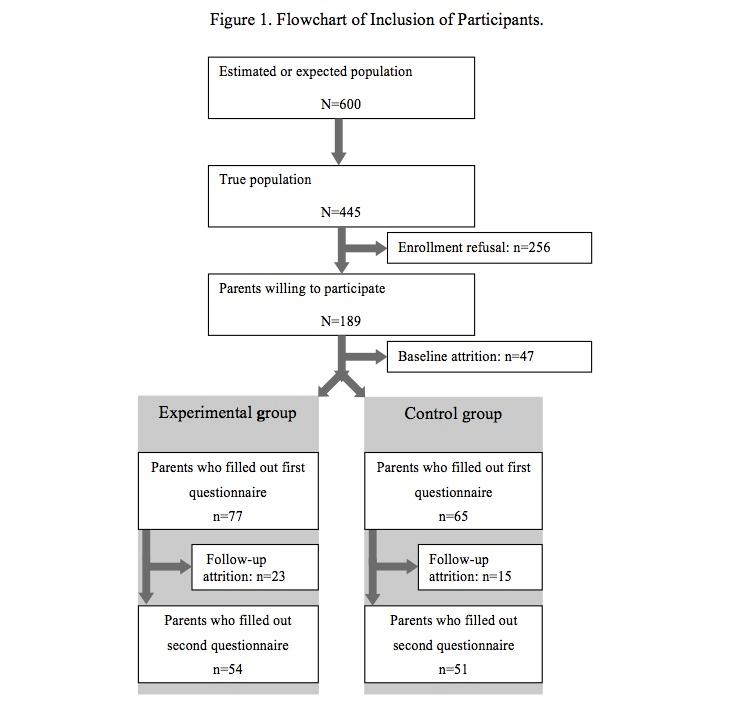
Of a potential population of parents of 445 children, 189 were willing to participate (enrollment refusal=57.5%, n=256), 142 filled in the baseline questionnaire (baseline attrition rate=25%, n=47), and 105 also filled in the questionnaire at T1 (post randomization attrition rate during follow-up=26%, n=32). As such, 24% of the potential population participated. Analysis in the experimental group (n=54) revealed a total of 32 (59%) unique users, divided into 12 (38%) frequent users, 9 (28%) incidental users, and 11 (34%) low-frequent users. Of the total of 44 professionals, 34 (77%) logged in, and 32 (73%) logged in repeatedly. Analysis of the user statistics in the experimental group further showed high practicability and integration in all users, moderate acceptability and demand in parents, and high acceptability and demand in health care professionals. Baseline parenting stress index scores were related to the parents' frequency of logging on (ρ=.282, P=.03) and page-views (ρ=.304, P=.01). No significant differences in change in parenting stress between experimental and control group were found (F=.49, P=.49).
CONCLUSIONS
The trial can be considered feasible, considering the average enrollment refusal rate, baseline attrition rate and postrandomization attrition rate, compared to other eHealth studies, although lower than hypothesized. Implementing Sugarsquare in clinical practice was partly feasible, given moderate demand and acceptability in parent users and lack of potential efficacy. Parents who reported higher levels of parenting stress used Sugarsquare more often than other parents, although Sugarsquare did not reduce parenting stress. These results indicate that Web-based interventions are a suitable way of providing parents of children with T1D with additional support. Future studies should determine how Sugarsquare could reduce parenting stress, for instance by adding targeted interventions. Factors potentially contributing to successful implementation are suggested.
TRIAL REGISTRATION
Nederlands Trial Register Number: NTR3643; http://www.trialregister.nl/trialreg/admin/rctview.asp?TC=3643 (Archived by WebCite at http://www.webcitation.org/6qihOVCi6).
背景
抚养一名患有1型糖尿病(T1D)的儿童意味着要将疾病管理的要求与日常育儿相结合,这会带来更高程度的困扰。开发了一个基于网络的患者门户网站Sugarsquare,通过提供在线家长与专业人员沟通、在线同伴支持和在线疾病信息来支持家长。
目的
本研究的首要目的是评估在荷兰患有T1D儿童的家长中开展多中心随机对照试验的可行性。第二个目的是评估在临床实践中实施Sugarsquare的可行性。
方法
105名13岁以下患有T1D儿童的家长参与了一项为期6个月的多中心随机对照可行性试验。他们被随机分配到实验组(n = 54,接受常规护理并使用Sugarsquare)或对照组(n = 51,仅接受常规护理)。收集失访率和用户统计数据以评估试验和实施的可行性。为确定潜在疗效,在基线(T0)和6个月后(T1)评估育儿压力指数(PSI - SF)。
结果
在445名儿童的家长这一潜在人群中,189名愿意参与(拒绝参与率 = 57.5%,n = 256),142名填写了基线问卷(基线失访率 = 25%,n = 47),105名在T1时也填写了问卷(随访期间随机分组后的失访率 = 26%,n = 32)。因此,潜在人群中有24%参与了研究。对实验组(n = 54)的分析显示共有32名(59%)独立用户,分为12名(38%)频繁用户、9名(28%)偶尔用户和11名(34%)低频用户。在总共44名专业人员中,34名(77%)登录,32名(73%)重复登录。对实验组用户统计数据的进一步分析表明,该系统在所有用户中具有较高的实用性和整合性,在家长中有中等的可接受性和需求,在医疗保健专业人员中有较高的可接受性和需求。基线育儿压力指数得分与家长的登录频率(ρ = 0.282,P = 0.03)和页面浏览量(ρ = 0.304,P = 0.01)相关。实验组和对照组在育儿压力变化方面未发现显著差异(F = 0.49,P = 0.49)。
结论
与其他电子健康研究相比,考虑到平均拒绝参与率、基线失访率和随机分组后的失访率,尽管低于预期假设,但该试验可被认为是可行的。鉴于家长用户的需求和可接受性中等且缺乏潜在疗效,在临床实践中实施Sugarsquare部分可行。报告育儿压力水平较高的家长比其他家长更频繁地使用Sugarsquare,尽管Sugarsquare并未减轻育儿压力。这些结果表明基于网络的干预措施是为患有T1D儿童的家长提供额外支持的合适方式。未来的研究应确定Sugarsquare如何能够减轻育儿压力,例如通过添加有针对性的干预措施。提出了可能有助于成功实施的因素。
试验注册
荷兰试验注册编号:NTR3643;http://www.trialregister.nl/trialreg/admin/rctview.asp?TC = 3643(由WebCite存档于http://www.webcitation.org/6qihOVCi6)。
 Zotero 插件