
青少年女性加速的 DNA 甲基化年龄:与日间皮质醇升高和海马体体积减小的关联。
Accelerated DNA methylation age in adolescent girls: associations with elevated diurnal cortisol and reduced hippocampal volume.
机构信息
Department of Psychiatry and Behavioral Sciences, Stanford University, Stanford, CA, USA.
Department of Psychology, Stanford University, Stanford, CA, USA.
出版信息
Transl Psychiatry. 2017 Aug 29;7(8):e1223. doi: 10.1038/tp.2017.188.
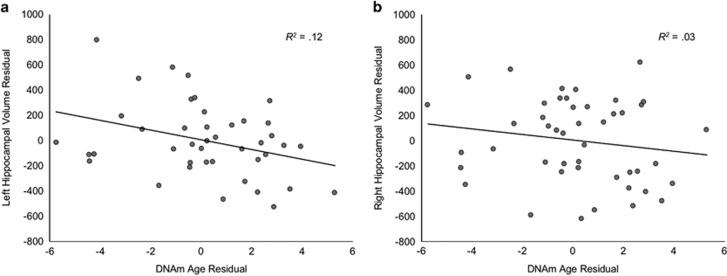
Numerous studies have linked exposure to stress to adverse health outcomes through the effects of cortisol, a product of the stress response system, on cellular aging processes. Accelerated DNA methylation age is a promising epigenetic marker associated with stress and disease risk that may constitute a link from stress response to changes in neural structures. Specifically, elevated glucocorticoid signaling likely contributes to accelerating DNA methylation age, which may signify a maladaptive stress-related cascade that leads to hippocampal atrophy. We examined the relations among diurnal cortisol levels, DNA methylation age and hippocampal volume in a longitudinal study of 46 adolescent girls. We computed area under the curve from two daily cortisol collection periods, and calculated DNA methylation age using previously established methods based on a set of CpG sites associated with chronological age. We computed a residual score by partialling out chronological age; higher discrepancies reflect relatively accelerated DNA methylation age. We assessed hippocampal volume via T1-weighted images and automated volumetric segmentation. We found that greater diurnal cortisol production was associated with accelerated DNA methylation age, which in turn was associated with reduced left hippocampal volume. Finally, accelerated DNA methylation age significantly mediated the association between diurnal cortisol and left hippocampal volume. Thus, accelerated DNA methylation age may be an epigenetic marker linking hypothalamic-pituitary-adrenal axis dysregulation with neural structure. If these findings are replicated, the current study provides a method for advancing our understanding of mechanisms by which glucocorticoid signaling is associated with cellular aging and brain development.
大量研究表明,皮质醇作为应激反应系统的产物,会影响细胞衰老过程,从而使人们暴露于压力之下与不良健康结果相关。加速的 DNA 甲基化年龄是与应激和疾病风险相关的有前途的表观遗传标志物,它可能构成从应激反应到神经结构变化的联系。具体来说,升高的糖皮质激素信号可能有助于加速 DNA 甲基化年龄,这可能表明与海马体萎缩相关的适应不良的应激相关级联。我们在一项对 46 名青春期女孩的纵向研究中,研究了日间皮质醇水平、DNA 甲基化年龄和海马体体积之间的关系。我们计算了两个每日皮质醇采集期的曲线下面积,并使用基于与年龄相关的 CpG 位点的先前建立的方法计算 DNA 甲基化年龄。我们通过部分消除年龄差异来计算残差得分;较高的差异反映了相对加速的 DNA 甲基化年龄。我们通过 T1 加权图像和自动体积分割来评估海马体体积。我们发现,日间皮质醇产生量较大与 DNA 甲基化年龄加速有关,而 DNA 甲基化年龄加速又与左海马体体积减少有关。最后,加速的 DNA 甲基化年龄显著介导了日间皮质醇与左海马体体积之间的关联。因此,加速的 DNA 甲基化年龄可能是将下丘脑-垂体-肾上腺轴失调与神经结构联系起来的表观遗传标志物。如果这些发现得到复制,那么本研究为推进我们对糖皮质激素信号与细胞衰老和大脑发育相关的机制的理解提供了一种方法。

 Zotero 插件