
一种识别美国人群中普遍存在的化学物质组合的方法。
A Method for Identifying Prevalent Chemical Combinations in the U.S. Population.
作者信息
Kapraun Dustin F, Wambaugh John F, Ring Caroline L, Tornero-Velez Rogelio, Setzer R Woodrow
机构信息
National Center for Computational Toxicology, U.S. Environmental Protection Agency , Research Triangle Park, North Carolina, USA.
Oak Ridge Institute for Science and Education , Oak Ridge, Tennessee, USA.
出版信息
Environ Health Perspect. 2017 Aug 24;125(8):087017. doi: 10.1289/EHP1265.
BACKGROUND
Through the food and water they ingest, the air they breathe, and the consumer products with which they interact at home and at work, humans are exposed to tens of thousands of chemicals, many of which have not been evaluated to determine their potential toxicities. Furthermore, while current chemical testing tends to focus on individual chemicals, the exposures that people actually experience involve mixtures of chemicals. Unfortunately, the number of mixtures that can be formed from the thousands of environmental chemicals is enormous, and testing all of them would be impossible.
OBJECTIVES
We seek to develop and demonstrate a method for identifying those mixtures that are most prevalent in humans.
METHODS
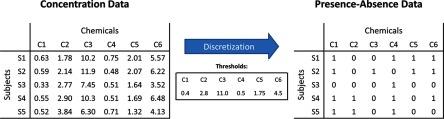
We applied frequent itemset mining, a technique traditionally used for market basket analysis, to biomonitoring data from the 2009-2010 cycle of the continuous National Health and Nutrition Examination Survey (NHANES) to identify combinations of chemicals that frequently co-occur in people.
RESULTS
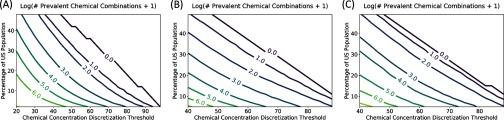
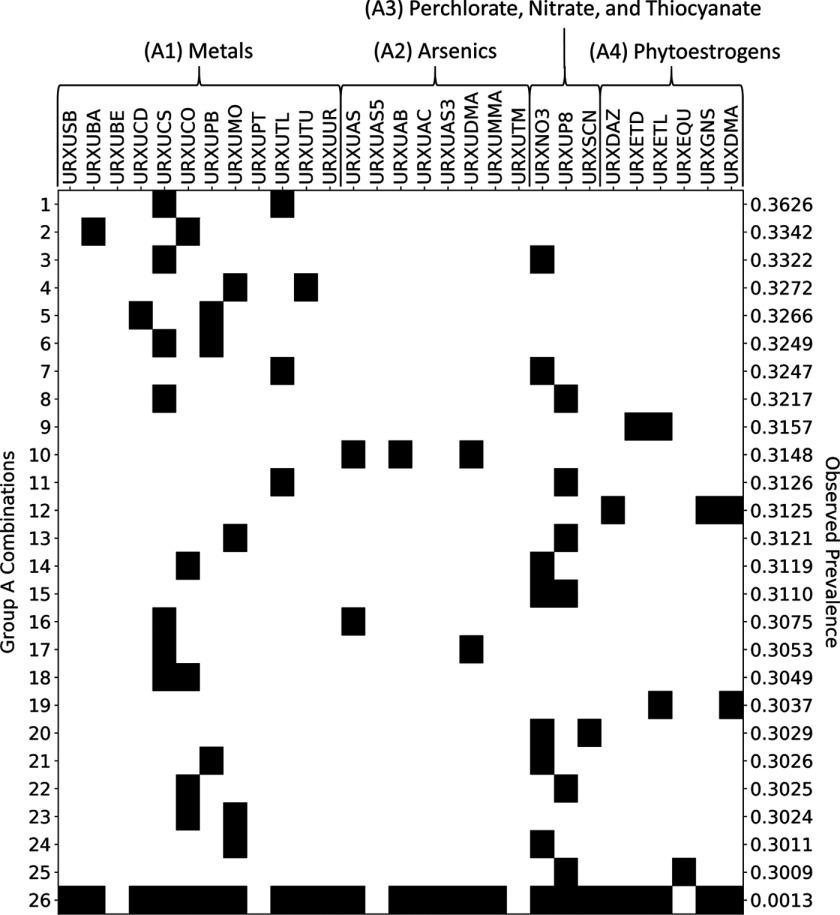
We identified 90 chemical combinations consisting of relatively few chemicals that occur in at least 30% of the U.S. population, as well as three supercombinations consisting of relatively many chemicals that occur in a small but nonnegligible proportion of the U.S. population.
CONCLUSIONS
We demonstrated how FIM can be used in conjunction with biomonitoring data to narrow a large number of possible chemical combinations down to a smaller set of prevalent chemical combinations. https://doi.org/10.1289/EHP1265.
背景
通过摄入的食物和水、呼吸的空气以及在家中和工作场所接触的消费品,人类接触到数以万计的化学物质,其中许多尚未经过评估以确定其潜在毒性。此外,虽然当前的化学物质测试往往侧重于单一化学物质,但人们实际接触的是化学物质混合物。不幸的是,由数千种环境化学物质形成的混合物数量巨大,对所有混合物进行测试是不可能的。
目的
我们试图开发并展示一种识别在人类中最普遍存在的混合物的方法。
方法
我们将频繁项集挖掘(一种传统上用于市场篮子分析的技术)应用于2009 - 2010年连续全国健康与营养检查调查(NHANES)周期的生物监测数据,以识别在人群中经常同时出现的化学物质组合。
结果
我们识别出90种由相对较少化学物质组成的化学组合,这些组合在美国至少30%的人口中出现,以及三种由相对较多化学物质组成的超级组合,这些组合在美国一小部分但不可忽视的人口中出现。
结论
我们展示了频繁项集挖掘如何与生物监测数据结合使用,将大量可能的化学物质组合缩小到一组较小的普遍存在的化学物质组合。https://doi.org/10.1289/EHP1265 。





 Zotero 插件