
将海面温度的遥感测量作为牡蛎肉中副溶血性弧菌及人类疾病指标的研究
Remote sensing measurements of sea surface temperature as an indicator of Vibrio parahaemolyticus in oyster meat and human illnesses.
作者信息
Konrad Stephanie, Paduraru Peggy, Romero-Barrios Pablo, Henderson Sarah B, Galanis Eleni
机构信息
Canadian Field Epidemiology Program, Public Health Agency of Canada, 130 Colonnade Road, Ottawa, Ontario, K1A 0K9, Canada.
BC Centre for Disease Control, 655 West 12 Avenue, Vancouver, British Columbia, V5Z 4R4, Canada.
出版信息
Environ Health. 2017 Aug 31;16(1):92. doi: 10.1186/s12940-017-0301-x.
BACKGROUND
Vibrio parahaemolyticus (Vp) is a naturally occurring bacterium found in marine environments worldwide. It can cause gastrointestinal illness in humans, primarily through raw oyster consumption. Water temperatures, and potentially other environmental factors, play an important role in the growth and proliferation of Vp in the environment. Quantifying the relationships between environmental variables and indicators or incidence of Vp illness is valuable for public health surveillance to inform and enable suitable preventative measures. This study aimed to assess the relationship between environmental parameters and Vp in British Columbia (BC), Canada.
METHODS
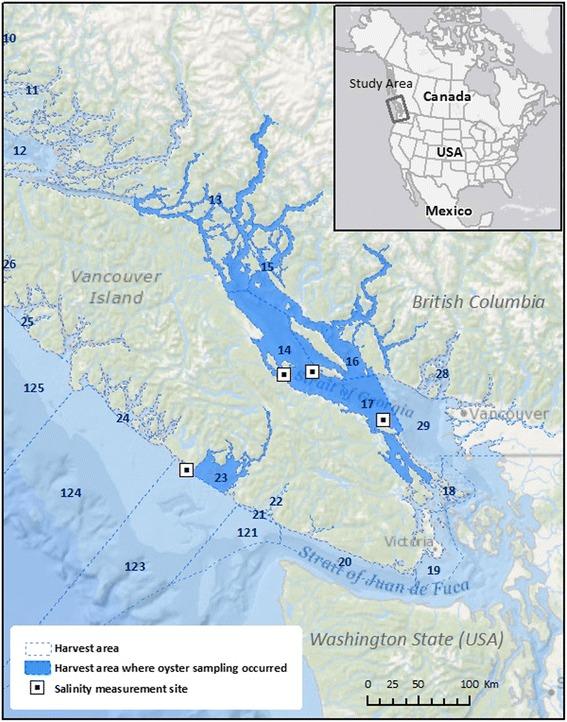
The study used Vp counts in oyster meat from 2002-2015 and laboratory confirmed Vp illnesses from 2011-2015 for the province of BC. The data were matched to environmental parameters from publicly available sources, including remote sensing measurements of nighttime sea surface temperature (SST) obtained from satellite readings at a spatial resolution of 1 km. Using three separate models, this paper assessed the relationship between (1) daily SST and Vp counts in oyster meat, (2) weekly mean Vp counts in oysters and weekly Vp illnesses, and (3) weekly mean SST and weekly Vp illnesses. The effects of salinity and chlorophyll a were also evaluated. Linear regression was used to quantify the relationship between SST and Vp, and piecewise regression was used to identify SST thresholds of concern.
RESULTS
A total of 2327 oyster samples and 293 laboratory confirmed illnesses were included. In model 1, both SST and salinity were significant predictors of log(Vp) counts in oyster meat. In model 2, the mean log(Vp) count in oyster meat was a significant predictor of Vp illnesses. In model 3, weekly mean SST was a significant predictor of weekly Vp illnesses. The piecewise regression models identified a SST threshold of approximately 14C for both model 1 and 3, indicating increased risk of Vp in oyster meat and Vp illnesses at higher temperatures.
CONCLUSION
Monitoring of SST, particularly through readily accessible remote sensing data, could serve as a warning signal for Vp and help inform the introduction and cessation of preventative or control measures.
背景
副溶血性弧菌(Vp)是一种在全球海洋环境中天然存在的细菌。它主要通过食用生牡蛎导致人类胃肠道疾病。水温以及其他潜在的环境因素在环境中Vp的生长和繁殖中起着重要作用。量化环境变量与Vp疾病指标或发病率之间的关系对于公共卫生监测很有价值,有助于制定并实施合适的预防措施。本研究旨在评估加拿大不列颠哥伦比亚省(BC)环境参数与Vp之间的关系。
方法
该研究使用了2002年至2015年BC省牡蛎肉中的Vp计数以及2011年至2015年实验室确诊的Vp疾病数据。这些数据与来自公开可用来源的环境参数相匹配,包括从空间分辨率为1公里的卫星读数中获取的夜间海表面温度(SST)遥感测量数据。本文使用三个独立模型评估了以下关系:(1)每日SST与牡蛎肉中Vp计数之间的关系;(2)牡蛎中每周平均Vp计数与每周Vp疾病之间的关系;(3)每周平均SST与每周Vp疾病之间的关系。还评估了盐度和叶绿素a的影响。使用线性回归来量化SST与Vp之间的关系,并使用分段回归来确定值得关注的SST阈值。
结果
共纳入2327个牡蛎样本和293例实验室确诊病例。在模型1中,SST和盐度都是牡蛎肉中log(Vp)计数的显著预测因子。在模型2中,牡蛎肉中平均log(Vp)计数是Vp疾病的显著预测因子。在模型3中每周平均SST是每周Vp疾病的显著预测因子。分段回归模型为模型1和模型3确定了大约14℃的SST阈值,表明在较高温度下牡蛎肉中Vp和Vp疾病的风险增加。
结论
监测SST,特别是通过易于获取的遥感数据,可以作为Vp的预警信号,并有助于为预防或控制措施的引入和停止提供信息。



 Zotero 插件