
2009 - 2014年美国非大都市和大都市地区18 - 64岁参加雇主赞助医疗保险的女性的BRCA基因检测及预防性干预措施的接受情况
BRCA Genetic Testing and Receipt of Preventive Interventions Among Women Aged 18-64 Years with Employer-Sponsored Health Insurance in Nonmetropolitan and Metropolitan Areas - United States, 2009-2014.
作者信息
Kolor Katherine, Chen Zhuo, Grosse Scott D, Rodriguez Juan L, Green Ridgely Fisk, Dotson W David, Bowen M Scott, Lynch Julie A, Khoury Muin J
机构信息
Office of Public Health Genomics, Division of Public Health Information Dissemination, Center for Surveillance, Epidemiology, and Laboratory Services, CDC, Atlanta, Georgia.
CFO Leasing, Inc., Atlanta, Georgia.
出版信息
MMWR Surveill Summ. 2017 Sep 8;66(15):1-11. doi: 10.15585/mmwr.ss6615a1.
PROBLEM/CONDITION: Genetic testing for breast cancer 1 (BRCA1) and breast cancer 2 (BRCA2) gene mutations can identify women at increased risk for breast and ovarian cancer. These testing results can be used to select preventive interventions and guide treatment. Differences between nonmetropolitan and metropolitan populations in rates of BRCA testing and receipt of preventive interventions after testing have not previously been examined.
PERIOD COVERED
2009-2014.
DESCRIPTION OF SYSTEM
Medical claims data from Truven Health Analytics MarketScan Commercial Claims and Encounters databases were used to estimate rates of BRCA testing and receipt of preventive interventions after BRCA testing among women aged 18-64 years with employer-sponsored health insurance in metropolitan and nonmetropolitan areas of the United States, both nationally and regionally.
RESULTS
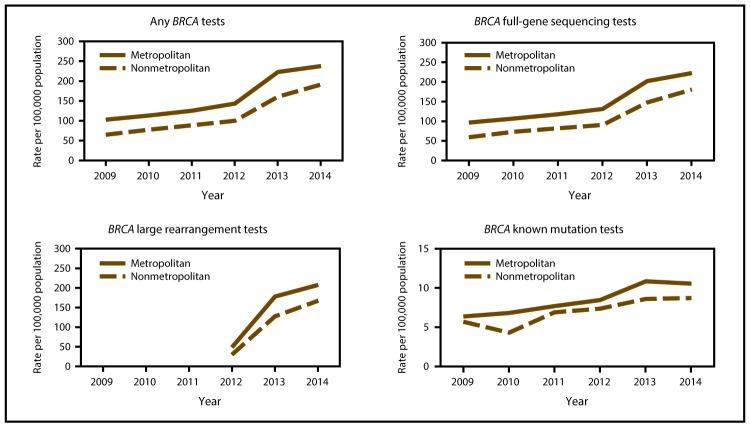
From 2009 to 2014, BRCA testing rates per 100,000 women aged 18-64 years with employer-sponsored health insurance increased 2.3 times (102.7 to 237.8) in metropolitan areas and 3.0 times (64.8 to 191.3) in nonmetropolitan areas. The relative difference in BRCA testing rates between metropolitan and nonmetropolitan areas decreased from 37% in 2009 (102.7 versus 64.8) to 20% in 2014 (237.8 versus 191.3). The relative difference in BRCA testing rates between metropolitan and nonmetropolitan areas decreased more over time in younger women than in older women and decreased in all regions except the West. Receipt of preventive services 90 days after BRCA testing in metropolitan versus nonmetropolitan areas throughout the period varied by service: the percentage of women who received a mastectomy was similar, the percentage of women who received magnetic resonance imaging of the breast was lower in nonmetropolitan areas (as low as 5.8% in 2014 to as high as 8.2% in 2011) than metropolitan areas (as low as 7.3% in 2014 to as high as 10.3% in 2011), and the percentage of women who received mammography was lower in nonmetropolitan areas in earlier years but was similar in later years.
INTERPRETATION
Possible explanations for the 47% decrease in the relative difference in BRCA testing rates over the study period include increased access to genetic services in nonmetropolitan areas and increased demand nationally as a result of publicity. The relative differences in metropolitan and nonmetropolitan BRCA testing rates were smaller among women at younger ages compared with older ages.
PUBLIC HEALTH ACTION
Improved data sources and surveillance tools are needed to gather comprehensive data on BRCA testing in the United States, monitor adherence to evidence-based guidelines for BRCA testing, and assess receipt of preventive interventions for women with BRCA mutations. Programs can build on the recent decrease in geographic disparities in receipt of BRCA testing while simultaneously educating the public and health care providers about U.S. Preventive Services Task Force recommendations and other clinical guidelines for BRCA testing and counseling.
问题/状况:对乳腺癌1(BRCA1)和乳腺癌2(BRCA2)基因突变进行基因检测,可识别出患乳腺癌和卵巢癌风险增加的女性。这些检测结果可用于选择预防性干预措施并指导治疗。此前尚未对非都市和都市人群在BRCA检测率以及检测后接受预防性干预措施方面的差异进行过研究。
涵盖时间段
2009 - 2014年。
系统描述
利用来自Truven Health Analytics MarketScan商业索赔与诊疗数据库的医疗索赔数据,估算美国都市和非都市地区18 - 64岁拥有雇主提供医疗保险的女性中BRCA检测率以及BRCA检测后接受预防性干预措施的比率,数据涵盖全国及各地区。
结果
2009年至2014年,每10万名18 - 64岁拥有雇主提供医疗保险的女性中,都市地区的BRCA检测率增长了2.3倍(从102.7增至237.8),非都市地区增长了3.0倍(从64.8增至191.3)。都市和非都市地区BRCA检测率的相对差异从2009年的37%(102.7对64.8)降至2014年的20%(237.8对191.3)。随着时间推移,都市和非都市地区BRCA检测率的相对差异在年轻女性中比在年长女性中下降得更多,且除西部外的所有地区均有所下降。在整个研究期间,都市和非都市地区BRCA检测后90天接受预防性服务的情况因服务项目而异:接受乳房切除术的女性比例相似,非都市地区接受乳房磁共振成像检查的女性比例低于都市地区(2014年低至5.8%,2011年高至8.2%),而都市地区(2014年低至7.3%,2011年高至10.3%);早年非都市地区接受乳房X光检查的女性比例较低,但后期与都市地区相似。
解读
研究期间BRCA检测率相对差异下降47%的可能原因包括非都市地区获得基因服务的机会增加以及因宣传导致全国范围内需求增加。与年长女性相比,年轻女性中都市和非都市BRCA检测率的相对差异更小。
公共卫生行动
需要改进数据来源和监测工具,以收集美国BRCA检测的全面数据,监测对BRCA检测循证指南的遵循情况,并评估BRCA突变女性接受预防性干预措施的情况。相关项目可基于近期BRCA检测在地域差异方面的减少,同时向公众和医疗服务提供者宣传美国预防服务工作组的建议以及其他BRCA检测和咨询的临床指南。

 Zotero 插件