
钠通道蛋白1.5(NaV1.5)突变体E1784K中电导-电压关系的去极化是由于快速失活的改变。
Depolarization of the conductance-voltage relationship in the NaV1.5 mutant, E1784K, is due to altered fast inactivation.
作者信息
Peters Colin H, Yu Alec, Zhu Wandi, Silva Jonathan R, Ruben Peter C
机构信息
Department of Biomedical Physiology and Kinesiology, Simon Fraser University, Burnaby, British Columbia, Canada.
Department of Biomedical Engineering, Washington University in St. Louis, St. Louis, Missouri, United States of America.
出版信息
PLoS One. 2017 Sep 12;12(9):e0184605. doi: 10.1371/journal.pone.0184605. eCollection 2017.
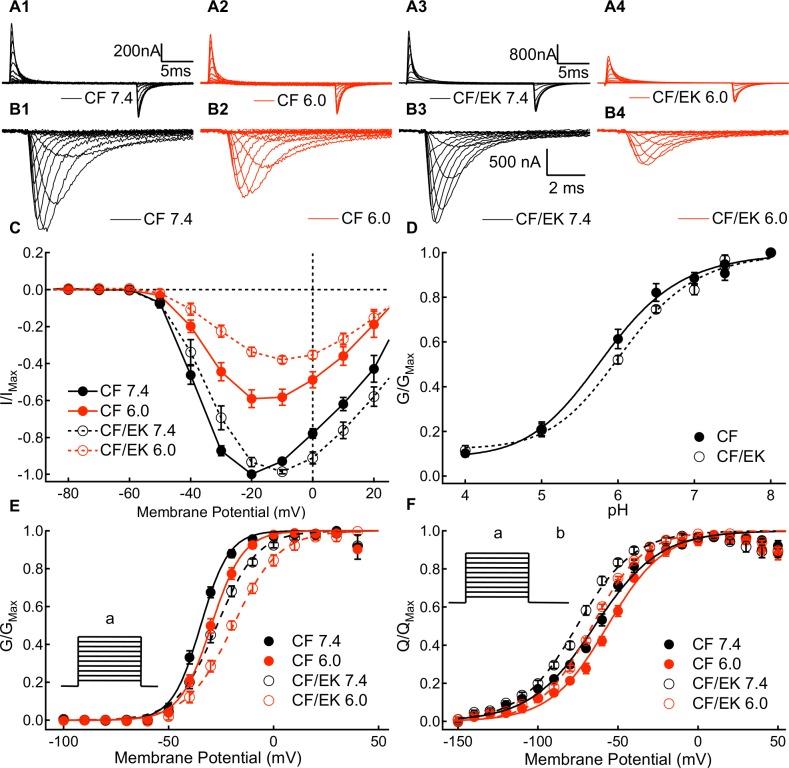
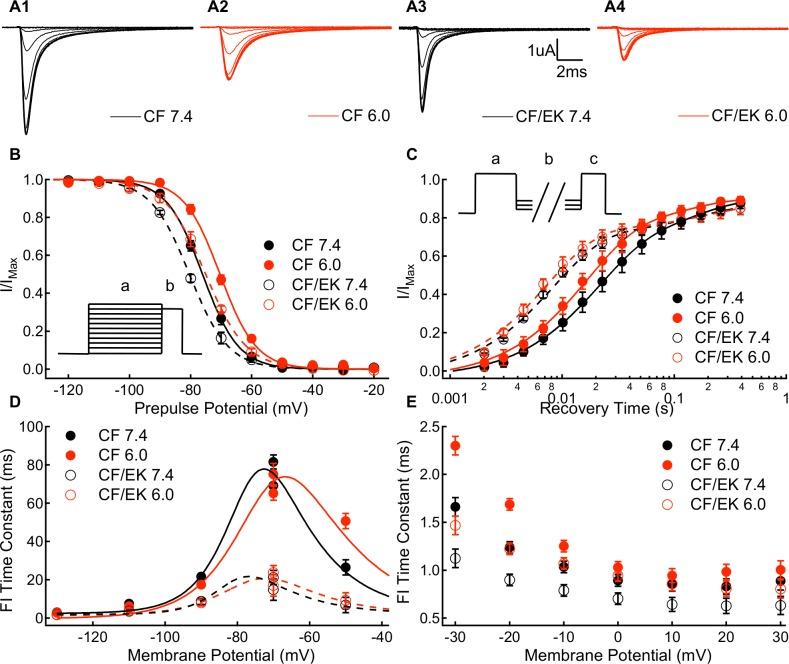
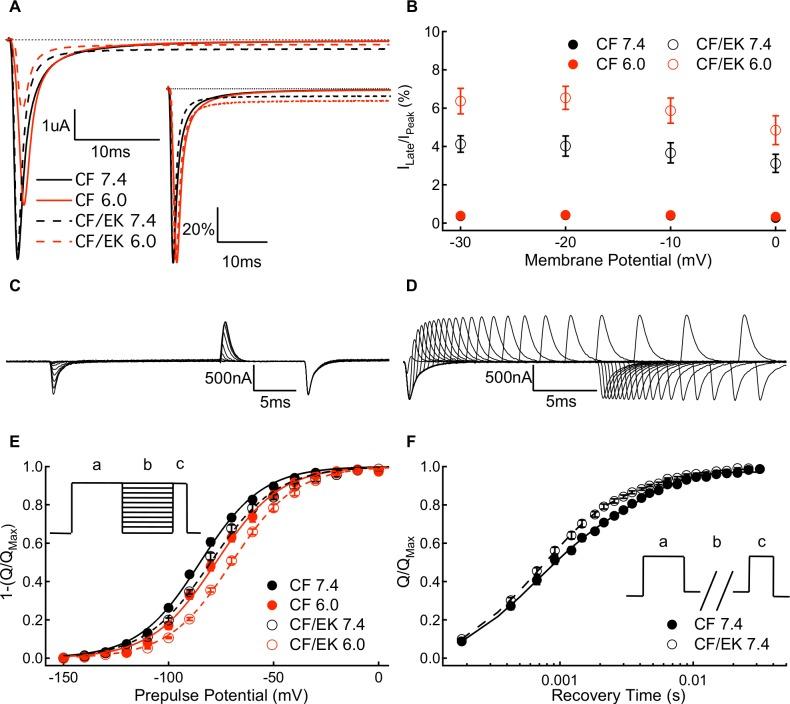
E1784K is the most common mixed long QT syndrome/Brugada syndrome mutant in the cardiac voltage-gated sodium channel NaV1.5. E1784K shifts the midpoint of the channel conductance-voltage relationship to more depolarized membrane potentials and accelerates the rate of channel fast inactivation. The depolarizing shift in the midpoint of the conductance curve in E1784K is exacerbated by low extracellular pH. We tested whether the E1784K mutant shifts the channel conductance curve to more depolarized membrane potentials by affecting the channel voltage-sensors. We measured ionic currents and gating currents at pH 7.4 and pH 6.0 in Xenopus laevis oocytes. Contrary to our expectation, the movement of gating charges is shifted to more hyperpolarized membrane potentials by E1784K. Voltage-clamp fluorimetry experiments show that this gating charge shift is due to the movement of the DIVS4 voltage-sensor being shifted to more hyperpolarized membrane potentials. Using a model and experiments on fast inactivation-deficient channels, we show that changes to the rate and voltage-dependence of fast inactivation are sufficient to shift the conductance curve in E1784K. Our results localize the effects of E1784K to DIVS4, and provide novel insight into the role of the DIV-VSD in regulating the voltage-dependencies of activation and fast inactivation.
E1784K是心脏电压门控钠通道NaV1.5中最常见的混合型长QT综合征/ Brugada综合征突变体。E1784K将通道电导-电压关系的中点移向更去极化的膜电位,并加速通道快速失活的速率。细胞外低pH会加剧E1784K电导曲线中点的去极化偏移。我们测试了E1784K突变体是否通过影响通道电压传感器将通道电导曲线移向更去极化的膜电位。我们在非洲爪蟾卵母细胞中测量了pH 7.4和pH 6.0时的离子电流和门控电流。与我们的预期相反,E1784K使门控电荷的移动移向更正极化的膜电位。电压钳荧光实验表明,这种门控电荷偏移是由于DIVS4电压传感器的移动移向了更超极化的膜电位。通过对快速失活缺陷通道的模型和实验,我们表明快速失活的速率和电压依赖性的变化足以使E1784K中的电导曲线发生偏移。我们的结果将E1784K的作用定位到DIVS4,并为DIV-VSD在调节激活和快速失活的电压依赖性中的作用提供了新的见解。



 Zotero 插件