
具有抗糖化活性的多酚及其作用机制:近期研究发现综述。
Polyphenols with antiglycation activity and mechanisms of action: A review of recent findings.
机构信息
School of Nutrition and Health Sciences, College of Nutrition, Taipei Medical University, Taipei, Taiwan.
Department of Pathology, Taipei Medical University-Shuang Ho Hospital, Taipei, Taiwan.
出版信息
J Food Drug Anal. 2017 Jan;25(1):84-92. doi: 10.1016/j.jfda.2016.10.017. Epub 2016 Dec 5.
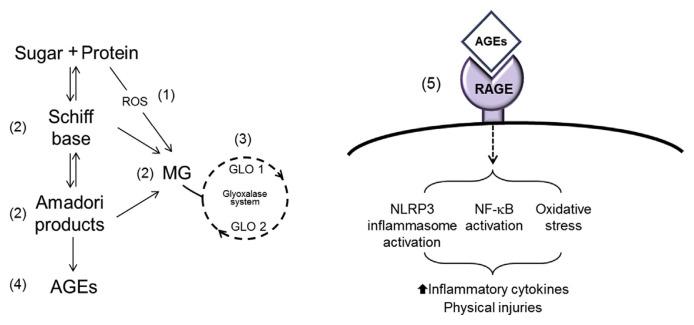
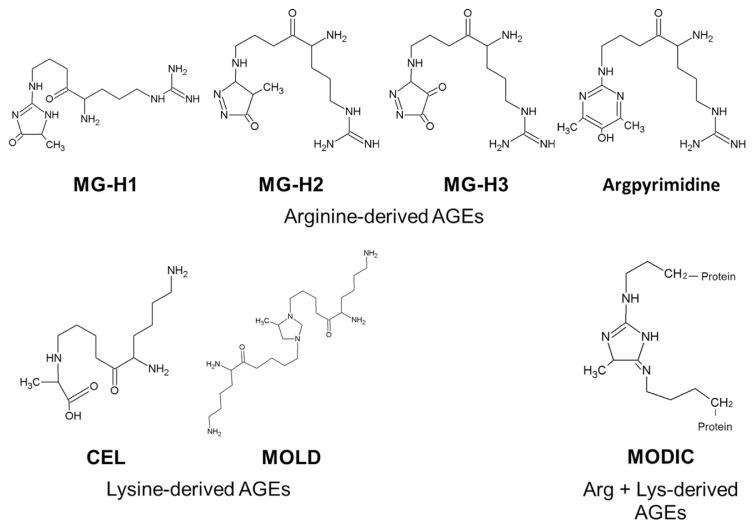
Advanced glycation end products (AGEs) are substances composed of amino groups of proteins and reducing sugars. The initial and propagation phases of the glycation process are accompanied by the production of a large amount of free radicals, carbonyl species, and reactive dicarbonyl species, of which, methylglyoxal (MG) is the most reactive and can cause dicarbonyl stress, influencing normal physiological functions. In the advanced phase, the production of AGEs and the interaction between AGEs and their receptor, RAGE, are also considered to be among the causes of chronic diseases, oxidative stress, and inflammatory reaction. Till date, multiple physiological activities of polyphenols have been confirmed. Recently, there have been many studies discussing the ability of polyphenols to suppress the MG and AGEs formation, which was also confirmed in some in vivo studies. This review article collects recent literatures concerning the effects of polyphenols on the generation of MG and AGEs through different pathways and discusses the feasibility of the inhibition of glycative stress and dicarbonyl stress by polyphenols.
糖基化终产物(AGEs)是由蛋白质的氨基基团和还原糖组成的物质。糖基化过程的初始和扩展阶段伴随着大量自由基、羰基化合物和反应性二羰基化合物的产生,其中,甲基乙二醛(MG)是最具反应性的,可以引起二羰基应激,影响正常的生理功能。在高级阶段,AGEs 的产生以及 AGEs 与其受体 RAGE 之间的相互作用也被认为是慢性疾病、氧化应激和炎症反应的原因之一。迄今为止,已经证实了多酚的多种生理活性。最近,有许多研究探讨了多酚抑制 MG 和 AGEs 形成的能力,一些体内研究也证实了这一点。本文综述了多酚通过不同途径影响 MG 和 AGEs 生成的最新文献,并讨论了多酚抑制糖基化应激和二羰基应激的可行性。


 Zotero 插件