
一种氨基酸-苯并环丁酮衍生物选择性抑制 PfA-M1 而非 PfA-M17,从而阻断疟原虫在体外和体内的发育。
Selective inhibition of PfA-M1, over PfA-M17, by an amino-benzosuberone derivative blocks malaria parasites development in vitro and in vivo.
机构信息
Molécules de Communication et Adaptation des Microorganismes, (MCAM, UMR7245), Muséum National Histoire Naturelle, Sorbonne Universités, CNRS, CP 52, 57 Rue Cuvier, 75005, Paris, France.
Laboratoire de Chimie Moléculaire, CNRS-UMR7509, Université de Strasbourg, 67037, Strasbourg Cedex 2, France.
出版信息
Malar J. 2017 Sep 21;16(1):382. doi: 10.1186/s12936-017-2032-4.
BACKGROUND
Plasmodium falciparum M1 family aminopeptidase is currently considered as a promising target for anti-malarial chemotherapy. Several series of inhibitors developed by various research groups display IC50/Ki values down to nM range on native PfA-M1 or recombinant forms and block the parasite development in culture at µM to sub-µM concentrations. A handful of these inhibitors has been tested on murine models of malaria and has shown anti plasmodial in vivo activity. However, most of these inhibitors do also target the other neutral malarial aminopeptidase, PfA-M17, often with lower Ki values, which questions the relative involvement and importance of each enzyme in the parasite biology.
RESULTS
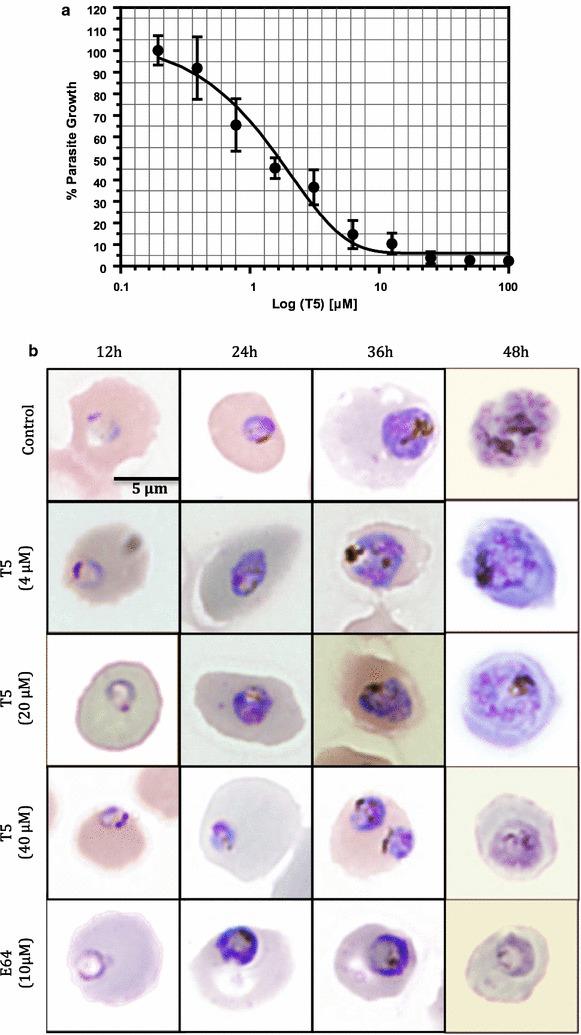
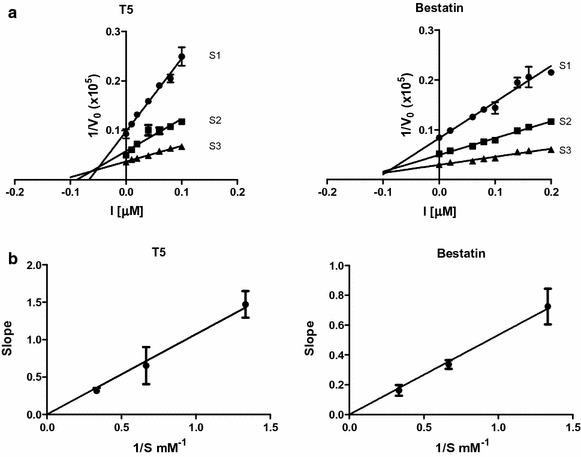
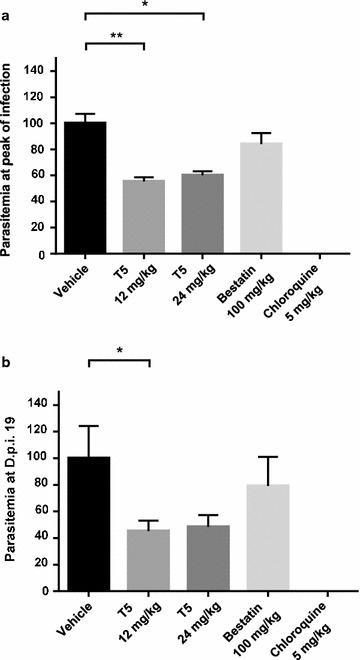
An amino-benzosuberone derivative from a previously published collection of chemicals targeting specifically the M1-aminopeptidases has been identified; it is highly potent on PfA-M1 (Ki = 50 nM) and devoid of inhibitory activity on PfA-M17 (no inhibition up to 100 µM). This amino-benzosuberone derivative (T5) inhibits, in the µM range, the in vitro growth of two P. falciparum strains, 3D7 and FcB1, respectively chloroquino-sensitive and resistant. Evaluated in vivo, on the murine non-lethal model of malaria Plasmodium chabaudi chabaudi, this amino-benzosuberone derivative was able to reduce the parasite burden by 44 and 40% in a typical 4-day Peters assay at a daily dose of 12 and 24 mg/kg by intraperitoneal route of administration.
CONCLUSIONS
The evaluation of a highly selective inhibitor of PfA-M1, over PfA-M17, active on Plasmodium parasites in vitro and in vivo, highlights the relevance of PfA-M1 in the biological development of the parasite as well as in the list of promising anti-malarial targets to be considered in combination with current or future anti-malarial drugs.
背景
恶性疟原虫 M1 家族氨肽酶目前被认为是抗疟药物化学治疗的一个有前途的靶点。 不同研究小组开发的几个系列抑制剂在天然 PfA-M1 或重组形式下显示出 IC50/Ki 值低至纳摩尔范围,并以微摩尔至亚微摩尔浓度在培养物中阻断寄生虫发育。 其中一些抑制剂已在疟疾的鼠模型中进行了测试,并显示出体内抗疟活性。 然而,这些抑制剂中的大多数也针对其他中性疟原虫氨肽酶 PfA-M17,其 Ki 值通常较低,这就质疑了每种酶在寄生虫生物学中的相对参与度和重要性。
结果
从专门针对 M1-氨肽酶的先前发表的化学物质库中鉴定出一种氨基苯并环丁酮衍生物;它对 PfA-M1 非常有效(Ki = 50 nM),对 PfA-M17 没有抑制活性(高达 100 μM 无抑制)。 这种氨基苯并环丁酮衍生物(T5)在µM 范围内抑制两种恶性疟原虫株 3D7 和 FcB1 的体外生长,分别为氯喹敏感和耐药。 在体内,用 Plasmodium chabaudi chabaudi 的非致死性鼠疟疾模型进行评估,这种氨基苯并环丁酮衍生物在每天腹腔给药 12 和 24 mg/kg 的典型 4 天 Peters 测定中,分别能使寄生虫负荷减少 44%和 40%。
结论
评估 PfA-M1 的高选择性抑制剂,对 PfA-M17 具有选择性,对体外和体内的疟原虫均有效,突出了 PfA-M1 在寄生虫生物学发育中的相关性,以及在与当前或未来抗疟药物联合考虑的有前途的抗疟靶点清单中的相关性。

 Zotero 插件