
不同全血捐献频率(INTERVAL)的效率和安全性:对 45000 名献血者的随机试验。
Efficiency and safety of varying the frequency of whole blood donation (INTERVAL): a randomised trial of 45 000 donors.
机构信息
NHS Blood and Transplant, Cambridge, UK; NHS Blood and Transplant, Oxford, UK; Department of Public Health and Primary Care, Strangeways Research Laboratory, Cambridge, UK; NIHR Blood and Transplant Research Unit in Donor Health and Genomics, Strangeways Research Laboratory, Cambridge, UK; NIHR Cambridge Biomedical Research Centre, Addenbrooke's Hospital, Cambridge, UK; British Heart Foundation Cambridge Centre for Research Excellence, Addenbrooke's Hospital, Cambridge, UK.
Department of Public Health and Primary Care, Strangeways Research Laboratory, Cambridge, UK; NIHR Blood and Transplant Research Unit in Donor Health and Genomics, Strangeways Research Laboratory, Cambridge, UK; NIHR Cambridge Biomedical Research Centre, Addenbrooke's Hospital, Cambridge, UK; British Heart Foundation Cambridge Centre for Research Excellence, Addenbrooke's Hospital, Cambridge, UK.
出版信息
Lancet. 2017 Nov 25;390(10110):2360-2371. doi: 10.1016/S0140-6736(17)31928-1. Epub 2017 Sep 21.
BACKGROUND
Limits on the frequency of whole blood donation exist primarily to safeguard donor health. However, there is substantial variation across blood services in the maximum frequency of donations allowed. We compared standard practice in the UK with shorter inter-donation intervals used in other countries.
METHODS
In this parallel group, pragmatic, randomised trial, we recruited whole blood donors aged 18 years or older from 25 centres across England, UK. By use of a computer-based algorithm, men were randomly assigned (1:1:1) to 12-week (standard) versus 10-week versus 8-week inter-donation intervals, and women were randomly assigned (1:1:1) to 16-week (standard) versus 14-week versus 12-week intervals. Participants were not masked to their allocated intervention group. The primary outcome was the number of donations over 2 years. Secondary outcomes related to safety were quality of life, symptoms potentially related to donation, physical activity, cognitive function, haemoglobin and ferritin concentrations, and deferrals because of low haemoglobin. This trial is registered with ISRCTN, number ISRCTN24760606, and is ongoing but no longer recruiting participants.
FINDINGS
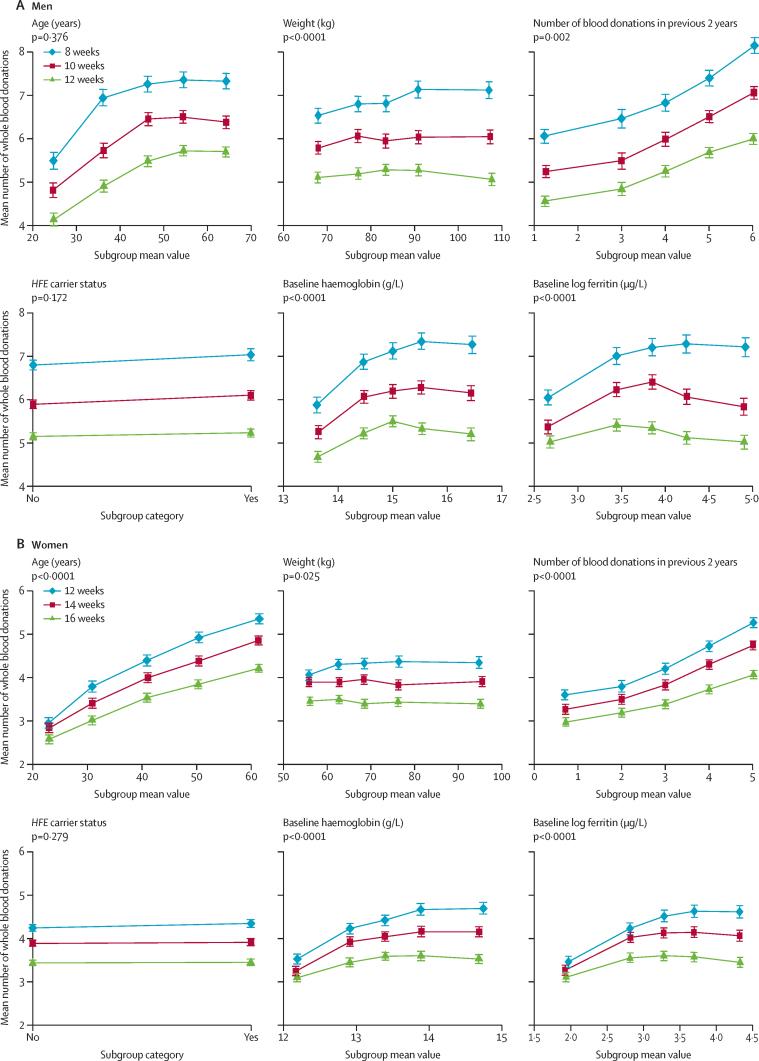
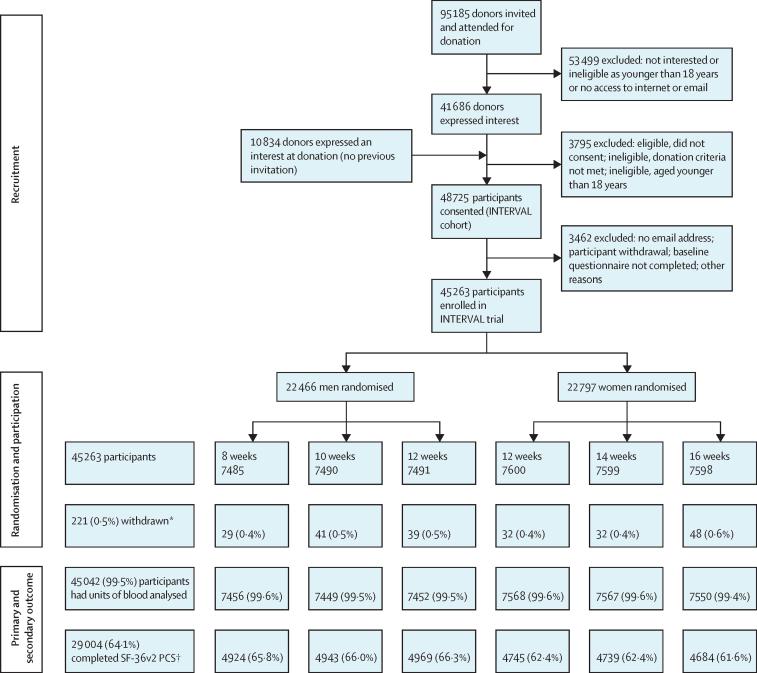
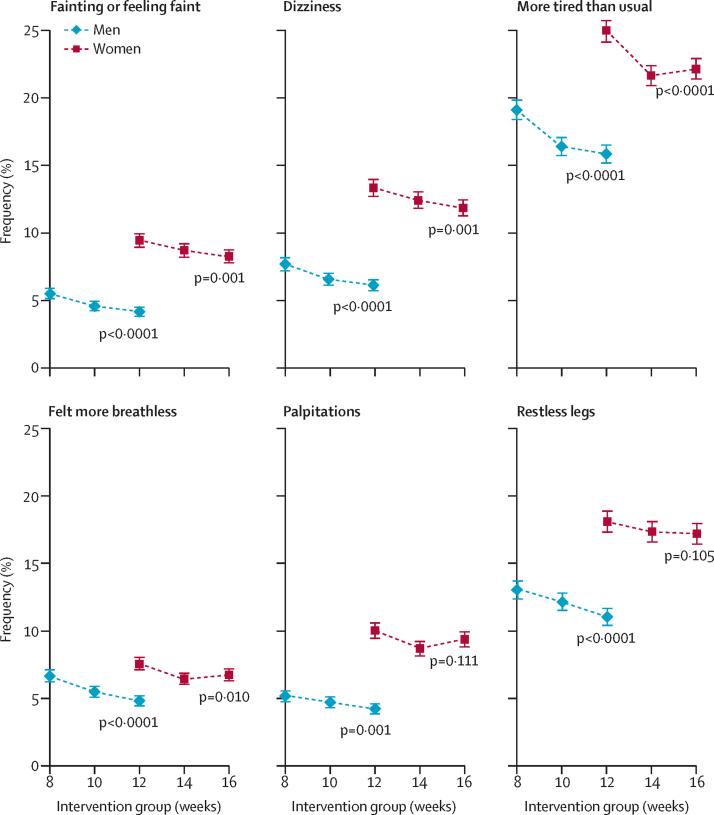
45 263 whole blood donors (22 466 men, 22 797 women) were recruited between June 11, 2012, and June 15, 2014. Data were analysed for 45 042 (99·5%) participants. Men were randomly assigned to the 12-week (n=7452) versus 10-week (n=7449) versus 8-week (n=7456) groups; and women to the 16-week (n=7550) versus 14-week (n=7567) versus 12-week (n=7568) groups. In men, compared with the 12-week group, the mean amount of blood collected per donor over 2 years increased by 1·69 units (95% CI 1·59-1·80; approximately 795 mL) in the 8-week group and by 0·79 units (0·69-0·88; approximately 370 mL) in the 10-week group (p<0·0001 for both). In women, compared with the 16-week group, it increased by 0·84 units (95% CI 0·76-0·91; approximately 395 mL) in the 12-week group and by 0·46 units (0·39-0·53; approximately 215 mL) in the 14-week group (p<0·0001 for both). No significant differences were observed in quality of life, physical activity, or cognitive function across randomised groups. However, more frequent donation resulted in more donation-related symptoms (eg, tiredness, breathlessness, feeling faint, dizziness, and restless legs, especially among men [for all listed symptoms]), lower mean haemoglobin and ferritin concentrations, and more deferrals for low haemoglobin (p<0·0001 for each) than those observed in the standard frequency groups.
INTERPRETATION
Over 2 years, more frequent donation than is standard practice in the UK collected substantially more blood without having a major effect on donors' quality of life, physical activity, or cognitive function, but resulted in more donation-related symptoms, deferrals, and iron deficiency.
FUNDING
NHS Blood and Transplant, National Institute for Health Research, UK Medical Research Council, and British Heart Foundation.
背景
全血捐献频率的限制主要是为了保障献血者的健康。然而,不同的血液服务机构在允许的最大捐献频率上存在很大差异。我们比较了英国的标准做法与其他国家使用的更短的捐献间隔。
方法
在这项平行组、实用型、随机试验中,我们从英国英格兰的 25 个中心招募了年龄在 18 岁及以上的全血捐献者。通过使用基于计算机的算法,男性被随机分配(1:1:1)至 12 周(标准)与 10 周与 8 周的捐献间隔,女性被随机分配(1:1:1)至 16 周(标准)与 14 周与 12 周的间隔。参与者对其分配的干预组没有进行掩饰。主要结局是在 2 年内的捐献次数。次要结局与安全性相关,包括生活质量、可能与捐献相关的症状、身体活动、认知功能、血红蛋白和铁蛋白浓度,以及因血红蛋白低而被推迟的情况。这项试验在 ISRCTN 注册,编号为 ISRCTN24760606,正在进行中,但不再招募参与者。
发现
在 2012 年 6 月 11 日至 2014 年 6 月 15 日期间,共招募了 45042 名(22466 名男性,22797 名女性)全血捐献者。对 45042 名(99.5%)参与者的数据进行了分析。男性被随机分配至 12 周(n=7452)与 10 周(n=7449)与 8 周(n=7456)组;女性至 16 周(n=7550)与 14 周(n=7567)与 12 周(n=7568)组。与 12 周组相比,男性中,在 2 年内每位捐献者采集的血量平均增加了 1.69 单位(95%CI 1.59-1.80;约 795 mL),在 8 周组中增加了 0.79 单位(0.69-0.88;约 370 mL),在 10 周组中增加了 0.79 单位(0.69-0.88;约 370 mL)(p<0.0001)。与 16 周组相比,女性中,在 12 周组中增加了 0.84 单位(95%CI 0.76-0.91;约 395 mL),在 14 周组中增加了 0.46 单位(0.39-0.53;约 215 mL)(p<0.0001)。在随机分组中,生活质量、身体活动或认知功能均无显著差异。然而,更频繁的捐献会导致更多与捐献相关的症状(例如疲劳、呼吸急促、头晕、眩晕和不安腿,尤其是男性[所有列出的症状])、更低的平均血红蛋白和铁蛋白浓度,以及更多因血红蛋白低而被推迟的情况(p<0.0001),比标准频率组更频繁的捐献更频繁。
解释
在 2 年内,与英国的标准做法相比,更频繁的捐献收集了大量的血液,而对献血者的生活质量、身体活动或认知功能没有重大影响,但导致了更多与捐献相关的症状、推迟和缺铁。
资助
英国国家医疗服务体系血液与移植中心、英国国家健康研究所、英国医学研究理事会和英国心脏基金会。

 Zotero 插件