
印度北部一家三级转诊儿科急诊科糖尿病酮症酸中毒住院病例的根本原因分析
Root Cause Analysis of Diabetic Ketoacidosis Admissions at a Tertiary Referral Pediatric Emergency Department in North India.
作者信息
Jayashree Muralidharan, Sasidharan Rohit, Singhi Sunit, Nallasamy Karthi, Baalaaji Mullai
机构信息
Department of Pediatrics, Advanced Pediatrics Centre, PGIMER, Chandigarh, Haryana, India.
Division of Pediatrics, Medanta - The Medicity, Gurgaon, Haryana, India.
出版信息
Indian J Endocrinol Metab. 2017 Sep-Oct;21(5):710-714. doi: 10.4103/ijem.IJEM_178_17.
OBJECTIVES
To identify system-based factors contributing to Emergency Department (ED) admissions of children with diabetic ketoacidosis (DKA) and related complications with emphasis on parental and physician awareness and prereferral management.
MATERIALS AND METHODS
A prospective observational root cause analysis study of all consecutive admissions of children with DKA to pediatric ED of a tertiary care referral hospital in northern India over a period of 1 year (July 2010-June 2011). Prehospital, health-care system, referral, follow-up, and continuum of care related details were obtained through direct interview of parents and physicians and/or field observations for all enrolled children.
RESULTS
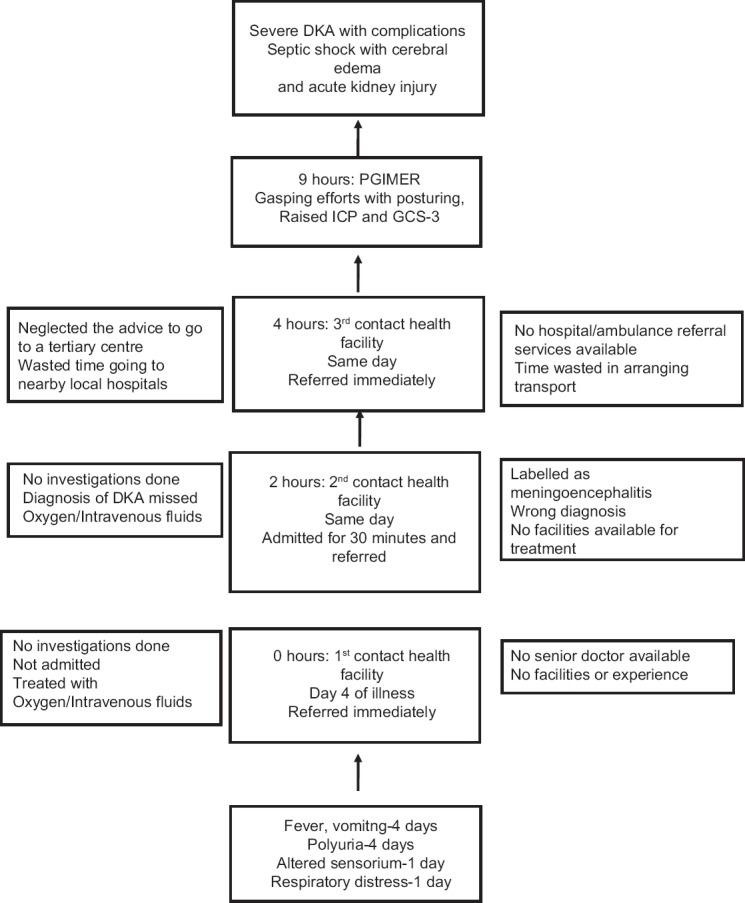
Of the 30 children enrolled, 26 (86.6%) were referrals; 16 (61.5%) from first, 7 (26.9%) from second, and 3 (11.5%) from third health-care facility. More than half ( [%], 18 [60%]) had new onset diabetes and belonged to lower socioeconomic strata. Twenty-two (73.3%) were complicated DKA; shock ( [%], 19 [63%]), hypokalemia ( [%], 11 [36%]), and CE ( [%], 3 [10%]) were the most common complications. Most parents were ignorant of diabetes, its symptoms or complicating DKA. Nearly, half of the cases remained undiagnosed ( = 11) at first contact health-care facility; more so for new onset as compared to known diabetes (9/18 vs. 2/8; = 0.022). The referring hospitals had limited facilities for rapid blood glucose estimation ( [%], 12 [40%]), blood gas analysis ( [%], 6 [20%]) and insulin infusion. On univariate analysis, patients with missed/delayed diagnosis more often had severe and complicated DKA.
CONCLUSION
Parental ignorance, lower socioeconomic status, lack of clinical experience, and limited primary health-care facilities were root causes for severe and complicated DKA.
目的
确定导致糖尿病酮症酸中毒(DKA)患儿及其相关并发症入住急诊科的基于系统的因素,重点关注家长和医生的认知以及转诊前管理。
材料与方法
对印度北部一家三级医疗转诊医院儿科急诊科在1年期间(2010年7月至2011年6月)连续收治的所有DKA患儿进行前瞻性观察性根本原因分析研究。通过直接访谈家长和医生和/或对所有登记患儿进行现场观察,获取院前、医疗保健系统、转诊、随访及连续护理相关细节。
结果
在登记的30名患儿中,26名(86.6%)为转诊患者;分别来自一级医疗机构16名(61.5%)、二级医疗机构7名(26.9%)和三级医疗机构3名(11.5%)。超过一半([X],18名[60%])为新发糖尿病,且属于社会经济地位较低阶层。22名(73.3%)为复杂性DKA;休克([X],19名[63%])、低钾血症([X],11名[36%])和脑水肿([X],3名[10%])是最常见的并发症。大多数家长对糖尿病及其症状或复杂性DKA一无所知。近一半病例(n = 11)在首次接触的医疗机构未被诊断;新发糖尿病患者比已知糖尿病患者更常见(9/18对比2/8;P = 0.022)。转诊医院快速血糖检测([X],12名[40%])、血气分析([X],6名[20%])和胰岛素输注设施有限。单因素分析显示,漏诊/延误诊断的患者更常患有严重和复杂性DKA。
结论
家长无知、社会经济地位较低、缺乏临床经验以及基层医疗保健设施有限是严重和复杂性DKA的根本原因。
 Zotero 插件