
呼吸复合物 I 中醌还原的末端电子-质子转移动力学。
Terminal Electron-Proton Transfer Dynamics in the Quinone Reduction of Respiratory Complex I.
机构信息
Department Chemie, Technische Universität München (TUM) , Lichtenbergstraße 4, Garching D-85747, Germany.
Department of Chemistry, University of Helsinki , P.O. Box 55, Helsinki FI-00014, Finland.
出版信息
J Am Chem Soc. 2017 Nov 15;139(45):16282-16288. doi: 10.1021/jacs.7b08486. Epub 2017 Nov 1.
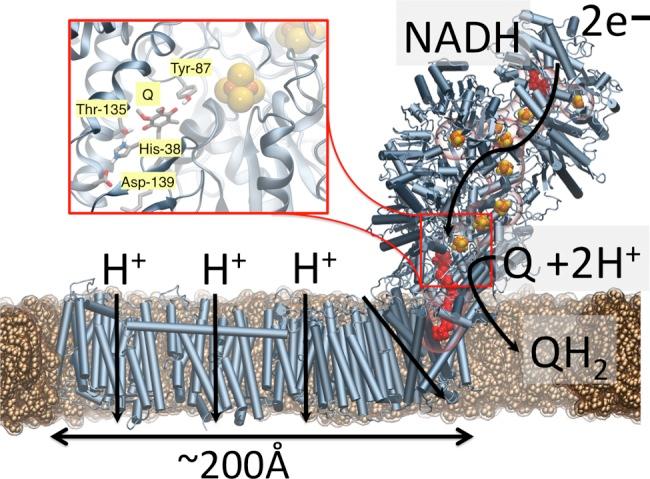
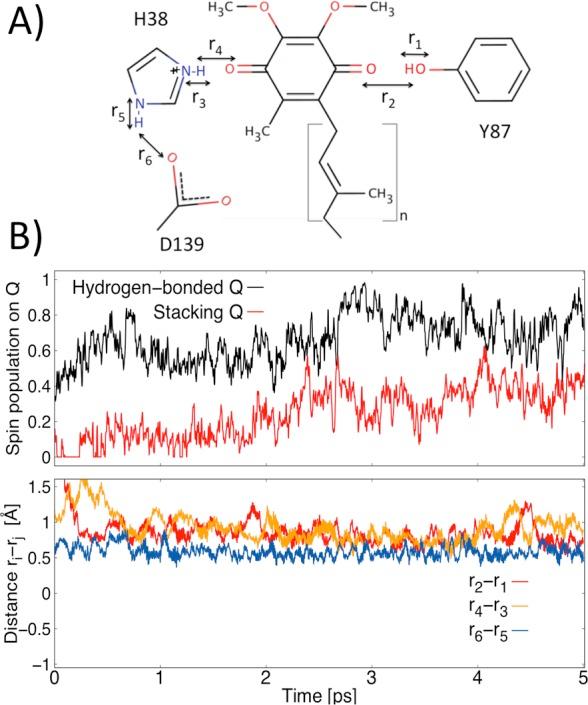
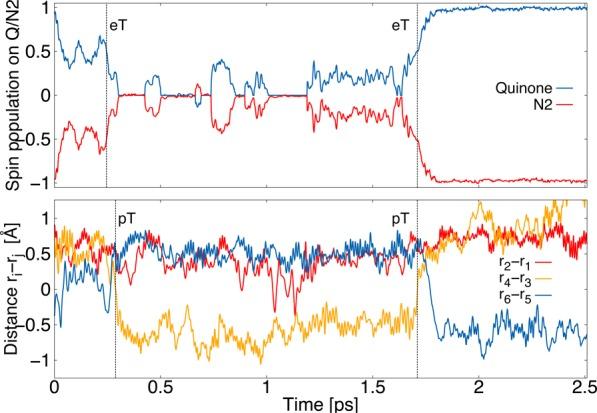
Complex I functions as a redox-driven proton pump in aerobic respiratory chains. By reducing quinone (Q), complex I employs the free energy released in the process to thermodynamically drive proton pumping across its membrane domain. The initial Q reduction step plays a central role in activating the proton pumping machinery. In order to probe the energetics, dynamics, and molecular mechanism for the proton-coupled electron transfer process linked to the Q reduction, we employ here multiscale quantum and classical molecular simulations. We identify that both ubiquinone (UQ) and menaquinone (MQ) can form stacking and hydrogen-bonded interactions with the conserved Q-binding-site residue His-38 and that conformational changes between these binding modes modulate the Q redox potentials and the rate of electron transfer (eT) from the terminal N2 iron-sulfur center. We further observe that, while the transient formation of semiquinone is not proton-coupled, the second eT process couples to a semiconcerted proton uptake from conserved tyrosine (Tyr-87) and histidine (His-38) residues within the active site. Our calculations indicate that both UQ and MQ have low redox potentials around -260 and -230 mV, respectively, in the Q-binding site, respectively, suggesting that release of the Q toward the membrane is coupled to an energy transduction step that could thermodynamically drive proton pumping in complex I.
复合体 I 在需氧呼吸链中充当氧化还原驱动的质子泵。通过还原醌(Q),复合体 I 利用在这个过程中释放的自由能,在其膜域中进行热力学驱动质子泵浦。最初的 Q 还原步骤在激活质子泵浦机械方面起着核心作用。为了探测与 Q 还原相关的质子偶联电子转移过程的能量学、动力学和分子机制,我们在这里采用了多尺度量子和经典分子模拟。我们确定,泛醌(UQ)和甲萘醌(MQ)都可以与保守的 Q 结合位点残基 His-38 形成堆积和氢键相互作用,并且这些结合模式之间的构象变化调节 Q 的氧化还原电位和来自末端 N2 铁硫中心的电子转移(eT)速率。我们进一步观察到,虽然半醌的瞬时形成不与质子偶联,但第二个 eT 过程与在活性位点内保守的酪氨酸(Tyr-87)和组氨酸(His-38)残基的协同质子摄取偶联。我们的计算表明,UQ 和 MQ 在 Q 结合位点的氧化还原电位分别约为-260 和-230 mV,这表明 Q 向膜的释放与能量传递步骤相关联,该步骤可以在复合体 I 中进行热力学驱动质子泵浦。


 Zotero 插件