
组蛋白去乙酰化酶6(HDAC6)抑制剂tubastatin A对光感受器细胞系的氧化应激具有保护作用,并能恢复遗传性失明斑马鱼模型的视觉功能。
HDAC6 inhibition by tubastatin A is protective against oxidative stress in a photoreceptor cell line and restores visual function in a zebrafish model of inherited blindness.
作者信息
Leyk Janina, Daly Conor, Janssen-Bienhold Ulrike, Kennedy Breandán N, Richter-Landsberg Christiane
机构信息
Department of Neuroscience, Molecular Neurobiology, University of Oldenburg, Oldenburg D-26111, Germany.
School of Biomolecular and Biomedical Science, Conway Institute, University College Dublin, Belfield, Dublin D04 V1W8, Ireland.
出版信息
Cell Death Dis. 2017 Aug 31;8(8):e3028. doi: 10.1038/cddis.2017.415.
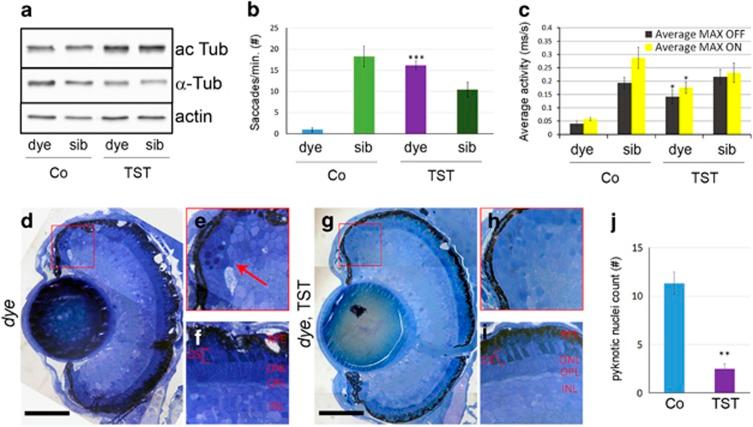
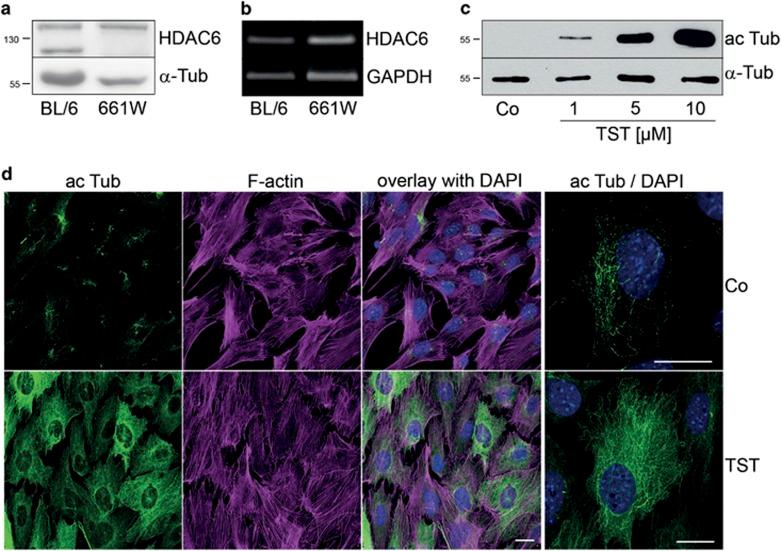
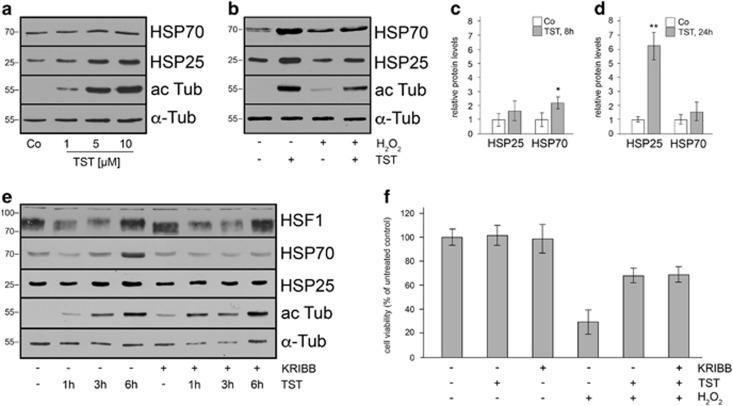
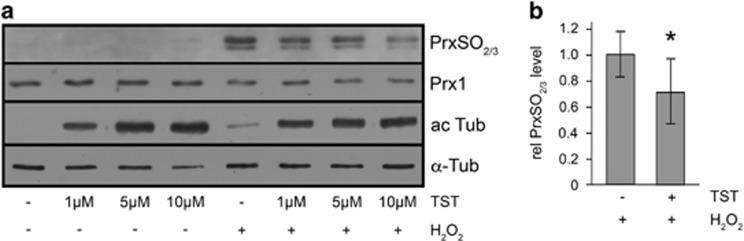
Retinal diseases, such as hereditary retinitis pigmentosa and age-related macular degeneration, are characterized by the progressive loss of photoreceptors. Histone deacetylase 6 (HDAC6) is considered as a stress surveillance factor and a potential target for neuroprotection and regeneration. Overexpression of HDAC6 has been connected to neurodegenerative disorders, and its suppression may provide protection. Here we show that HDAC6 is constitutively present in the mouse retina, and in the cone-like mouse cell line 661W. In 661W cells HDAC6 inhibition by the specific inhibitor tubastatin A (TST) led to the acetylation of α-tubulin, which is a major substrate for HDAC6. After oxidative stress, exerted by hydrogen peroxide, TST promoted cell survival and the upregulation of heat-shock proteins HSP70 and HSP25 by activation of heat-shock transcription factor 1. Furthermore, in response to oxidative stress the redox regulatory protein peroxiredoxin 1 (Prx1) was modulated in 661W cells by HDAC6 inhibition. The peroxide reducing activity of Prx1 is dependent on its acetylation, which is mediated by HDAC6. Pre-incubation with TST prevented the inactivation of Prx1 and its preserved activity may exert protective effects in photoreceptor cells. To determine whether TST treatment has a therapeutic effect on visual function, the dye zebrafish model of inherited sight loss was utilized. Zebrafish have developed as a suitable model system for pharmacological testing. In vivo application of TST caused the hyperacetylation of α-tubulin, indicating that HDAC6 is active in this model. Furthermore, TST was sufficient to rescue visual function and retinal morphology. Hence, HDAC6 inhibition and the regulation of peroxiredoxin activity may play a significant role in protecting retinal cells and in particular photoreceptors, which are exposed to high levels of reactive oxygen species derived from oxidative stress-induced injuries.
视网膜疾病,如遗传性视网膜色素变性和年龄相关性黄斑变性,其特征是光感受器逐渐丧失。组蛋白去乙酰化酶6(HDAC6)被认为是一种应激监测因子以及神经保护和再生的潜在靶点。HDAC6的过表达与神经退行性疾病有关,抑制它可能提供保护作用。在这里我们表明,HDAC6在小鼠视网膜以及类视锥小鼠细胞系661W中持续存在。在661W细胞中,特异性抑制剂tubastatin A(TST)抑制HDAC6导致α-微管蛋白乙酰化,α-微管蛋白是HDAC6的主要底物。在用过氧化氢施加氧化应激后,TST通过激活热休克转录因子1促进细胞存活以及热休克蛋白HSP70和HSP25的上调。此外,在氧化应激反应中,HDAC6抑制调节了661W细胞中的氧化还原调节蛋白过氧化物酶1(Prx1)。Prx1的过氧化物还原活性取决于其乙酰化,而这是由HDAC6介导的。用TST预孵育可防止Prx1失活,其保留的活性可能在光感受器细胞中发挥保护作用。为了确定TST治疗是否对视功能有治疗作用,使用了遗传性视力丧失的染料斑马鱼模型。斑马鱼已发展成为一种适合进行药理学测试的模型系统。TST的体内应用导致α-微管蛋白高度乙酰化,表明HDAC6在该模型中具有活性。此外,TST足以挽救视功能和视网膜形态。因此,HDAC6抑制和过氧化物酶活性调节可能在保护视网膜细胞尤其是光感受器方面发挥重要作用,这些光感受器暴露于氧化应激诱导损伤产生的高水平活性氧中。

 Zotero 插件