
characterizing 内生菌的内生能力和植物促生特性的研究 细菌内生菌栖息在水稻种子的内生环境中。
Characterizing endophytic competence and plant growth promotion of bacterial endophytes inhabiting the seed endosphere of Rice.
机构信息
Department of Environmental and Biological Chemistry, College of Agriculture, Life and Environmental Sciences, Chungbuk National University, Cheongju, Chungbuk, 28644, Republic of Korea.
Temasek Life Sciences Laboratory, Biomaterials and Biocatalyst, National University of Singapore, Singapore, Singapore.
出版信息
BMC Microbiol. 2017 Oct 26;17(1):209. doi: 10.1186/s12866-017-1117-0.
BACKGROUND
Rice (Oryza sativa L. ssp. indica) seeds as plant microbiome present both an opportunity and a challenge to colonizing bacterial community living in close association with plants. Nevertheless, the roles and activities of bacterial endophytes remain largely unexplored and insights into plant-microbe interaction are compounded by its complexity. In this study, putative functions or physiological properties associated with bacterial endophytic nature were assessed. Also, endophytic roles in plant growth and germination that may allow them to be selectively chosen by plants were also studied.
RESULTS
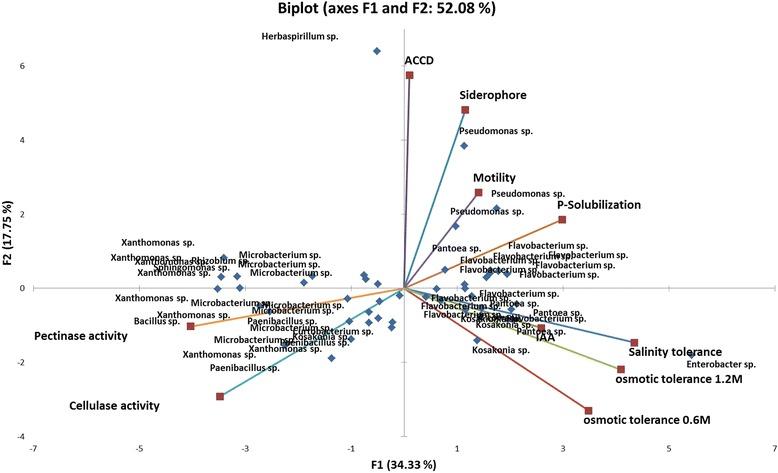
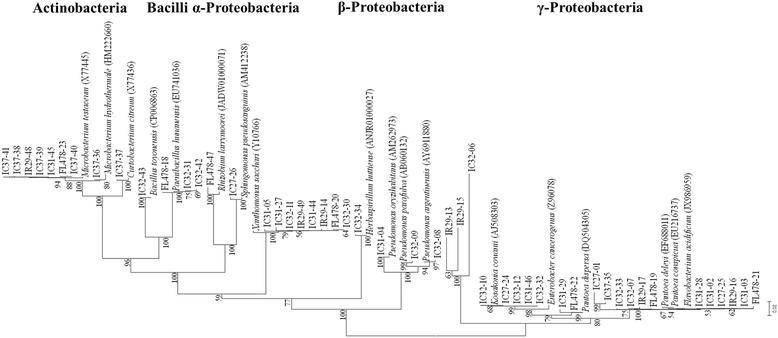
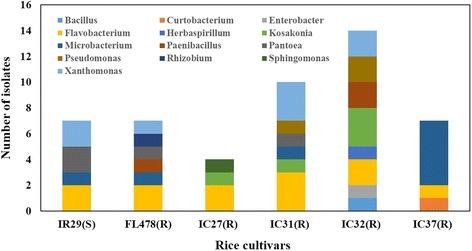
The cultivable seed endophytes were dominated by Proteobacteria particularly class Gammaproteobacteria. Highly identical type strains were isolated from the seed endosphere regardless of the rice host's physiological tolerance to salinity. Among the type strains, Flavobacterium sp., Microbacterium sp. and Xanthomonas sp. were isolated from the salt-sensitive and salt-tolerant cultivars. PCA-Biplot ordination also showed that specific type strains isolated from different rice cultivars have distinguishing similar characteristics. Flavobacterium sp. strains are phosphate solubilizers and indole-3-acetic acid producers with high tolerance to salinity and osmotic stress. Pseudomonas strains are characterized as high siderophore producers while Microbacterium sp. and Xanthomonas sp. strains have very high pectinase and cellulase activity. Among the physiological traits of the seed endophytes, bacterial pectinase and cellulase activity are positively correlated as well as salt and osmotic tolerance. Overall characterization shows that majority of the isolates could survive in 4-8% salt concentration as well as in 0.6 M and 1.2 M sucrose solution. The activities of catalase, pectinase and cellulase were also observed in almost all of the isolates indicating the importance of these characteristics for survival and colonization into the seed endosphere. Seed bacterial endophytes also showed promising plant growth promoting activities including hormone modulation, nitrogen fixation, siderophore production and phosphate solubilization.
CONCLUSION
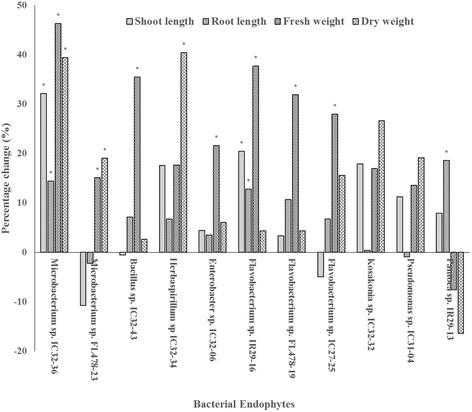
Though many of the isolates possess similar PGP and endophytic physiological traits, this study shows some prominent and distinguishing traits among bacterial groups indicating key determinants for their success as endophytes in the rice seed endosphere. Rice seeds are also inhabited by bacterial endophytes that promote growth during early seedling development.
背景
水稻(Oryza sativa L. ssp. indica)种子作为植物微生物组,为与植物密切相关的细菌群落的定殖提供了机会和挑战。然而,细菌内生菌的作用和活动在很大程度上仍未得到探索,而植物-微生物相互作用的复杂性则使这一问题更加复杂。在本研究中,评估了与细菌内生性质相关的潜在功能或生理特性。同时,还研究了内生菌在植物生长和萌发中的作用,这些作用可能使它们被植物选择性选择。
结果
可培养的种子内生菌主要由变形菌门,特别是γ-变形菌纲所主导。无论水稻宿主对盐度的生理耐受性如何,都能从种子内球中分离出高度相同的模式菌株。在模式菌株中,从盐敏感和耐盐品种中分离出了黄单胞菌属、微杆菌属和黄杆菌属。主成分分析 - 双标图排序也表明,从不同水稻品种中分离出的特定模式菌株具有相似的特征。黄杆菌属菌株是溶磷菌和吲哚-3-乙酸(IAA)的产生菌,对盐度和渗透压有很高的耐受性。假单胞菌属菌株的特征是高铁载体产生菌,而微杆菌属和黄单胞菌属菌株的果胶酶和纤维素酶活性非常高。在种子内生菌的生理特性中,细菌果胶酶和纤维素酶活性呈正相关,同时对盐度和渗透压有耐受性。总体特征表明,大多数分离株可以在 4-8%的盐浓度以及 0.6 M 和 1.2 M 蔗糖溶液中存活。几乎所有的分离株都观察到过氧化氢酶、果胶酶和纤维素酶的活性,这表明这些特性对其在种子内球中的生存和定殖非常重要。种子细菌内生菌还表现出有希望的植物生长促进活性,包括激素调节、固氮、铁载体生产和溶磷。
结论
尽管许多分离株具有相似的促生和内生生理特性,但本研究表明,细菌群体之间存在一些突出和不同的特性,这表明它们作为水稻种子内生菌成功的关键决定因素。水稻种子中还栖息着促进幼苗早期生长的细菌内生菌。
 Zotero 插件