
ABLE:一种用于双光子钙成像数据的基于活动的水平集分割算法。
ABLE: An Activity-Based Level Set Segmentation Algorithm for Two-Photon Calcium Imaging Data.
机构信息
Department of Electrical and Electronic Engineering, Imperial College London, South Kensington Campus, London SW7 2AZ, United Kingdom.
Centre for Neurotechnology, Imperial College London, South Kensington Campus, London SW7 2AZ, United Kingdom.
出版信息
eNeuro. 2017 Oct 30;4(5). doi: 10.1523/ENEURO.0012-17.2017. eCollection 2017 Sep-Oct.
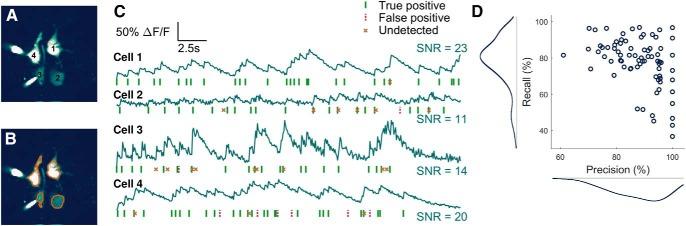
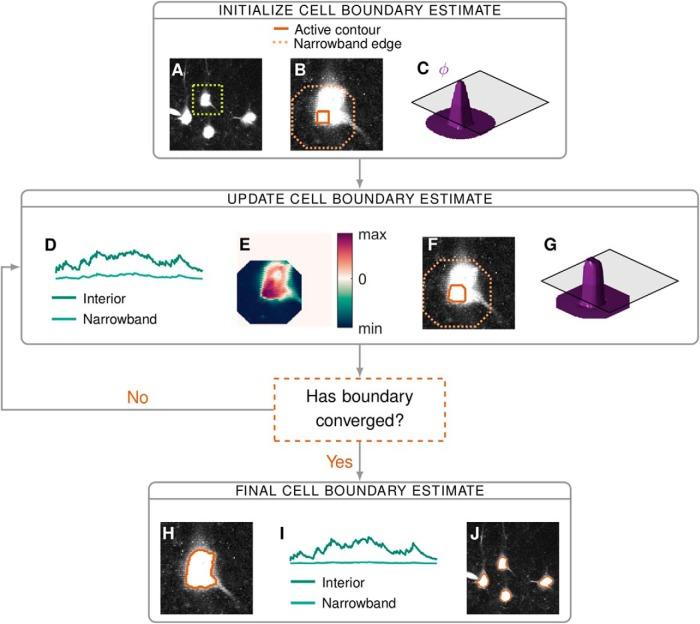
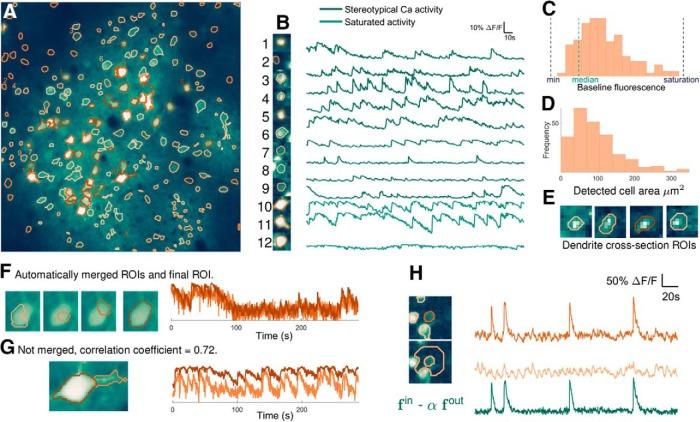
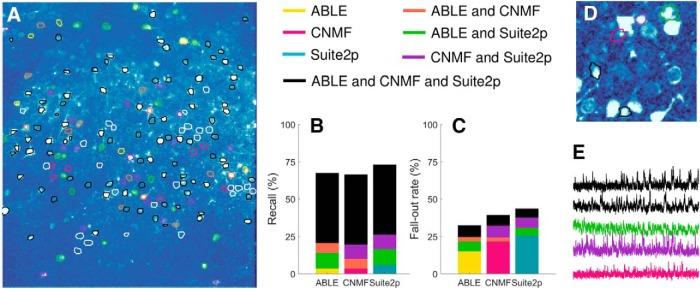
We present an algorithm for detecting the location of cells from two-photon calcium imaging data. In our framework, multiple coupled active contours evolve, guided by a model-based cost function, to identify cell boundaries. An active contour seeks to partition a local region into two subregions, a cell interior and exterior, in which all pixels have maximally "similar" time courses. This simple, local model allows contours to be evolved predominantly independently. When contours are sufficiently close, their evolution is coupled, in a manner that permits overlap. We illustrate the ability of the proposed method to demix overlapping cells on real data. The proposed framework is flexible, incorporating no prior information regarding a cell's morphology or stereotypical temporal activity, which enables the detection of cells with diverse properties. We demonstrate algorithm performance on a challenging mouse dataset, containing synchronously spiking cells, and a manually labelled mouse dataset, on which ABLE (the proposed method) achieves a 67.5% success rate.
我们提出了一种从双光子钙成像数据中检测细胞位置的算法。在我们的框架中,多个耦合的主动轮廓通过基于模型的代价函数进行演化,以识别细胞边界。主动轮廓试图将一个局部区域划分为两个子区域,一个是细胞内部,一个是细胞外部,其中所有像素的时间序列都具有最大的“相似性”。这种简单的局部模型允许轮廓主要独立地演化。当轮廓足够接近时,它们的演化是耦合的,这种耦合方式允许重叠。我们通过真实数据说明了所提出的方法在分离重叠细胞方面的能力。所提出的框架是灵活的,不包含关于细胞形态或典型时间活动的先验信息,这使得能够检测具有不同特性的细胞。我们在一个具有挑战性的小鼠数据集上展示了算法的性能,该数据集包含同步发射的细胞,以及一个手动标记的小鼠数据集,在该数据集上,ABLE(所提出的方法)的成功率为 67.5%。


 Zotero 插件