
美国心力衰竭男女性患者住院轨迹的种族和民族差异。
Racial and Ethnic Differences in Trajectories of Hospitalization in US Men and Women With Heart Failure.
机构信息
Duke Clinical Research Institute, Duke University, Durham, NC
Department of Population Health Sciences, Duke University, Durham, NC.
出版信息
J Am Heart Assoc. 2017 Nov 16;6(11):e006290. doi: 10.1161/JAHA.117.006290.
BACKGROUND
Prior studies have documented racial and ethnic disparities in hospitalization among patients with heart failure (HF). However, racial/ethnic differences in trajectories of hospitalization following the diagnosis of HF have not been well characterized. This study examined racial/ethnic differences in individual-level trajectories of hospitalization in older adults with diagnosed HF.
METHODS AND RESULTS
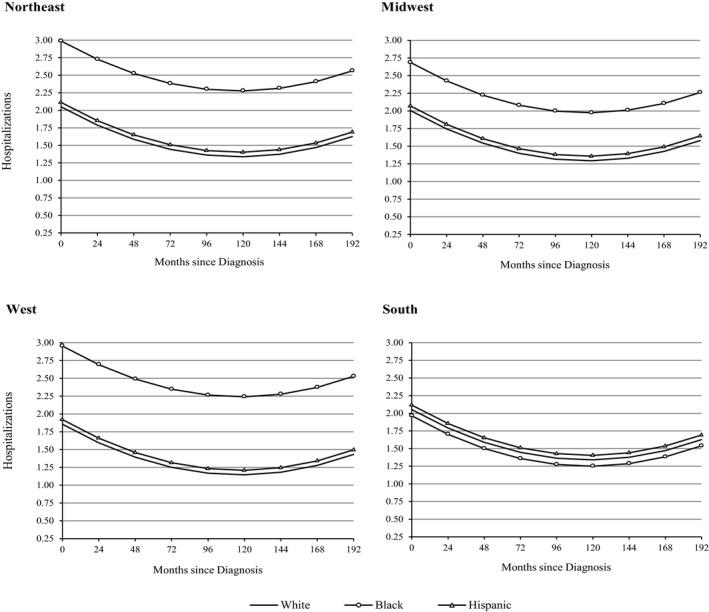
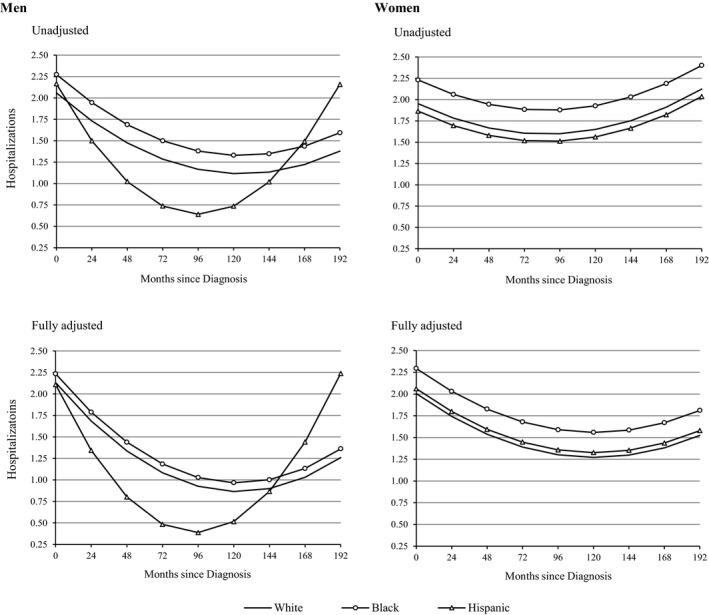
Data from a nationally representative prospective cohort of US men and women aged 45 years and older were used to examine the number of hospitalizations reported every 24 months. Participants who were non-Hispanic white, non-Hispanic black, and Hispanic with a reported diagnosis of HF (n=3011) were followed from 1998 to 2014. Results showed a quadratic change in the number of reported hospitalizations following HF diagnosis, with an average of 2.36 (95% confidence interval [CI], 2.19-2.53; <0.001) hospitalizations within 24 months that decreased by 0.35 (95% CI, -0.45 to -0.25; <0.001) every 24 months and subsequently increased by 0.03 (95% CI, 0.02-0.05; <0.001) thereafter. In men, there were no racial/ethnic differences in hospitalizations reported at the time of diagnosis; however, Hispanic men had significant declines in hospitalizations after diagnosis (Hispanic×time=-0.52; 95% CI, -0.99 to -0.05 [=0.031]) followed by a sizeable increase in hospitalizations at later stages of disease (Hispanic×time=0.06; 95% CI, 0.00-0.12 [=0.047]). In women, hospitalizations were consistently high following their diagnosis and black women had significantly more hospitalizations throughout follow-up than white women (black=0.28; 95% CI, 0.00-0.55 [=0.048]). Racial/ethnic disparities varied by geography and the differences remained significant after adjusting for multiple sociodemographic, psychosocial, behavioral, and physiological factors.
CONCLUSIONS
There were significant racial/ethnic differences in trajectories of hospitalization following the diagnosis of HF in US men and women. Racial/ethnic disparities varied by place of residence and the differences persisted after adjustment for multiple risk factors. The findings have important implications that may be crucial to planning the immediate and long-term delivery of care in patients with HF to reduce potentially preventable hospitalizations.
背景
先前的研究记录了心力衰竭(HF)患者住院治疗中的种族和民族差异。然而,HF 诊断后住院治疗轨迹的种族/民族差异尚未得到充分描述。本研究探讨了老年 HF 确诊患者个体水平住院治疗轨迹的种族/民族差异。
方法和结果
本研究使用了来自美国年龄在 45 岁及以上的男性和女性的全国代表性前瞻性队列数据,以检查每 24 个月报告的住院次数。将报告有 HF 诊断的非西班牙裔白人、非西班牙裔黑人和西班牙裔参与者(n=3011)纳入研究,并随访至 1998 年至 2014 年。结果显示,HF 诊断后报告的住院次数呈二次变化,24 个月内平均有 2.36 次(95%置信区间[CI],2.19-2.53;<0.001)住院治疗,此后每 24 个月减少 0.35 次(95%CI,-0.45 至-0.25;<0.001),随后增加 0.03 次(95%CI,0.02-0.05;<0.001)。在男性中,诊断时的种族/民族差异并不明显;然而,西班牙裔男性在诊断后住院治疗的次数显著减少(西班牙裔×时间=-0.52;95%CI,-0.99 至-0.05[=0.031]),随后在疾病后期住院治疗的次数显著增加(西班牙裔×时间=0.06;95%CI,0.00-0.12[=0.047])。在女性中,诊断后住院治疗的次数一直很高,黑人女性在整个随访期间的住院治疗次数明显多于白人女性(黑人=0.28;95%CI,0.00-0.55[=0.048])。种族/民族差异因地理位置而异,调整了多个社会人口统计学、心理社会、行为和生理因素后,这些差异仍然显著。
结论
在美国男性和女性中,HF 诊断后的住院治疗轨迹存在显著的种族/民族差异。种族/民族差异因居住地而异,调整多个危险因素后,差异仍然存在。这些发现具有重要意义,可能对规划 HF 患者的即时和长期护理提供至关重要的指导,以减少潜在可预防的住院治疗。

 Zotero 插件