
印度的产后抑郁症:系统评价和荟萃分析。
Postpartum depression in India: a systematic review and meta-analysis.
机构信息
Department of Community Medicine, Room 517, 5th floor, College Building, Department of Community Medicine, Vardhman Mahavir Medical College and Safdarjung Hospital, New Delhi 110029, India.
Independent Researcher, New Delhi, India.
出版信息
Bull World Health Organ. 2017 Oct 1;95(10):706-717C. doi: 10.2471/BLT.17.192237. Epub 2017 Sep 5.
OBJECTIVE
To provide an estimate of the burden of postpartum depression in Indian mothers and investigate some risk factors for the condition.
METHODS
We searched PubMed®, Google Scholar and Embase® databases for articles published from year 2000 up to 31 March 2016 on the prevalence of postpartum depression in Indian mothers. The search used subject headings and keywords with no language restrictions. Quality was assessed via the Newcastle-Ottawa quality assessment scale. We performed the meta-analysis using a random effects model. Subgroup analysis and meta-regression was done for heterogeneity and the Egger test was used to assess publication bias.
FINDINGS
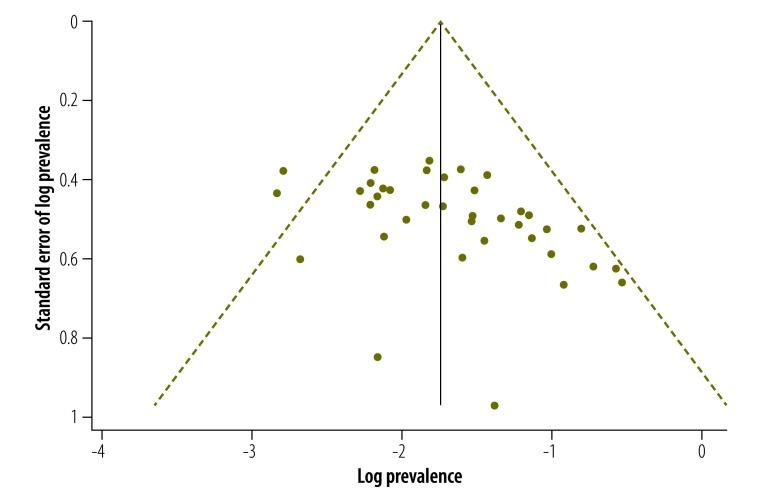
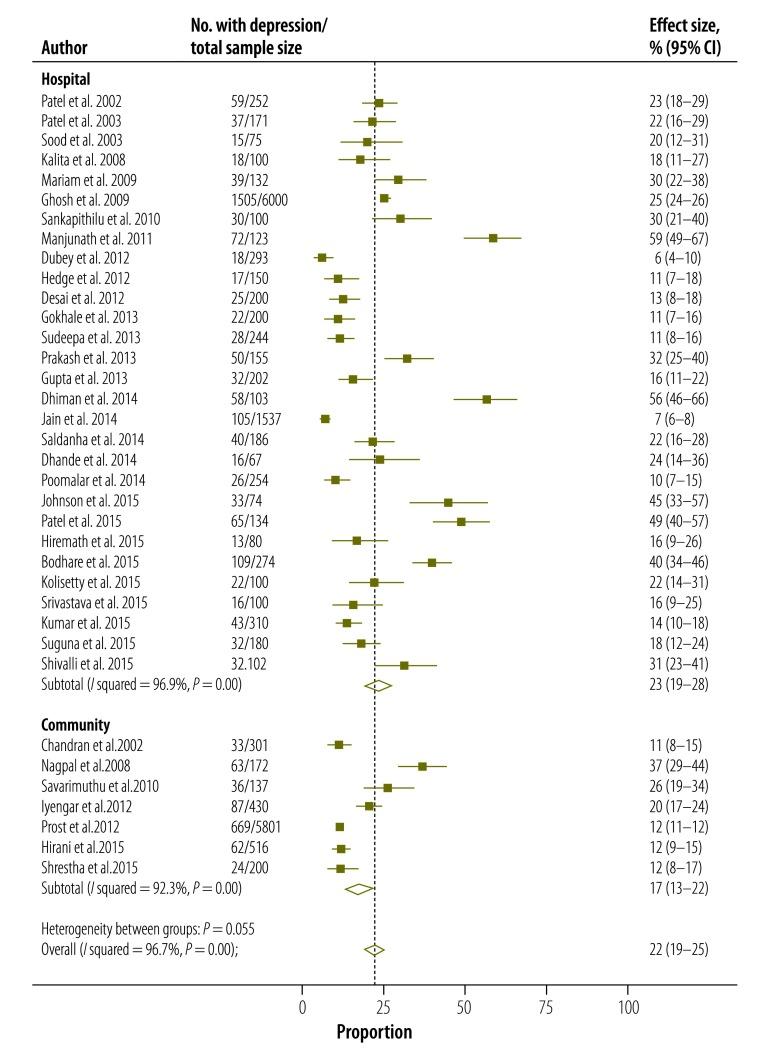
Thirty-eight studies involving 20 043 women were analysed. Studies had a high degree of heterogeneity ( = 96.8%) and there was evidence of publication bias (Egger bias = 2.58; 95% confidence interval, CI: 0.83-4.33). The overall pooled estimate of the prevalence of postpartum depression was 22% (95% CI: 19-25). The pooled prevalence was 19% (95% CI: 17-22) when excluding 8 studies reporting postpartum depression within 2 weeks of delivery. Small, but non-significant differences in pooled prevalence were found by mother's age, geographical location and study setting. Reported risk factors for postpartum depression included financial difficulties, presence of domestic violence, past history of psychiatric illness in mother, marital conflict, lack of support from husband and birth of a female baby.
CONCLUSION
The review shows a high prevalence of postpartum depression in Indian mothers. More resources need to be allocated for capacity-building in maternal mental health care in India.
目的
评估印度母亲产后抑郁症的负担,并调查该病症的一些风险因素。
方法
我们在 PubMed®、Google Scholar 和 Embase®数据库中检索了 2000 年至 2016 年 3 月 31 日期间发表的关于印度母亲产后抑郁症患病率的文章。搜索使用了主题词和关键词,无语言限制。使用纽卡斯尔-渥太华质量评估量表对质量进行评估。我们使用随机效应模型进行荟萃分析。对异质性进行亚组分析和荟萃回归,并用 Egger 检验评估发表偏倚。
发现
分析了 38 项涉及 20043 名女性的研究。这些研究具有高度的异质性(I²=96.8%),且存在发表偏倚的证据(Egger 偏倚=2.58;95%置信区间,CI:0.83-4.33)。产后抑郁症的总体患病率为 22%(95%CI:19-25)。当排除 8 项报告产后 2 周内患有产后抑郁症的研究后,汇总的患病率为 19%(95%CI:17-22)。按母亲年龄、地理位置和研究环境的不同,汇总的患病率略有差异,但无统计学意义。产后抑郁症的报告风险因素包括经济困难、存在家庭暴力、母亲有精神病史、婚姻冲突、缺乏丈夫支持和生女孩。
结论
综述显示印度母亲产后抑郁症的患病率较高。印度需要投入更多资源来加强孕产妇心理健康护理方面的能力建设。



 Zotero 插件