
在中国儿童分离出的耐甲氧西林金黄色葡萄球菌(MRSA)中,主要鉴定出具有强生物膜形成能力的多重耐药ST59-SCCmec IV-t437克隆。
Multiresistant ST59-SCCmec IV-t437 clone with strong biofilm-forming capacity was identified predominantly in MRSA isolated from Chinese children.
作者信息
Yang Xin, Qian Suyun, Yao Kaihu, Wang Lijuan, Liu Yingchao, Dong Fang, Song Wenqi, Zhen Jinghui, Zhou Wei, Xu Hong, Zheng Hongyan, Li Wenting
机构信息
Pediatric Intensive Care Unit, Beijing Children's Hospital, Capital Medical University, National Center for Children's Health, No.56 Nan-Li-Shi Road, Beijing, 100045, China.
MOE Key Laboratory of Major Diseases in Children, National Key Discipline of Pediatrics (Capital Medical University), National Clinical Research Center for Respiratory Diseases, Beijing Key Laboratory of Pediatric Respiratory Infection Diseases, Beijing Pediatric Research Institute, Beijing Children's Hospital, Capital Medical University, National Center for Children's Health, Beijing, 100045, China.
出版信息
BMC Infect Dis. 2017 Nov 25;17(1):733. doi: 10.1186/s12879-017-2833-7.
BACKGROUND
This study aimed to investigate the clinical and molecular epidemiology and biofilm formation of Staphylococcus aureus (SA) isolated from pediatricians in China.
METHODS
SA strains were isolated from Beijing Children's hospital from February 2016 to January 2017. Isolates were typed by multilocus sequence typing (MLST), spa and SCCmec typing (for Methicillin-resistant SA [MRSA] only). Antimicrobial susceptibility testing was performed by agar dilution method except sulphamethoxazole/trimethoprim (E-test method). Biofilm formation and biofilm associated genes were detected.
RESULTS
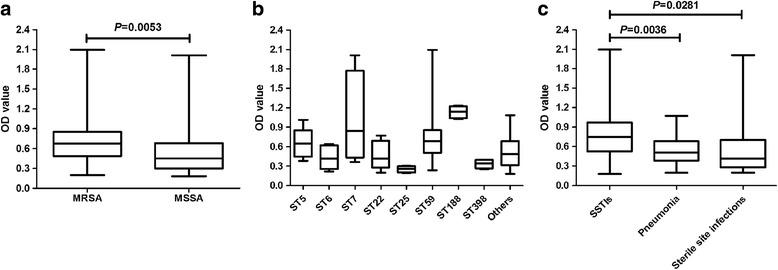
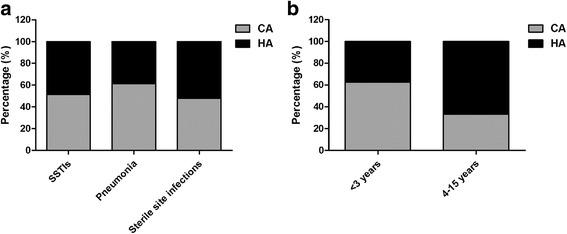
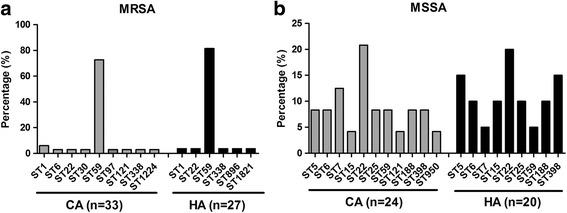
Totally 104 children (41 females and 63 males; median age, 5.2 months) were enrolled in this study, in which 60 patients suffered from MRSA infection. Among the 104 cases, 54.8% were categorized as community associated SA (CA-SA) infections. The children under 3 years were more likely to occur CA-SA infections compared with older ones (P = 0.0131). ST59-SCCmec IV-t437 (61.7%) was the most prevalent genotype of MRSA, and ST22-t309 (18.2%), ST5-t002 (9.1%), ST6-t701 (9.1%), ST188-t189 (9.1%) were the top four genotypes of methicillin-sensitive SA (MSSA). All the present isolates were susceptible to linezolid, vancomycin, trimethoprim-sulfamethoxazole, mupirocin, tigecyclin, fusidic acid. No erythromycin-susceptible isolate was determined, and only a few isolates (3.8%) were identified as susceptible to penicillin. Multi-drug resistant isolates were reponsible for 83.8% of the ST59-SCCmec IV-t437 isolates. The isolates with strong biofilm formation were found in 85% of MRSA and 53.2% of MSSA, and in 88.7% of ST59-SCCmec IV-t437 isolates. Biofilm formation ability varied not only between MRSA and MSSA (P = 0.0053), but also greatly among different genotypes (P < 0.0001). The prevalence of the biofilm associated genes among ST59-SCCmec IV-t437 clone was: icaA (100.0%), icaD (97.3%), fnbpA (100.0%), fnbpB (0), clfA (100%), clfB (100%), cna (2.7%), bbp (0), ebpS (88.5%), sdrC (78.4%), sdrD (5.4%), and sdrE (94.5%).
CONCLUSIONS
These results indicated strong homology of the MRSA stains isolated from Chinese children, which was caused by spread of multiresistant ST59-SCCmec IV-t437 clone with strong biofilm formation ability. The MSSA strains, in contrast, were very heterogeneity, half of which could produce biofilm strongly.
背景
本研究旨在调查从中国儿科医生处分离出的金黄色葡萄球菌(SA)的临床和分子流行病学以及生物膜形成情况。
方法
2016年2月至2017年1月从北京儿童医院分离出SA菌株。分离株通过多位点序列分型(MLST)、spa分型和SCCmec分型(仅针对耐甲氧西林SA [MRSA])进行分型。除磺胺甲恶唑/甲氧苄啶采用E试验法外,其余抗菌药物敏感性试验采用琼脂稀释法。检测生物膜形成及生物膜相关基因。
结果
本研究共纳入104例儿童(41例女性,63例男性;中位年龄5.2个月),其中60例患者发生MRSA感染。在104例病例中,54.8%被归类为社区相关性SA(CA-SA)感染。与年龄较大的儿童相比,3岁以下儿童更易发生CA-SA感染(P = 0.0131)。ST59-SCCmec IV-t437(61.7%)是MRSA最常见基因型,ST22-t309(18.2%)、ST5-t002(9.1%)、ST6-t701(9.1%)、ST188-t189(9.1%)是甲氧西林敏感SA(MSSA)的前四种基因型。所有分离株对利奈唑胺、万古霉素、甲氧苄啶-磺胺甲恶唑、莫匹罗星、替加环素、夫西地酸敏感。未检测到对红霉素敏感的分离株,仅少数分离株(3.8%)被鉴定为对青霉素敏感。83.8%的ST59-SCCmec IV-t437分离株为多重耐药株。85%的MRSA和53.2%的MSSA分离株具有较强的生物膜形成能力,并在88.7%的ST59-SCCmec IV-t437分离株中发现。生物膜形成能力不仅在MRSA和MSSA之间存在差异(P = 0.0053),而且在不同基因型之间也存在很大差异(P < 0.0001)。ST59-SCCmec IV-t437克隆中生物膜相关基因的流行率为:icaA(100.0%)、icaD(97.3%)、fnbpA(100.0%)、fnbpB(0)、clfA(100%)、clfB(100%)、cna(2.7%)、bbp(0)、ebpS(88.5%)、sdrC(78.4%)、sdrD(5.4%)和sdrE(94.5%)。
结论
这些结果表明,从中国儿童分离出的MRSA菌株具有很强的同源性,这是由具有强生物膜形成能力且多重耐药的ST59-SCCmec IV-t437克隆传播所致。相比之下,MSSA菌株具有很大的异质性,其中一半能够强烈产生生物膜。
 Zotero 插件