
提高真正仿生水凝胶热稳定性的策略:结合疏水性和定向氢键作用
Strategies To Increase the Thermal Stability of Truly Biomimetic Hydrogels: Combining Hydrophobicity and Directed Hydrogen Bonding.
作者信息
Yuan Hongbo, Xu Jialiang, van Dam Eliane P, Giubertoni Giulia, Rezus Yves L A, Hammink Roel, Bakker Huib J, Zhan Yong, Rowan Alan E, Xing Chengfen, Kouwer Paul H J
机构信息
School of Materials Science and Engineering, Hebei University of Technology, Tianjin 300401, P. R. China.
Institute for Molecules and Materials (IMM), Radboud University, Heyendaalseweg 135, 6525AJ Nijmegen, The Netherlands.
出版信息
Macromolecules. 2017 Nov 28;50(22):9058-9065. doi: 10.1021/acs.macromol.7b01832. Epub 2017 Nov 15.
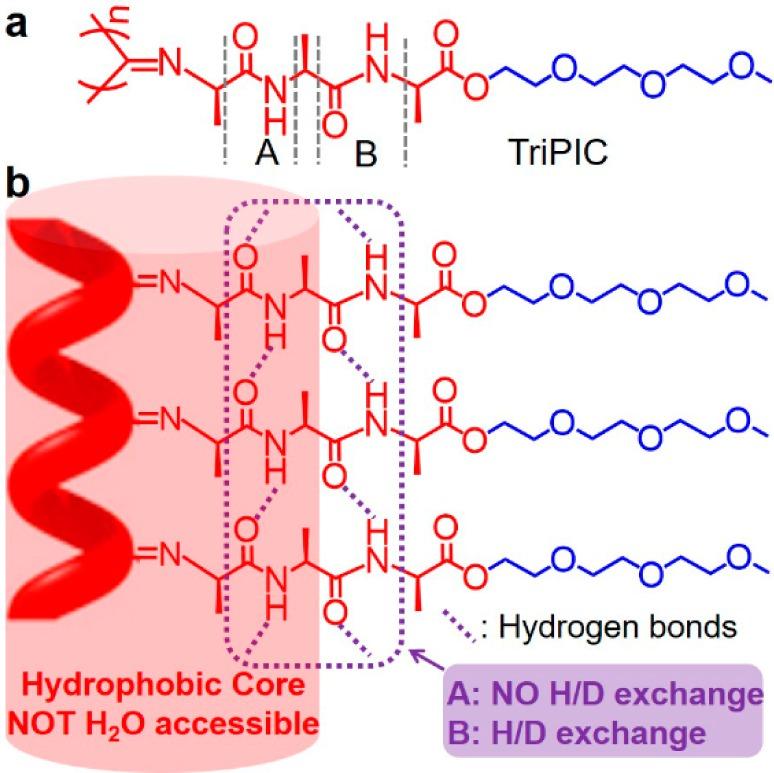
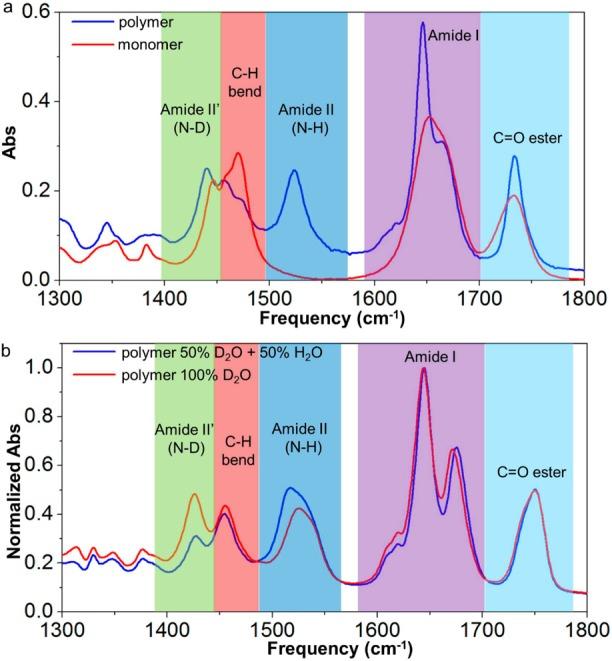
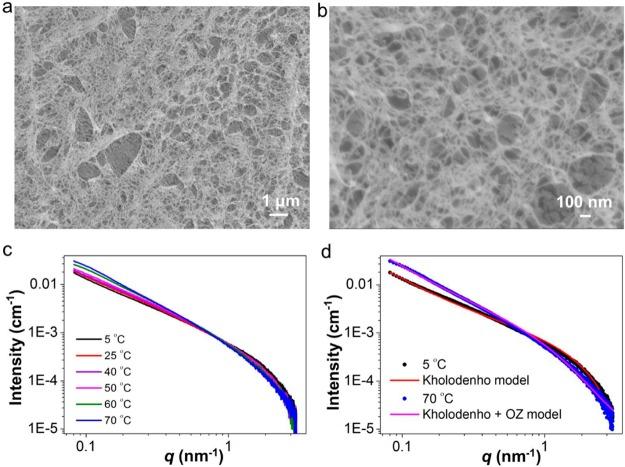
Enhancing the thermal stability of proteins is an important task for protein engineering. There are several ways to increase the thermal stability of proteins in biology, such as greater hydrophobic interactions, increased helical content, decreased occurrence of thermolabile residues, or stable hydrogen bonds. Here, we describe a well-defined polymer based on β-helical polyisocyanotripeptides (TriPIC) that uses biological approaches, including hydrogen bonding and hydrophobic interactions for its exceptional thermal stability in aqueous solutions. The multiple hydrogen bonding arrays along the polymer backbone shield the hydrophobic core from water. Variable temperature CD and FTIR studies indicate that, on heating, a better packed polymer conformation further stiffens the backbone. Driven by hydrophobic interactions, TriPIC solutions give fully reversible hydrogels that can withstand high temperatures (80 °C) for extended times. Cryo-scanning electron microscopy (cryo-SEM), small-angle X-ray scattering (SAXS), and thorough rheological analysis show that the hydrogel has a bundled architecture, which gives rise to strain stiffening effects on deformation of the gel, analogous to many biological hydrogels.
提高蛋白质的热稳定性是蛋白质工程的一项重要任务。在生物学中,有几种方法可以提高蛋白质的热稳定性,比如增强疏水相互作用、增加螺旋含量、减少热不稳定残基的出现或者形成稳定的氢键。在此,我们描述了一种基于β-螺旋聚异氰三肽(TriPIC)的结构明确的聚合物,它利用包括氢键和疏水相互作用在内的生物学方法,在水溶液中具有出色的热稳定性。沿着聚合物主链的多个氢键阵列使疏水核心免受水的影响。可变温度圆二色光谱(CD)和傅里叶变换红外光谱(FTIR)研究表明,加热时,排列更紧密的聚合物构象会进一步使主链变硬。在疏水相互作用的驱动下,TriPIC溶液能形成完全可逆的水凝胶,这种水凝胶可以在高温(80°C)下长时间耐受。低温扫描电子显微镜(cryo-SEM)、小角X射线散射(SAXS)以及全面的流变学分析表明,这种水凝胶具有束状结构,这会对凝胶变形产生应变强化效应,类似于许多生物水凝胶。



 Zotero 插件