
将PLK1作为一种新型化学预防方法,以消除头颈部肿瘤前黏膜变化。
Targeting PLK1 as a novel chemopreventive approach to eradicate preneoplastic mucosal changes in the head and neck.
作者信息
de Boer D Vicky, Martens-de Kemp Sanne R, Buijze Marijke, Stigter-van Walsum Marijke, Bloemena Elisabeth, Dietrich Ralf, Leemans C René, van Beusechem Victor W, Braakhuis Boudewijn J M, Brakenhoff Ruud H
机构信息
Department of Otolaryngology-Head and Neck Surgery, VU University Medical Center, Cancer Center Amsterdam, Amsterdam, The Netherlands.
Department of Pathology, VU University Medical Center, Cancer Center Amsterdam, Amsterdam, The Netherlands.
出版信息
Oncotarget. 2017 May 16;8(58):97928-97940. doi: 10.18632/oncotarget.17880. eCollection 2017 Nov 17.
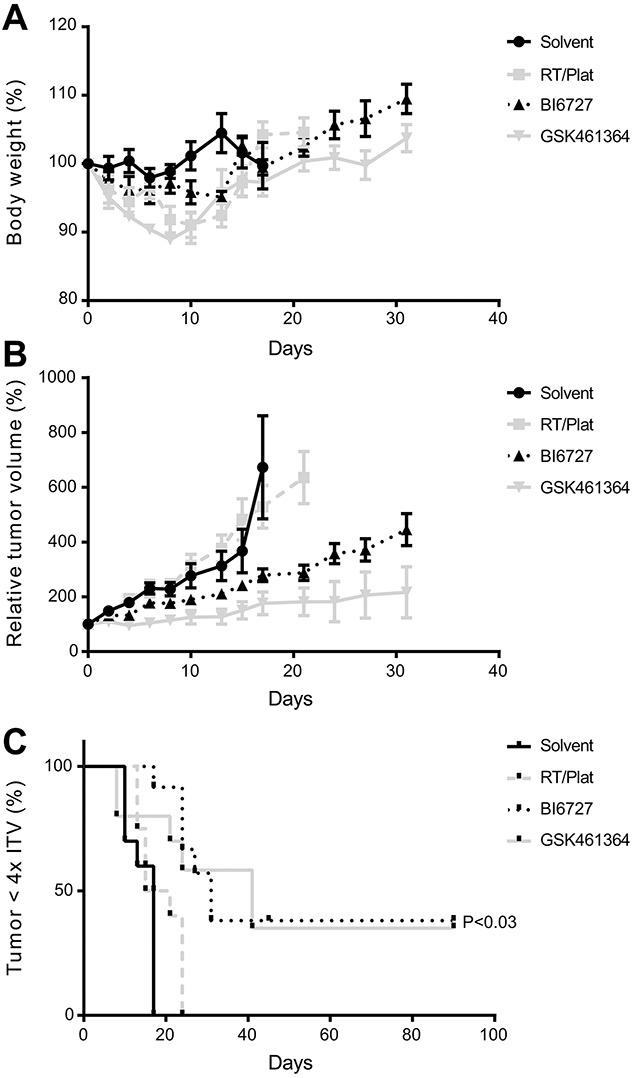
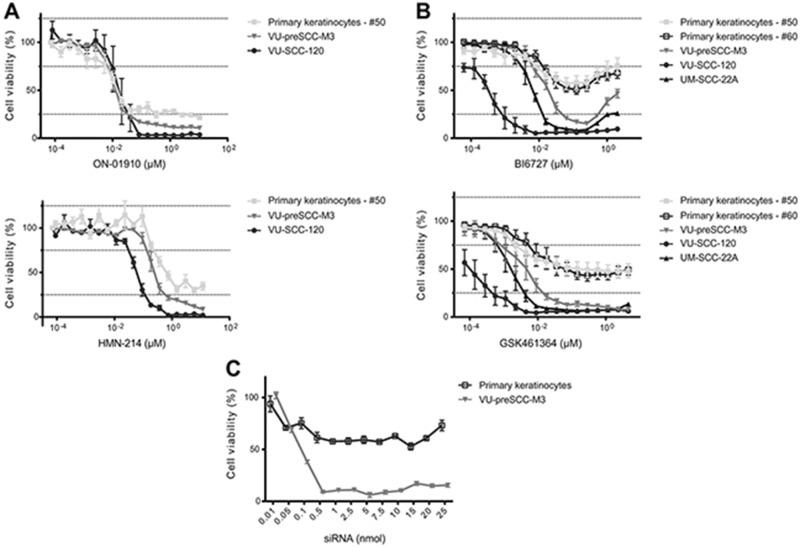
Head and neck squamous cell carcinomas (HNSCC) and local relapses thereof develop in preneoplastic fields in the mucosal linings of the upper aerodigestive tract. These fields are characterized by tumor-associated genetic changes, are frequently dysplastic and occasionally macroscopically visible. Currently, no adequate treatment options exist to prevent tumor development. Array-based screening with a panel of tumor-lethal small interfering RNAs (siRNAs) identified () as essential for survival of preneoplastic cells. Inhibition of PLK1 caused cell death of preneoplastic and HNSCC cells, while primary cells were hardly affected. Both siRNAs and small molecule inhibitors caused a strong G2/M cell cycle arrest accompanied by formation of monopolar spindles. In a xenografted mouse model PLK1 caused a significant tumor growth delay and cures, while chemoradiation had no effect. Thus, PLK1 seems to be a promising target for chemopreventive treatment of preneoplastic cells, and could be applied to prevent HNSCC and local relapses.
头颈部鳞状细胞癌(HNSCC)及其局部复发发生在上呼吸道消化道黏膜的癌前区域。这些区域具有与肿瘤相关的基因变化特征,常发育异常,偶尔在宏观上可见。目前,尚无足够的治疗方案来预防肿瘤发生。用一组肿瘤致死性小干扰RNA(siRNA)进行基于阵列的筛选,确定()是癌前细胞存活所必需的。抑制PLK1会导致癌前细胞和HNSCC细胞死亡,而原代细胞几乎不受影响。siRNA和小分子抑制剂均导致强烈的G2/M细胞周期停滞,并伴有单极纺锤体的形成。在异种移植小鼠模型中,PLK1导致肿瘤生长显著延迟并治愈,而放化疗则无效。因此,PLK1似乎是癌前细胞化学预防治疗的一个有前景的靶点,可用于预防HNSCC及其局部复发。


 Zotero 插件