
肠道微生物群-脑轴在(R)-氯胺酮抗社会挫败应激模型中抗抑郁作用的可能机制。
Possible role of the gut microbiota-brain axis in the antidepressant effects of (R)-ketamine in a social defeat stress model.
机构信息
Division of Clinical Neuroscience, Chiba University Center for Forensic Mental Health, Chiba, Japan.
Department of Anesthesiology, Tongji Hospital, Tongji Medical College, Huazhong University of Science and Technology, Wuhan, 430030, China.
出版信息
Transl Psychiatry. 2017 Dec 18;7(12):1294. doi: 10.1038/s41398-017-0031-4.
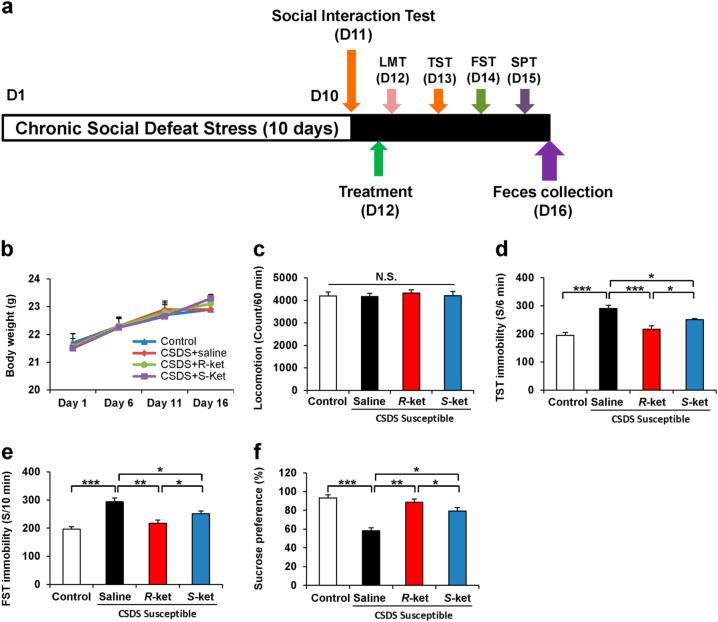
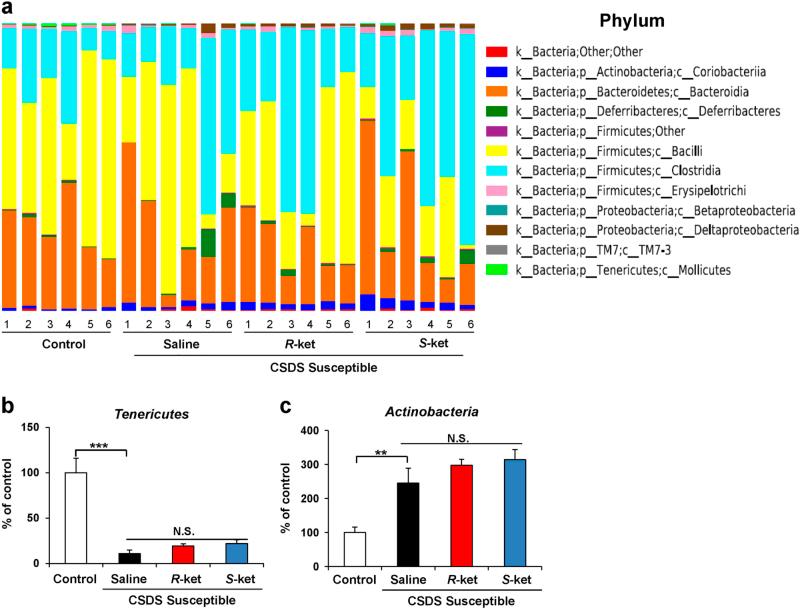
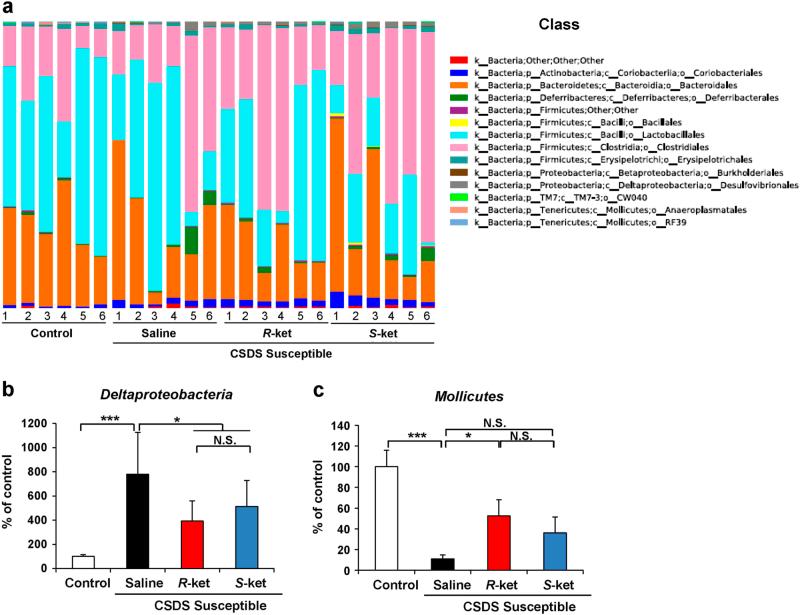
Accumulating evidence suggests that the gut microbiota-brain axis plays a role in the pathogenesis of depression, thereby contributing to the antidepressant actions of certain compounds. (R)-ketamine has a greater potency and longer-lasting antidepressant effects than (S)-ketamine. Here, we investigated whether the gut microbiota plays a role in the antidepressant effects of these two ketamine enantiomers. The role of the gut microbiota in the antidepressant effects of ketamine enantiomers in a chronic social defeat stress (CSDS) model of depression was examined using 16S ribosomal RNA gene sequencing of fecal samples. At the phylum level, CSDS-susceptible mice showed alterations in the levels of Tenericutes and Actinobacteria; however, neither ketamine enantiomers influenced these alterations. At the class level, both ketamine enantiomers significantly attenuated the increase in the levels of Deltaproteobacteria in the susceptible mice after CSDS. Furthermore, (R)-ketamine, but not (S)-ketamine, significantly attenuated the reduction in the levels of Mollicutes in the susceptible mice. At the genus level, both ketamine enantiomers significantly attenuated the decrease in the levels of Butyricimonas in the susceptible mice. Notably, (R)-ketamine was more potent than (S)-ketamine at reducing the levels of Butyricimonas in the susceptible mice. In conclusion, this study suggests that the antidepressant effects of two enantiomers of ketamine in CSDS model may be partly mediated by the restoration of the gut microbiota. Furthermore, the specific effect of (R)-ketamine on the levels of Mollicutes and Butyricimonas may explain its robust antidepressant action.
越来越多的证据表明,肠道微生物群-脑轴在抑郁症的发病机制中起作用,从而有助于某些化合物的抗抑郁作用。(R)-氯胺酮比(S)-氯胺酮具有更强的效力和更持久的抗抑郁作用。在这里,我们研究了肠道微生物群是否在这两种氯胺酮对映体的抗抑郁作用中起作用。使用粪便样本的 16S 核糖体 RNA 基因测序,研究了肠道微生物群在慢性社会挫败应激(CSDS)抑郁症模型中对氯胺酮对映体抗抑郁作用的影响。在易感性 CSDS 小鼠中,门水平的 Tenericutes 和 Actinobacteria 水平发生变化;然而,两种氯胺酮对映体都没有影响这些变化。在类水平,两种氯胺酮都显著减弱了 CSDS 后易感性小鼠中 Delta-proteobacteria 水平的升高。此外,(R)-氯胺酮而不是(S)-氯胺酮显著减弱了易感性小鼠中 Mollicutes 水平的降低。在属水平,两种氯胺酮都显著减弱了易感性小鼠中 Butyricimonas 水平的降低。值得注意的是,(R)-氯胺酮在降低易感性小鼠中 Butyricimonas 水平的作用强于(S)-氯胺酮。总之,这项研究表明,两种氯胺酮对映体在 CSDS 模型中的抗抑郁作用可能部分是通过恢复肠道微生物群来介导的。此外,(R)-氯胺酮对 Mollicutes 和 Butyricimonas 水平的特定影响可能解释了其强大的抗抑郁作用。



 Zotero 插件