
中药治疗便秘型肠易激综合征的系统评价与荟萃分析
Systematic review and meta-analysis of traditional Chinese medicine in the treatment of constipation-predominant irritable bowel syndrome.
作者信息
Li Dan-Yan, Dai Yun-Kai, Zhang Yun-Zhan, Huang Meng-Xin, Li Ru-Liu, Ou-Yang Jia, Chen Wei-Jing, Hu Ling
机构信息
Institute of Gastroenterology, Guangzhou University of Chinese Medicine, Guangzhou, Guangdong, China.
Department of Neurosurgery, the Second Affiliated Hospital of Soochow University, Suzhou, Jiangsu, China.
出版信息
PLoS One. 2017 Dec 18;12(12):e0189491. doi: 10.1371/journal.pone.0189491. eCollection 2017.
AIM
This meta-analysis analyzed the efficacy and safety of traditional Chinese medicine (TCM) for the treatment of irritable bowel syndrome with constipation (IBS-C).
METHODS
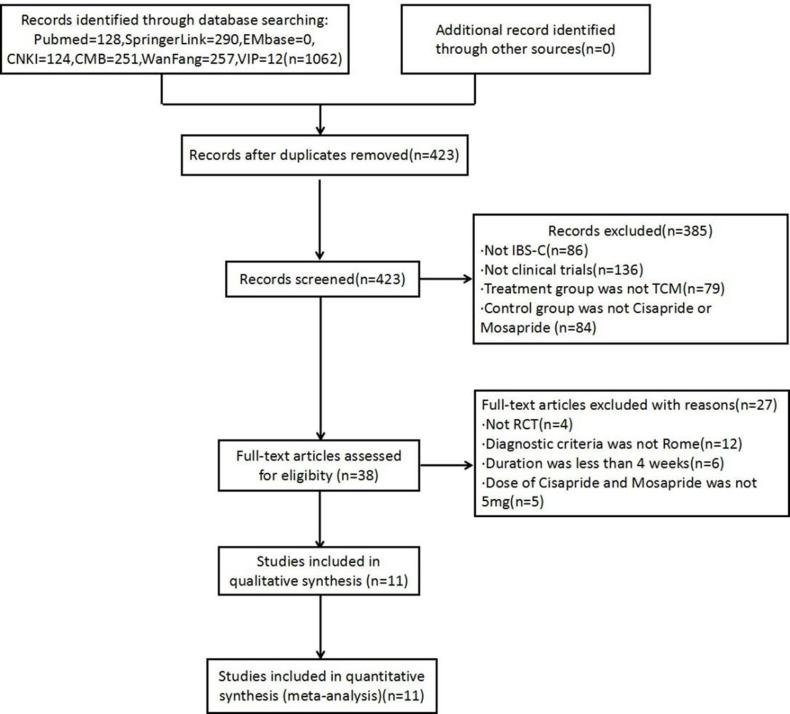
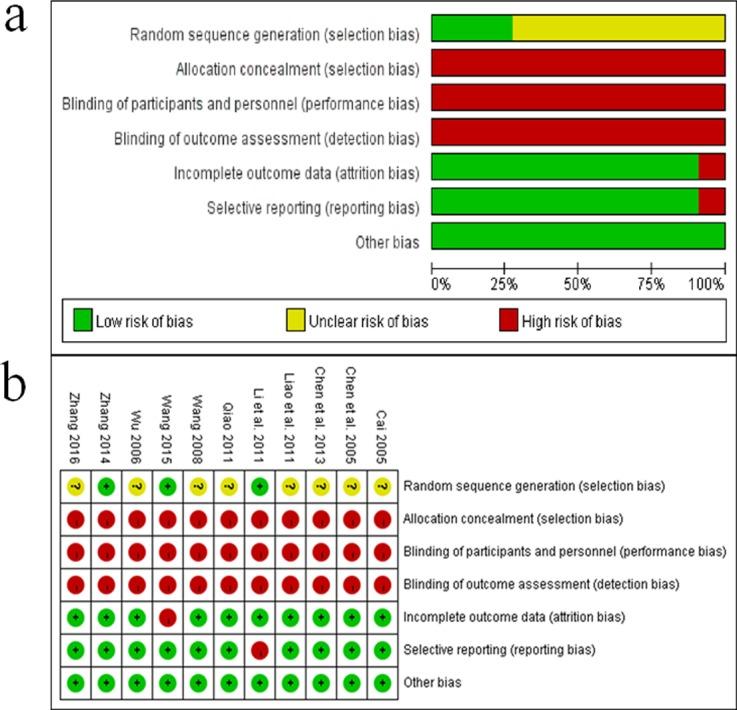
We searched seven electronic databases for randomized controlled trials investigating the efficacy of TCM in the treatment of IBS-C. The search period was from inception to June 1, 2017. Eligible RCTs compared TCM with cisapride and mosapride. Article quality was evaluated with the Cochrane Risk Bias Tool in the Cochrane Handbook by two independent reviewers. Begg's test was performed to evaluate publication bias. Review Manager 5.3 and Stata 12.0 were used for analyses.
RESULTS
Eleven eligible studies comprising a total of 906 participants were identified. In the primary outcome, TCM showed significant improvement in overall clinical efficacy compared with cisapride and mosapride (odds ratio [OR] = 4.00; 95% confidence interval [CI]: 2.74,5.84; P < 0.00001). In terms of secondary outcomes, TCM significantly alleviated abdominal pain (OR = 5.69; 95% CI: 2.35, 13.78; P = 0.0001), defecation frequency (OR = 4.38; 95% CI: 1.93, 9.93. P = 0.0004), and stool form (OR = 4.96; 95% CI: 2.11, 11.65; P = 0.0002) in the treatment group as compared to the control group. A lower recurrence rate was associated with TCM as compared to cisapride and mosapride (OR = 0.15; 95% CI: 0.08, 0.27; P < 0.00001). No adverse effects were observed during TCM treatment.
CONCLUSIONS
TCM showed greater improvement in terms of clinical efficacy in the treatment of IBS-C than cisapride and mosapride, although it was not possible to draw a definitive conclusion due to the small sample size, high risk, and low quality of the studies. Large multi-center and long-term high-quality randomized control trials are needed.
目的
本荟萃分析旨在分析中药治疗便秘型肠易激综合征(IBS-C)的疗效和安全性。
方法
我们检索了七个电子数据库,以查找研究中药治疗IBS-C疗效的随机对照试验。检索时间段为从数据库建立至2017年6月1日。符合条件的随机对照试验将中药与西沙必利和莫沙必利进行了比较。由两名独立评审员使用《Cochrane系统评价手册》中的Cochrane偏倚风险工具对文章质量进行评估。采用Begg检验评估发表偏倚。使用Review Manager 5.3和Stata 12.0进行分析。
结果
共纳入11项符合条件的研究,总计906名参与者。在主要结局方面,与西沙必利和莫沙必利相比,中药在总体临床疗效上有显著改善(优势比[OR]=4.00;95%置信区间[CI]:2.74,5.84;P<0.00001)。在次要结局方面,与对照组相比,治疗组中中药显著缓解了腹痛(OR=5.69;95%CI:2.35,13.78;P=0.0






 Zotero 插件