
酵母端粒酶逆转录酶 N 端结构域的结构与功能。
Structure and function of the N-terminal domain of the yeast telomerase reverse transcriptase.
机构信息
A.N. Belozersky Institute of Physico-Chemical Biology, M.V. Lomonosov Moscow State University, Moscow 119991, Russia.
Centre for Magnetic Tomography and Spectroscopy, Faculty of Fundamental Medicine, M.V. Lomonosov Moscow State University, Moscow 119991, Russia.
出版信息
Nucleic Acids Res. 2018 Feb 16;46(3):1525-1540. doi: 10.1093/nar/gkx1275.
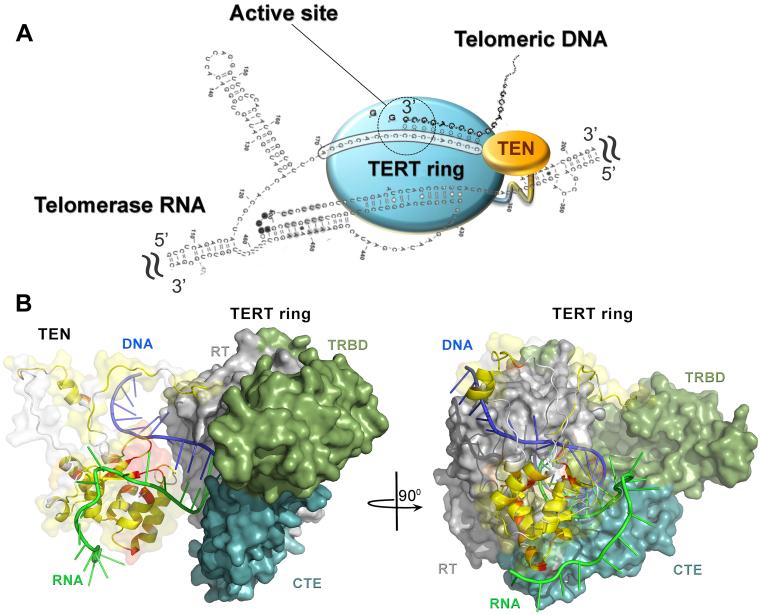
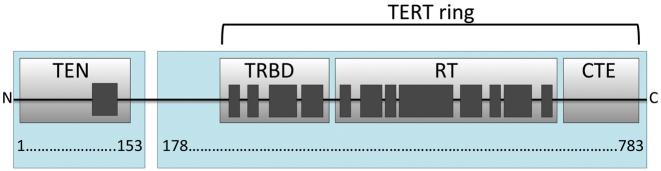
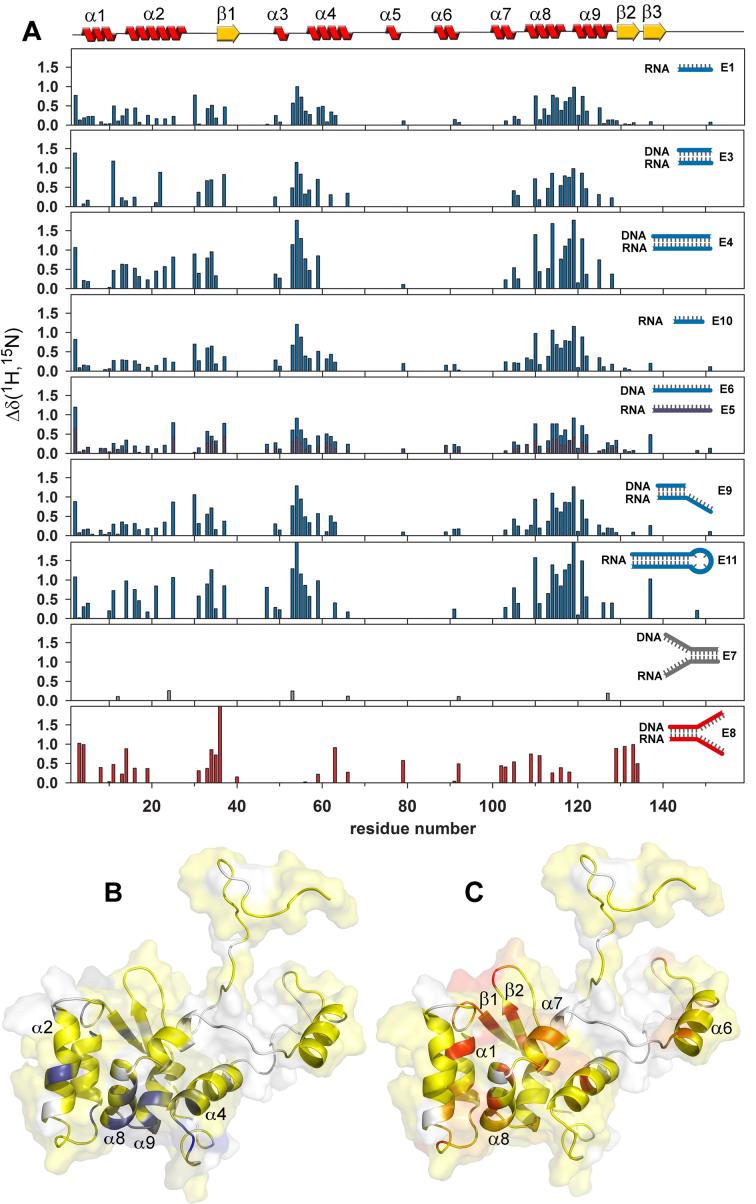
The elongation of single-stranded DNA repeats at the 3'-ends of chromosomes by telomerase is a key process in maintaining genome integrity in eukaryotes. Abnormal activation of telomerase leads to uncontrolled cell division, whereas its down-regulation is attributed to ageing and several pathologies related to early cell death. Telomerase function is based on the dynamic interactions of its catalytic subunit (TERT) with nucleic acids-telomerase RNA, telomeric DNA and the DNA/RNA heteroduplex. Here, we present the crystallographic and NMR structures of the N-terminal (TEN) domain of TERT from the thermotolerant yeast Hansenula polymorpha and demonstrate the structural conservation of the core motif in evolutionarily divergent organisms. We identify the TEN residues that are involved in interactions with the telomerase RNA and in the recognition of the 'fork' at the distal end of the DNA product/RNA template heteroduplex. We propose that the TEN domain assists telomerase biological function and is involved in restricting the size of the heteroduplex during telomere repeat synthesis.
端粒酶通过延伸染色体 3' 末端的单链 DNA 重复序列,是真核生物维持基因组完整性的关键过程。端粒酶的异常激活导致不受控制的细胞分裂,而其下调则归因于衰老和与早期细胞死亡相关的几种病理。端粒酶的功能基于其催化亚基(TERT)与核酸-端粒酶 RNA、端粒 DNA 和 DNA/RNA 杂合双链的动态相互作用。在这里,我们展示了耐热酵母 Hansenula polymorpha 端粒酶 TERT 的 N 端(TEN)结构域的晶体结构和 NMR 结构,并证明了核心基序在进化上不同的生物体中的结构保守性。我们确定了 TEN 残基,这些残基参与与端粒酶 RNA 的相互作用,并参与识别 DNA 产物/RNA 模板杂合双链远端的“叉”。我们提出 TEN 结构域辅助端粒酶的生物学功能,并参与限制在端粒重复合成过程中杂合双链的大小。


 Zotero 插件