
及时转诊至门诊肾病护理可减缓慢性肾脏病的进展并降低治疗成本。
Timely Referral to Outpatient Nephrology Care Slows Progression and Reduces Treatment Costs of Chronic Kidney Diseases.
作者信息
Lonnemann Gerhard, Duttlinger Johannes, Hohmann David, Hickstein Lennart, Reichel Helmut
机构信息
WiNe Institute of DN e.V., Düsseldorf, Germany.
HGC Gesundheits Consult GmbH, Düsseldorf, Germany.
出版信息
Kidney Int Rep. 2016 Oct 14;2(2):142-151. doi: 10.1016/j.ekir.2016.09.062. eCollection 2017 Mar.
INTRODUCTION
We present a new approach to evaluate the importance of ambulatory nephrology care in patients with chronic kidney disease (CKD).
METHODS
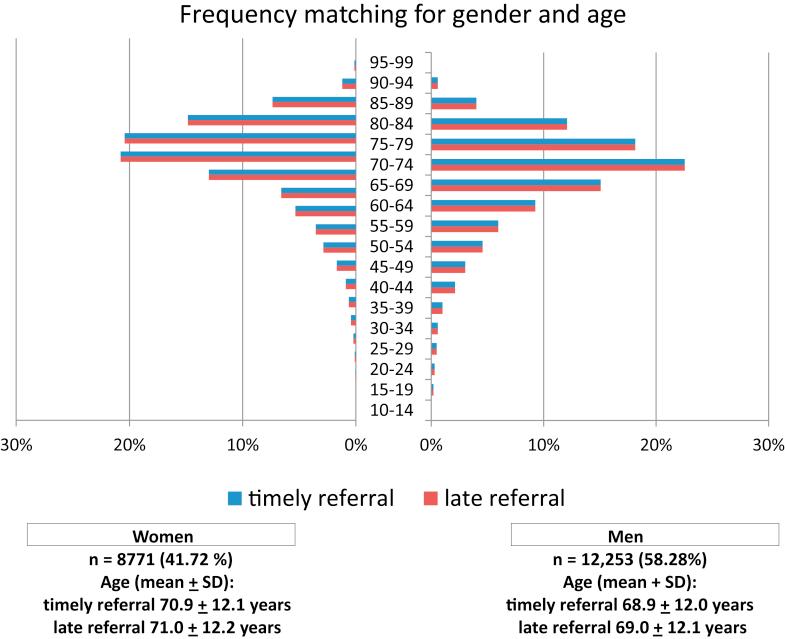
An anonymized health claims database of German insurance companies was searched in a retrospective analysis for patients with CKD using the codes of the International Classification of Diseases, 10th German modification. A total of 105,219 patients with CKD were identified. Patients were assigned to the group "timely referral," when nephrology care was present in the starting year 2009, or initiated during the following 3 years in CKD1-4. Using frequency matching for age and gender, 21,024 of the late referral group were matched with the equal number of patients in the timely referral group. Hospital admission rates, total treatment costs, and kidney function (change in CKD stages, start of dialysis, mortality) were documented each year during the 4-year follow-up.
RESULTS
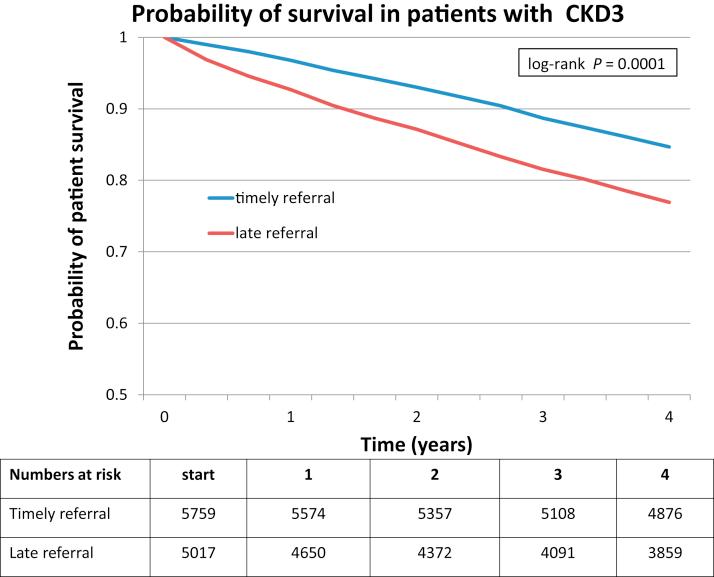
Hospital admission rates (110%-186%) and total treatment costs (119%-160%) were significantly higher ( < 0.03) in late referral compared with timely referral. In the timely referral group, significantly more patients did not change their CKD stage (65%-72.9% vs. 52%-64.6%, < 0.05) compared with late referral. Starting in CKD3 more patients tended to start dialysis in 1 year in timely referral (1.9 ± 0.6 vs. 1.0 ± 0.4, = 0.1). In contrast, death rates were significantly higher in the late referral group (18.8 ± 1.8% vs. 6.7 ± 0.4%, = 0.0001).
DISCUSSION
Timely referral to outpatient nephrology care is associated with slowed disease progression, less hospital admissions, reduced total treatment costs, and improved survival in patients with CKD.
引言
我们提出了一种新方法来评估门诊肾脏病护理在慢性肾脏病(CKD)患者中的重要性。
方法
在一项回顾性分析中,利用德国第10版国际疾病分类修订版编码,对德国保险公司的匿名健康理赔数据库进行检索,以查找CKD患者。共识别出105219例CKD患者。当2009年起始年份存在肾脏病护理,或在CKD1 - 4期接下来的3年内开始接受肾脏病护理时,患者被分配到“及时转诊”组。通过年龄和性别频率匹配,将21024例延迟转诊组患者与及时转诊组中数量相等的患者进行匹配。在4年随访期间,每年记录住院率、总治疗费用和肾功能(CKD分期变化、开始透析、死亡率)。
结果
与及时转诊相比,延迟转诊的住院率(110% - 186%)和总治疗费用(119% - 160%)显著更高(< 0.03)。与延迟转诊相比,及时转诊组中更多患者的CKD分期未发生变化(65% - 72.9%对52% - 64.6%,< 0.05)。从CKD3期开始,及时转诊组中更多患者倾向于在1年内开始透析(1.9 ± 0.6对1.0 ± 0.4,= 0.1)。相比之下,延迟转诊组的死亡率显著更高(18.8 ± 1.8%对6.7 ± 0.4%,= 0.0001)。
讨论
及时转诊至门诊肾脏病护理与CKD患者疾病进展减缓、住院次数减少、总治疗费用降低以及生存率提高相关。


 Zotero 插件