
“风暴中的血管”:在结直肠癌中寻找预后和预测性血管生成因子。
"Vessels in the Storm": Searching for Prognostic and Predictive Angiogenic Factors in Colorectal Cancer.
机构信息
Department of Biotechnological and Applied Clinical Sciences, University of L'Aquila, Via Vetoio, Coppito 2, 67100 L'Aquila, Italy.
Medical Oncology Unit, St. Salvatore Hospital, 67100 L'Aquila, Italy.
出版信息
Int J Mol Sci. 2018 Jan 19;19(1):299. doi: 10.3390/ijms19010299.
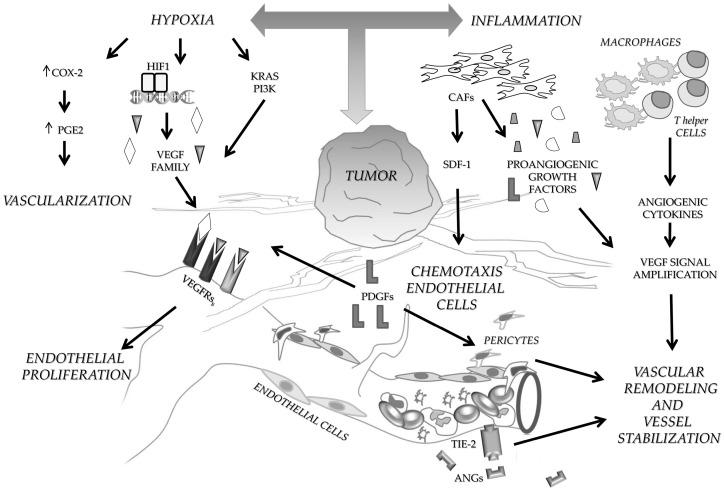
High expectations are placed upon anti-angiogenic compounds for metastatic colorectal cancer (mCRC), the first malignancy for which such type of treatment has been approved. Indeed, clinical trials have confirmed that targeting the formation of new vessels can improve in many cases clinical outcomes of mCRC patients. However, current anti-angiogenic drugs are far from obtaining the desirable or expected curative results. Many are the factors probably involved in such disappointing results, but particular attention is currently focused on the validation of biomarkers able to improve the direction of treatment protocols. Because clinical studies have clearly demonstrated that serum or tissue concentration of some angiogenic factors is associated with the evolution of the disease of mCRC patients, they are currently explored as potential biomarkers of prognosis and of tumor response to therapy. However, the complex biology underlying CRC -induced angiogenesis is a hurdle in finding rapid solutions. The aim of this review was to explore molecular mechanisms that determine the formation of tumor-associated vessels during CRC progression, and to discuss the potential role of angiogenic factors as diagnostic, prognostic and predictive biomarkers in CRC.
人们对用于转移性结直肠癌(mCRC)的抗血管生成化合物寄予厚望,这是第一种获得此类治疗批准的恶性肿瘤。事实上,临床试验已经证实,靶向新血管的形成可以改善许多 mCRC 患者的临床预后。然而,目前的抗血管生成药物远未获得理想或预期的治疗效果。许多因素可能与此类令人失望的结果有关,但目前特别关注的是验证能够改善治疗方案方向的生物标志物。因为临床研究已经清楚地表明,一些血管生成因子的血清或组织浓度与 mCRC 患者疾病的进展相关,因此它们目前被作为预后和肿瘤对治疗反应的潜在生物标志物进行研究。然而,CRC 诱导的血管生成背后的复杂生物学是寻找快速解决方案的一个障碍。本综述旨在探讨决定 CRC 进展过程中肿瘤相关血管形成的分子机制,并讨论血管生成因子作为 CRC 诊断、预后和预测生物标志物的潜在作用。
 Zotero 插件