
成年猫超重情况:一项横断面研究。
Overweight in adult cats: a cross-sectional study.
作者信息
Öhlund Malin, Palmgren Malin, Holst Bodil Ström
机构信息
Department of Clinical Sciences, Swedish University of Agricultural Sciences, P.O. Box 7054, 750 07, Uppsala, Sweden.
Kumla Animal Hospital, Företagsgatan 7, 692 71, Kumla, Sweden.
出版信息
Acta Vet Scand. 2018 Jan 19;60(1):5. doi: 10.1186/s13028-018-0359-7.
BACKGROUND
Overweight in cats is a major risk factor for diabetes mellitus and has also been associated with other disorders. Overweight and obesity are believed to be increasing problems in cats, as is currently seen in people, with important health consequences. The objectives of the present study were to determine the prevalence of overweight in cats from two different cohorts in a cross-sectional study design and to assess associations between overweight and diagnoses, and between overweight and demographic and environmental factors. Data were obtained from medical records for cats (n = 1072) visiting an academic medical center during 2013-2015, and from a questionnaire on insured cats (n = 1665). From the medical records, information on body condition score, breed, age, sex, neutering status, and diagnosis was obtained. The questionnaire included questions relating to the cat's body condition, breed, age, sex, neutering status, outdoor access, activity level, and diet. Data were analyzed by multivariable logistic regression.
RESULTS
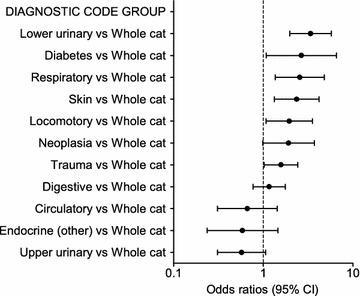
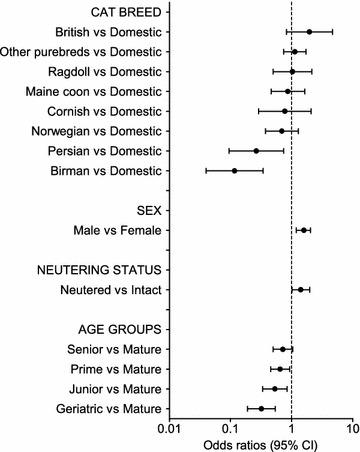
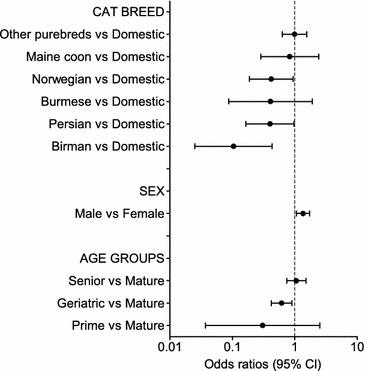
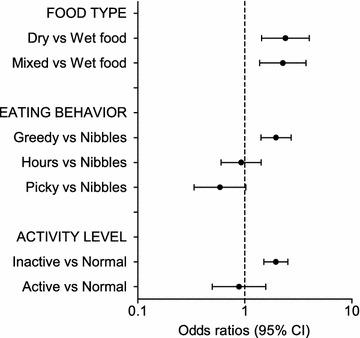
The prevalence of overweight was 45% in the medical records cohort and 22% in the questionnaire cohort, where owners judged their pet's body condition. Overweight cats in the medical records cohort were more likely to be diagnosed with lower urinary tract disease, diabetes mellitus, respiratory disease, skin disorders, locomotor disease, and trauma. Eating predominantly dry food, being a greedy eater, and inactivity were factors associated with an increased risk of overweight in the final model in the questionnaire cohort. In both cohorts, the Birman and Persian breeds, and geriatric cats, were less likely to be overweight, and male cats were more likely to be overweight.
CONCLUSIONS
The prevalence of overweight cats (45%) as assessed by trained personnel was high and in the same range as previously reported. Birman and Persian cats had a lower risk of overweight. The association with dry food found in adult, neutered cats is potentially important because this type of food is commonly fed to cats worldwide, and warrants further attention. Drawbacks related to the study design need to be acknowledged when interpreting the results, such as a potential for selection bias for cats visiting an animal hospital, and an information bias for questionnaire data. The high occurrence of overweight in cats needs to be addressed because it negatively affects their health.
背景
猫超重是糖尿病的主要危险因素,还与其他疾病有关。超重和肥胖在猫中被认为是日益严重的问题,就像目前在人类中看到的那样,会产生重要的健康后果。本研究的目的是在一项横断面研究设计中,确定来自两个不同队列的猫的超重患病率,并评估超重与诊断之间,以及超重与人口统计学和环境因素之间的关联。数据来自2013 - 2015年期间就诊于一家学术医疗中心的猫(n = 1072)的病历,以及一份关于参保猫(n = 1665)的问卷。从病历中获取了身体状况评分、品种、年龄、性别、绝育状态和诊断等信息。问卷包括与猫的身体状况、品种、年龄、性别、绝育状态、户外活动、活动水平和饮食有关的问题。数据通过多变量逻辑回归进行分析。
结果
在病历队列中,超重患病率为45%;在问卷队列中,由主人判断其宠物身体状况,超重患病率为22%。病历队列中的超重猫更有可能被诊断患有下尿路疾病、糖尿病、呼吸系统疾病、皮肤疾病、运动系统疾病和创伤。在问卷队列的最终模型中,主要食用干粮、贪吃和不活动是与超重风险增加相关的因素。在两个队列中,伯曼猫和波斯猫品种以及老年猫超重的可能性较小,而雄性猫超重的可能性较大。
结论
经训练有素的人员评估,超重猫的患病率较高(45%),与先前报道的范围相同。伯曼猫和波斯猫超重风险较低。在成年绝育猫中发现的与干粮的关联可能很重要,因为这种类型的食物在全球范围内普遍喂给猫,值得进一步关注。在解释结果时,需要承认与研究设计相关的缺点,例如就诊于动物医院的猫存在选择偏倚的可能性以及问卷数据存在信息偏倚。猫超重的高发生率需要得到解决,因为这会对它们的健康产生负面影响。
 Zotero 插件