
NHE3 抑制剂 Tenapanor 的药效学、安全性和耐受性:两项健康志愿者试验。
Pharmacodynamics, Safety, and Tolerability of the NHE3 Inhibitor Tenapanor: Two Trials in Healthy Volunteers.
机构信息
Ardelyx Inc., 34175 Ardenwood Blvd, Suite 200, Fremont, CA, 94555, USA.
出版信息
Clin Drug Investig. 2018 Apr;38(4):341-351. doi: 10.1007/s40261-017-0614-0.
BACKGROUND
Tenapanor, a small molecule with minimal systemic availability, is a first-in-class sodium/hydrogen exchanger 3 (NHE3) inhibitor that acts in the gut. Here, we evaluate the pharmacodynamics and safety of tenapanor in healthy adults.
METHODS
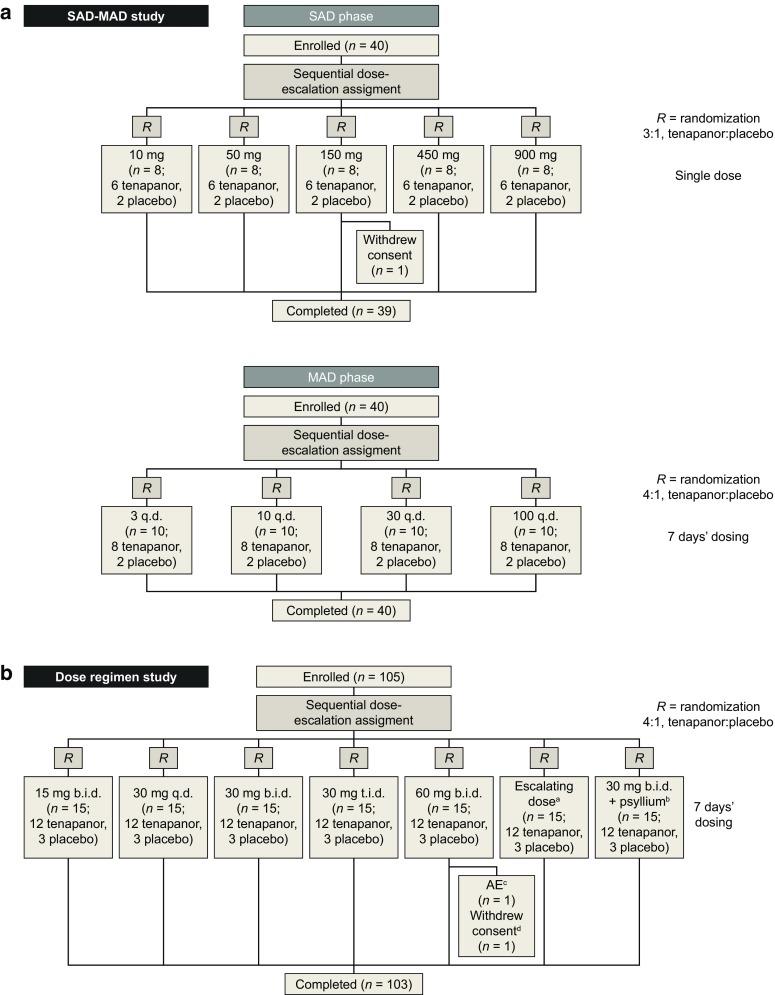
Two phase I, single-center, randomized, double-blind, placebo-controlled studies were performed. The first study assessed single-ascending oral tenapanor doses of 10, 50, 150, 450, and 900 mg (n = 8 per group; six tenapanor, two placebo) and multiple ascending doses over 7 days of 3, 10, 30, and 100 mg q.d. (n = 10 per group; eight tenapanor, two placebo). In the second study, different tenapanor regimens were evaluated over 7 days (n = 15 per group; 12 tenapanor, three placebo): 15 mg twice daily (b.i.d.), 30 mg once daily (q.d.), 30 mg b.i.d., 30 mg three times daily (t.i.d.), 60 mg b.i.d., escalating b.i.d. dose (daily total 30-90 mg), 30 mg b.i.d. with psyllium.
RESULTS
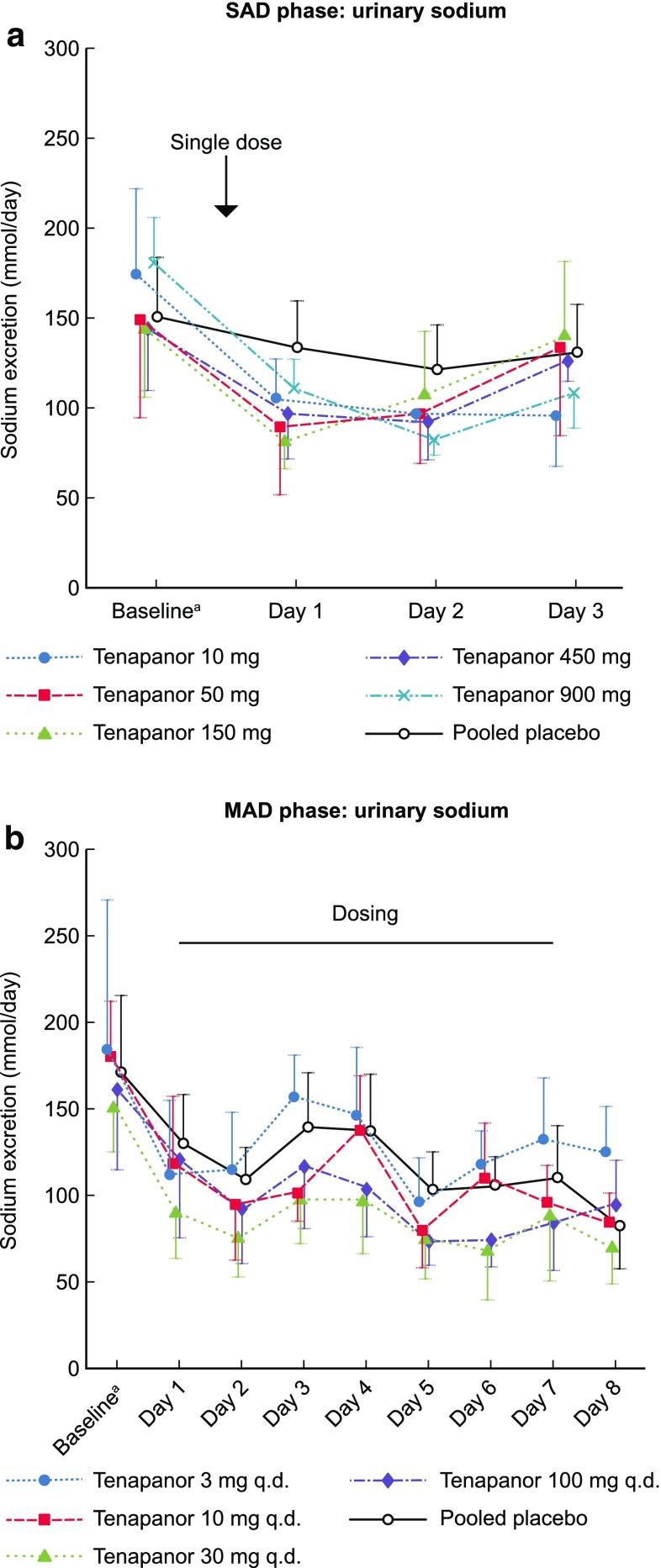
Tenapanor produced generally dose-dependent increases in stool sodium excretion and decreases in urinary sodium excretion versus placebo; in addition, twice-daily dosing appeared to have a greater effect on sodium absorption than once-daily dosing with an equivalent daily dose. Tenapanor softened stool consistency and increased stool frequency and weight from baseline versus placebo. Tenapanor concentrations were below the quantification limit (0.5 ng/ml) in 98.5% of 895 plasma samples. Adverse events were mild or moderate in severity, and were typically gastrointestinal in nature. There were no clinically relevant changes in serum electrolytes.
CONCLUSIONS
Tenapanor was well tolerated and resulted in reduced intestinal sodium absorption and softer stool consistency versus placebo. Systemic exposure to tenapanor was minimal. These results support potential use of tenapanor in patients who could benefit from modification of gastrointestinal sodium balance. CLINICALTRIALS.
GOV IDENTIFIERS
NCT02819687, NCT02796131.
背景
小分子 Tenapanor 全身利用率低,是一种作用于肠道的首创钠离子/氢交换体 3(NHE3)抑制剂。在此,我们评估了健康成年人中单用 Tenapanor 的药效学和安全性。
方法
进行了两项 I 期、单中心、随机、双盲、安慰剂对照研究。第一项研究评估了 10、50、150、450 和 900mg 单口服 Tenapanor 剂量(每组 8 人,每组 6 人 Tenapanor,2 人安慰剂)和 7 天内 3、10、30 和 100mg q.d.(每组 10 人,每组 8 人 Tenapanor,2 人安慰剂)递增剂量。在第二项研究中,7 天内评估了不同的 Tenapanor 方案(每组 15 人,每组 12 人 Tenapanor,3 人安慰剂):每天 2 次 15mg(b.i.d.),每天 1 次 30mg(q.d.),b.i.d.30mg,t.i.d.30mg 三次/天(30mg 每天三次),b.i.d.60mg,递增 b.i.d.剂量(每天总计 30-90mg),b.i.d.与车前子合用 30mg。
结果
Tenapanor 与安慰剂相比,通常呈剂量依赖性地增加粪便钠排泄和减少尿钠排泄;此外,与相同日剂量的每日一次给药相比,每日两次给药似乎对钠吸收的影响更大。Tenapanor 使粪便稠度变软,并增加粪便频率和重量与基线相比。895 个血浆样本中,有 98.5%的 Tenapanor 浓度低于定量下限(0.5ng/ml)。不良事件的严重程度为轻度或中度,且通常为胃肠道性质。血清电解质无临床相关变化。
结论
Tenapanor 耐受性良好,与安慰剂相比,可减少肠道钠吸收并使粪便稠度变软。全身暴露于 Tenapanor 最小。这些结果支持在可能受益于胃肠道钠平衡改变的患者中使用 Tenapanor。临床试验。
.gov 标识符:NCT02819687,NCT02796131。


 Zotero 插件