
脆性X智力低下蛋白调节活性依赖的膜转运和介导突触重塑的突触信号传导。
Fragile X Mental Retardation Protein Regulates Activity-Dependent Membrane Trafficking and -Synaptic Signaling Mediating Synaptic Remodeling.
作者信息
Sears James C, Broadie Kendal
机构信息
Department of Biological Sciences, Vanderbilt University, Nashville, TN, United States.
Vanderbilt Kennedy Center for Research on Human Development, Nashville, TN, United States.
出版信息
Front Mol Neurosci. 2018 Jan 12;10:440. doi: 10.3389/fnmol.2017.00440. eCollection 2017.
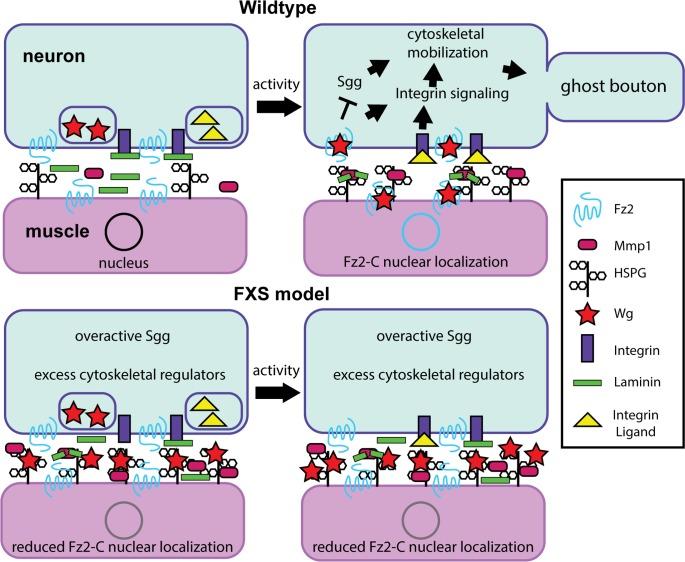
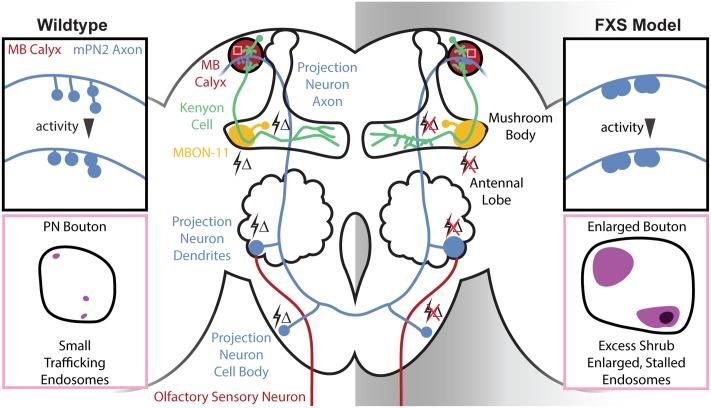
Fragile X syndrome (FXS) is the leading monogenic cause of autism and intellectual disability. The disease arises through loss of fragile X mental retardation protein (FMRP), which normally exhibits peak expression levels in early-use critical periods, and is required for activity-dependent synaptic remodeling during this transient developmental window. FMRP canonically binds mRNA to repress protein translation, with targets that regulate cytoskeleton dynamics, membrane trafficking, and -synaptic signaling. We focus here on recent advances emerging in these three areas from the disease model. In the well-characterized central brain mushroom body (MB) olfactory learning/memory circuit, FMRP is required for activity-dependent synaptic remodeling of projection neurons innervating the MB calyx, with function tightly restricted to an early-use critical period. FMRP loss is phenocopied by conditional removal of FMRP only during this critical period, and rescued by FMRP conditional expression only during this critical period. Consistent with FXS hyperexcitation, FMRP loss defects are phenocopied by heightened sensory experience and targeted optogenetic hyperexcitation during this critical period. FMRP binds mRNA encoding ESCRTIII core component Shrub (human CHMP4 homolog) to restrict Shrub translation in an activity-dependent mechanism only during this same critical period. Shrub mediates endosomal membrane trafficking, and perturbing Shrub expression is known to interfere with neuronal process pruning. Consistently, FMRP loss and Shrub overexpression targeted to projection neurons similarly causes endosomal membrane trafficking defects within synaptic boutons, and genetic reduction of Shrub strikingly rescues FXS model defects. In parallel work on the well-characterized giant fiber (GF) circuit, FMRP limits iontophoretic dye loading into central interneurons, demonstrating an FMRP role controlling core neuronal properties through the activity-dependent repression of translation. In the well-characterized neuromuscular junction (NMJ) model, developmental synaptogenesis and activity-dependent synaptic remodeling both require extracellular matrix metalloproteinase (MMP) enzymes interacting with the heparan sulfate proteoglycan (HSPG) glypican dally-like protein (Dlp) to restrict -synaptic Wnt signaling, with FXS synaptogenic defects alleviated by both MMP and HSPG reduction. This new mechanistic axis spanning from activity to FMRP to HSPG-dependent MMP regulation modulates activity-dependent synaptogenesis. We discuss future directions for these mechanisms, and intersecting research priorities for FMRP in glial and signaling interactions.
脆性X综合征(FXS)是自闭症和智力残疾的主要单基因病因。该疾病是由于脆性X智力低下蛋白(FMRP)缺失所致,FMRP通常在早期关键期表现出峰值表达水平,并且在这个短暂的发育窗口期间,对于活动依赖的突触重塑是必需的。FMRP通常与mRNA结合以抑制蛋白质翻译,其靶标调节细胞骨架动力学、膜运输和突触信号传导。我们在此重点关注从疾病模型中在这三个领域出现的最新进展。在特征明确的中枢脑蘑菇体(MB)嗅觉学习/记忆回路中,FMRP是支配MB花萼的投射神经元活动依赖的突触重塑所必需的,其功能严格限于早期关键期。仅在这个关键期有条件地去除FMRP可模拟FMRP缺失的表型,而仅在这个关键期有条件地表达FMRP可挽救该表型。与FXS的过度兴奋一致,在这个关键期,增强的感官体验和靶向光遗传学过度兴奋可模拟FMRP缺失的缺陷。FMRP仅在同一关键期通过一种活动依赖的机制结合编码ESCRTIII核心成分Shrub(人类CHMP4同源物)的mRNA,以限制Shrub的翻译。Shrub介导内体膜运输,已知干扰Shrub表达会干扰神经元突起修剪。一致地,靶向投射神经元的FMRP缺失和Shrub过表达同样会导致突触小体内的内体膜运输缺陷,而Shrub的基因敲低显著挽救了FXS模型缺陷。在对特征明确的巨纤维(GF)回路的平行研究中,FMRP限制离子电渗染料加载到中枢中间神经元中,表明FMRP通过活动依赖的翻译抑制作用控制核心神经元特性。在特征明确的神经肌肉接头(NMJ)模型中,发育性突触形成和活动依赖的突触重塑都需要细胞外基质金属蛋白酶(MMP)与硫酸乙酰肝素蛋白聚糖(HSPG)类果蝇硫酸乙酰肝素蛋白聚糖(Dlp)相互作用,以限制突触Wnt信号传导,MMP和HSPG的减少均可减轻FXS的突触形成缺陷。这个从活动到FMRP再到HSPG依赖的MMP调节的新机制轴调节活动依赖的突触形成。我们讨论了这些机制的未来方向,以及FMRP在神经胶质和信号相互作用方面交叉的研究重点。

 Zotero 插件