
谷氨酰胺转运与线粒体代谢在癌细胞生长中的作用
Glutamine Transport and Mitochondrial Metabolism in Cancer Cell Growth.
作者信息
Scalise Mariafrancesca, Pochini Lorena, Galluccio Michele, Console Lara, Indiveri Cesare
机构信息
Department DiBEST (Biologia, Ecologia, Scienze della Terra), Unit of Biochemistry and Molecular Biotechnology, University of Calabria, Arcavacata di Rende, Italy.
CNR Institute of Biomembranes, Bioenergetics and Molecular Biotechnology, Bari, Italy.
出版信息
Front Oncol. 2017 Dec 11;7:306. doi: 10.3389/fonc.2017.00306. eCollection 2017.
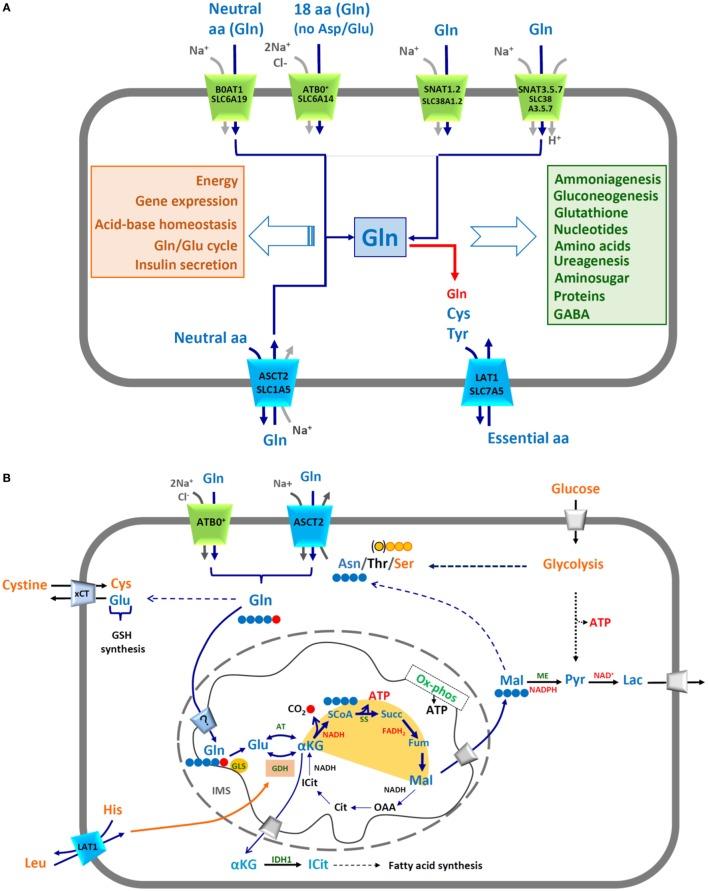
The concept that cancer is a metabolic disease is now well acknowledged: many cancer cell types rely mostly on glucose and some amino acids, especially glutamine for energy supply. These findings were corroborated by overexpression of plasma membrane nutrient transporters, such as the glucose transporters (GLUTs) and some amino acid transporters such as ASCT2, LAT1, and ATB, which became promising targets for pharmacological intervention. On the basis of their sodium-dependent transport modes, ASCT2 and ATB0 have the capacity to sustain glutamine need of cancer cells; while LAT1, which is sodium independent will have the role of providing cancer cells with some amino acids with plausible signaling roles. According to the metabolic reprogramming of many types of cancer cells, glucose is mainly catabolized by aerobic glycolysis in tumors, while the fate of Glutamine is completed at mitochondrial level where the enzyme Glutaminase converts Glutamine to Glutamate. Glutamine rewiring in cancer cells is heterogeneous. For example, Glutamate is converted to α-Ketoglutarate giving rise to a truncated form of Krebs cycle. This reprogrammed pathway leads to the production of ATP mainly at substrate level and regeneration of reducing equivalents needed for cells growth, redox balance, and metabolic energy. Few studies on hypothetical mitochondrial transporter for Glutamine are reported and indirect evidences suggested its presence. Pharmacological compounds able to inhibit Glutamine metabolism may represent novel drugs for cancer treatments. Interestingly, well acknowledged targets for drugs are the Glutamine transporters of plasma membrane and the key enzyme Glutaminase.
癌症是一种代谢性疾病这一概念如今已得到广泛认可
许多癌细胞类型主要依赖葡萄糖和一些氨基酸,尤其是谷氨酰胺来提供能量。质膜营养转运蛋白的过表达证实了这些发现,比如葡萄糖转运蛋白(GLUTs)以及一些氨基酸转运蛋白,如ASCT2、LAT1和ATB0,它们成为了药物干预的有前景的靶点。基于其钠依赖性转运模式,ASCT2和ATB0有能力维持癌细胞对谷氨酰胺的需求;而不依赖钠的LAT1则具有为癌细胞提供一些具有合理信号传导作用的氨基酸的作用。根据多种癌细胞的代谢重编程,葡萄糖在肿瘤中主要通过有氧糖酵解进行分解代谢,而谷氨酰胺的代谢则在线粒体水平完成,谷氨酰胺酶将谷氨酰胺转化为谷氨酸。癌细胞中的谷氨酰胺重排是异质性的。例如,谷氨酸被转化为α-酮戊二酸,从而产生一种截短形式的三羧酸循环。这种重编程途径主要在底物水平导致ATP的产生以及细胞生长、氧化还原平衡和代谢能量所需的还原当量的再生。关于谷氨酰胺假想线粒体转运蛋白的研究报道很少,间接证据表明其存在。能够抑制谷氨酰胺代谢的药理化合物可能代表癌症治疗的新型药物。有趣的是,药物的公认靶点是质膜的谷氨酰胺转运蛋白和关键酶谷氨酰胺酶。
 Zotero 插件