
多剂量小瓶中注射用贝伐珠单抗储存污染的研究。
A study on the contamination of injection bevacizumab on storage of multidose vials.
机构信息
Department of Ophthalmology, INHS Asvini, Mumbai, Maharashtra, India.
出版信息
Indian J Ophthalmol. 2018 Feb;66(2):252-255. doi: 10.4103/ijo.IJO_969_16.
PURPOSE
The aim of this study is to establish the safety of storage and reuse of bevacizumab vials for 1 week with multiple vial punctures.
METHODS
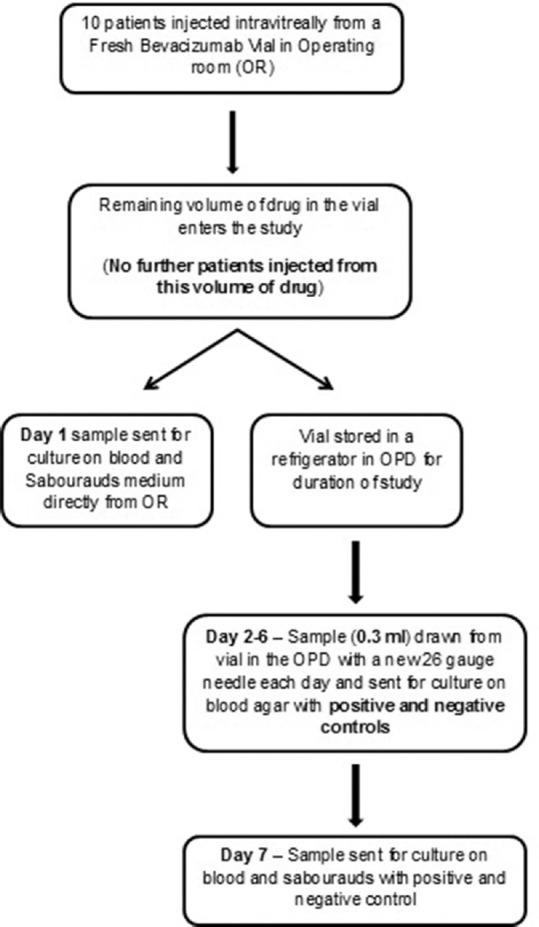
This was an experimental microbiological study conducted at tertiary care hospital. The study samples included bevacizumab vials that had been used for injecting patients by the pooling method. Vials were stored and sampled in a manner that replicated their proposed clinical use. Contamination of vials was evaluated on the basis of microbial culture and validated by positive and negative controls. The probability of obtaining such results purely by chance was calculated.
RESULTS
A total of 210 samples from 30 vials were evaluated along with 210 positive and 210 negative controls. No growth was seen in any of the bevacizumab samples. The probability of obtaining 210 consecutive sterile samples just by chance is <5.547 × 10⁻⁶ (0.000005547).
CONCLUSION
The vials showed no contamination on storage for 7 days in an ordinary refrigerator. Thus, we conclude that the rate of contamination of bevacizumab vials on storage for 7 days in a refrigerator is likely to be insignificant. The results need to be validated by other studies replicating this protocol.
目的
本研究旨在确定贝伐单抗小瓶在多次瓶穿刺后可安全储存和重复使用一周。
方法
这是在三级护理医院进行的一项实验微生物学研究。研究样本包括通过汇集法为患者注射用过的贝伐单抗小瓶。小瓶以复制其预期临床使用的方式进行储存和采样。根据微生物培养评估小瓶污染,并通过阳性和阴性对照进行验证。计算获得此类结果纯属偶然的概率。
结果
共评估了 30 个小瓶的 210 个样本,以及 210 个阳性对照和 210 个阴性对照。在任何贝伐单抗样本中均未观察到生长。仅通过偶然获得 210 个连续无菌样本的概率<5.547×10⁻⁶(0.000005547)。
结论
小瓶在普通冰箱中储存 7 天未显示污染。因此,我们得出结论,贝伐单抗小瓶在冰箱中储存 7 天的污染率可能微不足道。需要通过复制此方案的其他研究来验证结果。
 Zotero 插件