
采用超高效液相色谱指纹图谱和多元化学计量学方法对不同产地的何首乌进行综合分析。
Comprehensive analysis of Polygoni Multiflori Radix of different geographical origins using ultra-high-performance liquid chromatography fingerprints and multivariate chemometric methods.
机构信息
School of Chinese Materia Medica, Tianjin University of Traditional Chinese Medicine, Tianjin, China.
Tianjin State Key Laboratory of Modern Chinese Medicine, Tianjin University of Traditional Chinese Medicine, Tianjin, China.
出版信息
J Food Drug Anal. 2018 Jan;26(1):90-99. doi: 10.1016/j.jfda.2016.11.009. Epub 2016 Dec 22.
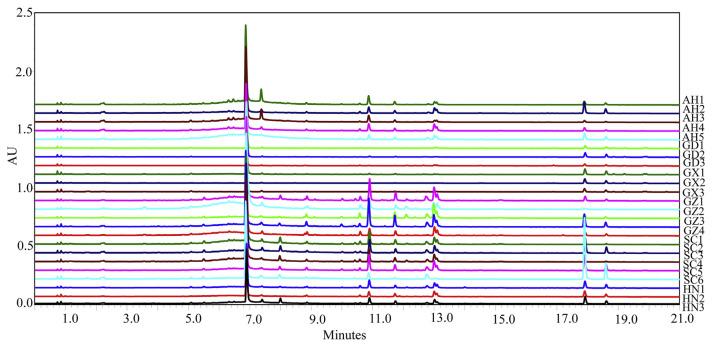
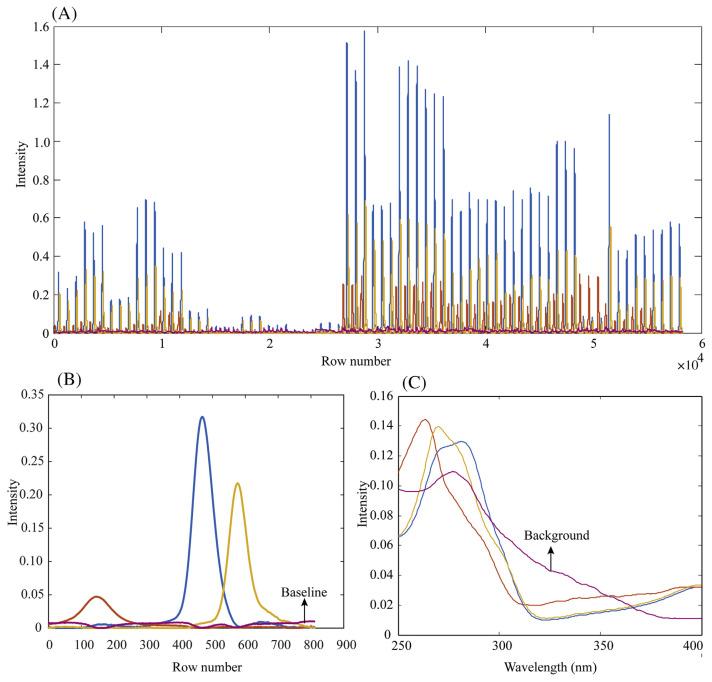
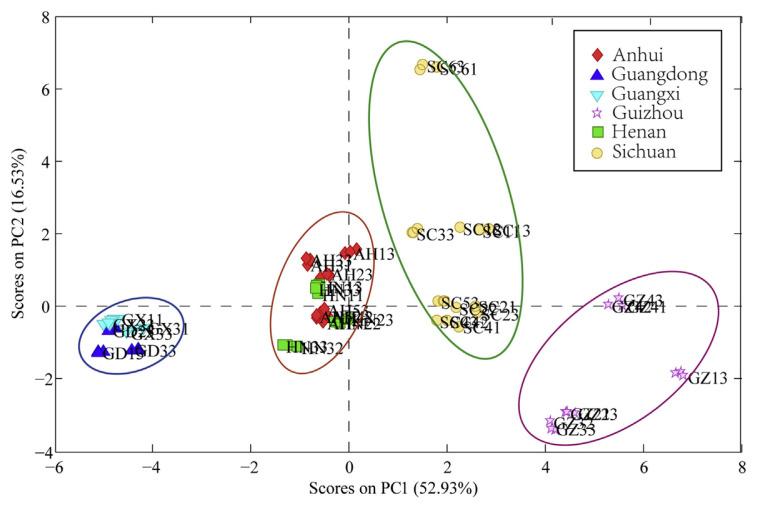
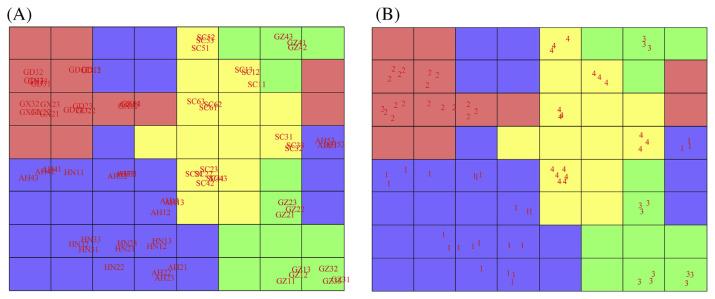
Polygoni Multiflori Radix (PMR) is increasingly being used not just as a traditional herbal medicine but also as a popular functional food. In this study, multivariate chemometric methods and mass spectrometry were combined to analyze the ultra-high-performance liquid chromatograph (UPLC) fingerprints of PMR from six different geographical origins. A chemometric strategy based on multivariate curve resolution-alternating least squares (MCR-ALS) and three classification methods is proposed to analyze the UPLC fingerprints obtained. Common chromatographic problems, including the background contribution, baseline contribution, and peak overlap, were handled by the established MCR-ALS model. A total of 22 components were resolved. Moreover, relative species concentrations were obtained from the MCR-ALS model, which was used for multivariate classification analysis. Principal component analysis (PCA) and Ward's method have been applied to classify 72 PMR samples from six different geographical regions. The PCA score plot showed that the PMR samples fell into four clusters, which related to the geographical location and climate of the source areas. The results were then corroborated by Ward's method. In addition, according to the variance-weighted distance between cluster centers obtained from Ward's method, five components were identified as the most significant variables (chemical markers) for cluster discrimination. A counter-propagation artificial neural network has been applied to confirm and predict the effects of chemical markers on different samples. Finally, the five chemical markers were identified by UPLC-quadrupole time-of-flight mass spectrometer. Components 3, 12, 16, 18, and 19 were identified as 2,3,5,4'-tetrahydroxy-stilbene-2-O-β-d-glucoside, emodin-8-O-β-d-glucopyranoside, emodin-8-O-(6'-O-acetyl)-β-d-glucopyranoside, emodin, and physcion, respectively. In conclusion, the proposed method can be applied for the comprehensive analysis of natural samples.
何首乌不仅作为传统草药,而且作为流行的功能性食品,应用日益广泛。本研究采用多元化学计量学方法和质谱联用技术,分析了 6 个不同产地何首乌的超高效液相色谱(UPLC)指纹图谱。提出了一种基于多元曲线分辨交替最小二乘法(MCR-ALS)和 3 种分类方法的化学计量学策略,用于分析所得 UPLC 指纹图谱。通过建立的 MCR-ALS 模型处理常见的色谱问题,包括背景贡献、基线贡献和峰重叠。共解析出 22 个成分。此外,还从 MCR-ALS 模型中获得相对物种浓度,用于多元分类分析。主成分分析(PCA)和 Ward 法已用于对 6 个不同产地的 72 个何首乌样品进行分类。PCA 得分图表明,何首乌样品分为 4 组,与来源地区的地理位置和气候有关。结果得到 Ward 法的验证。此外,根据 Ward 法获得的聚类中心之间方差加权距离,鉴定出 5 个成分作为聚类区分的最显著变量(化学标志物)。采用对传人工神经网络(counter-propagation artificial neural network)对化学标志物对不同样品的影响进行确认和预测。最后,采用 UPLC-四极杆飞行时间质谱仪鉴定出 5 个化学标志物。鉴定出的 5 个化学标志物分别为:2,3,5,4'-四羟基二苯乙烯-2-O-β-D-葡萄糖苷、大黄素-8-O-β-D-吡喃葡萄糖苷、大黄素-8-O-(6'-O-乙酰基)-β-D-吡喃葡萄糖苷、大黄素和大黄素甲醚。总之,该方法可用于天然样品的综合分析。


 Zotero 插件