
CSL112(载脂蛋白 A-I [人])可增强健康个体和稳定动脉粥样硬化疾病患者的胆固醇外流。
CSL112 (Apolipoprotein A-I [Human]) Enhances Cholesterol Efflux Similarly in Healthy Individuals and Stable Atherosclerotic Disease Patients.
机构信息
From the CSL Limited, Parkville, Australia (A.G.); CSL Behring, King of Prussia, PA (D.D., M.A.T., S.D.W.); and QIMR Berghofer Medical Research Institute, Brisbane City, Australia (G.H.).
出版信息
Arterioscler Thromb Vasc Biol. 2018 Apr;38(4):953-963. doi: 10.1161/ATVBAHA.118.310538. Epub 2018 Feb 8.
OBJECTIVE
CSL112 (apolipoprotein A-I [apoA-I; human]) is a novel formulation of apoA-I in development for reduction of early recurrent cardiovascular events after acute myocardial infarction. Cholesterol efflux capacity (CEC) is a marker of high-density lipoprotein (HDL) function that is strongly correlated with incident cardiovascular disease. Impaired CEC has been observed in patients with coronary heart disease. Here, we determined whether infused apoA-I improves CEC when administered to patients with stable atherosclerotic disease versus healthy volunteers.
APPROACH AND RESULTS
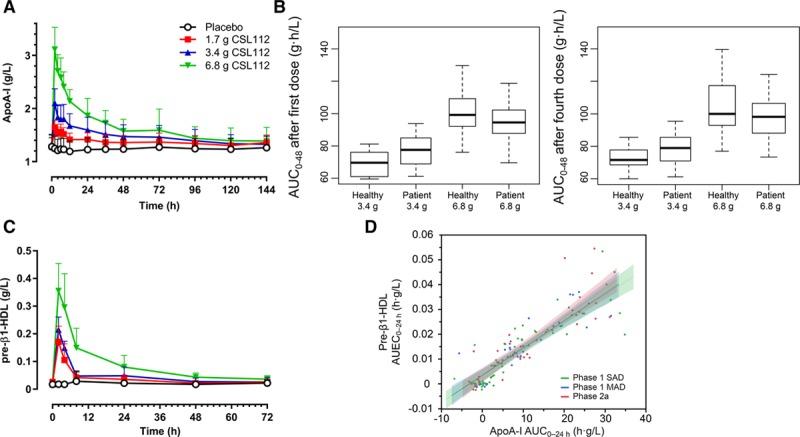
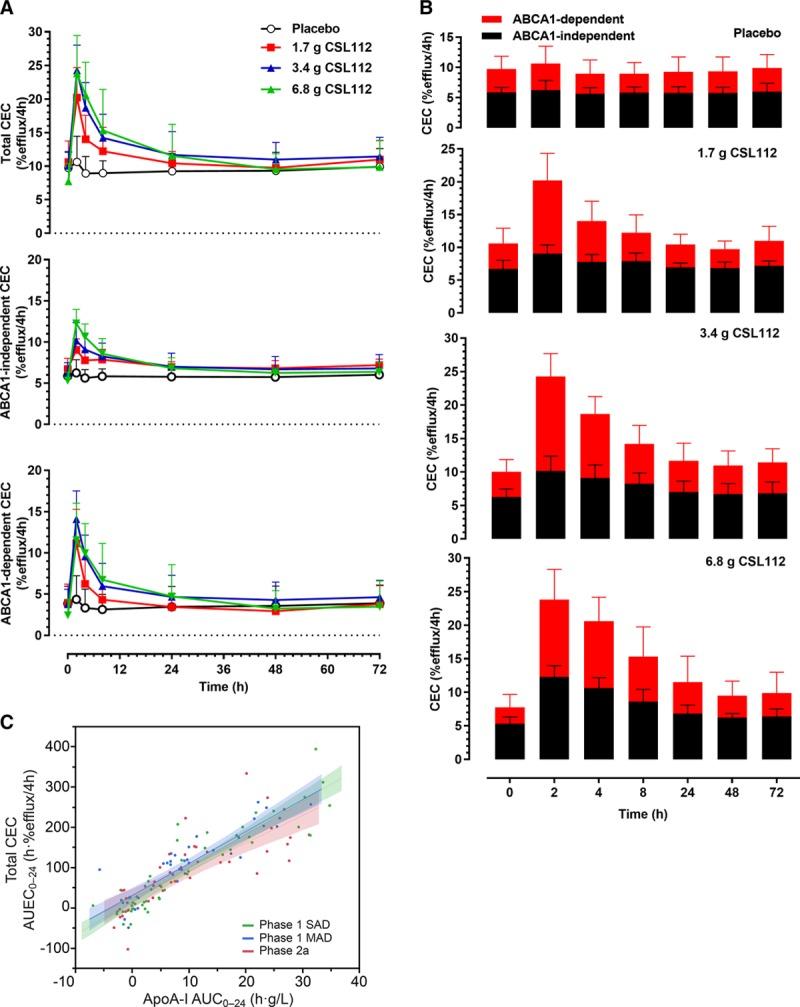
Measurements of apoA-I, HDL unesterified cholesterol, HDL esterified cholesterol, pre-β1-HDL, and CEC were determined in samples from patients with stable atherosclerotic disease before and after intravenous administration of CSL112. These measures were compared with 2 prior studies in healthy volunteers for differences in CEC at baseline and after CSL112 infusion. Patients with stable atherosclerotic disease exhibited significantly lower ATP-binding cassette transporter 1-mediated CEC at baseline (<0.0001) despite slightly higher apoA-I levels when compared with healthy individuals (2 phase 1 studies pooled; ≤0.05), suggesting impaired HDL function. However, no differences were observed in apoA-I pharmacokinetics or in pre-β1-HDL (=0.5) or CEC (=0.1) after infusion of CSL112. Similar elevation in CEC was observed in patients with low or high baseline HDL function (based on tertiles of apoA-I-normalized CEC; =0.1242). These observations were extended and confirmed using cholesterol esterification as an additional measure.
CONCLUSIONS
CSL112 shows comparable, strong, and immediate effects on CEC despite underlying cardiovascular disease. CSL112 is, therefore, a promising novel therapy for lowering the burden of atherosclerosis and reducing the risk of recurrent cardiovascular events.
目的
CSL112(载脂蛋白 A-I[apoA-I;人])是一种新型载脂蛋白 A-I 制剂,用于减少急性心肌梗死后早期复发性心血管事件。胆固醇流出能力(CEC)是高密度脂蛋白(HDL)功能的标志物,与心血管疾病的发生有很强的相关性。在冠心病患者中观察到 CEC 受损。在这里,我们确定在给予稳定动脉粥样硬化疾病患者与健康志愿者时,输注 apoA-I 是否会改善 CEC。
方法和结果
在静脉内给予 CSL112 前后,从稳定动脉粥样硬化疾病患者的样本中测定 apoA-I、HDL 未酯化胆固醇、HDL 酯化胆固醇、前β1-HDL 和 CEC。这些测量结果与 2 项先前在健康志愿者中进行的研究进行了比较,以了解 CEC 在基线和 CSL112 输注后的差异。与健康个体相比(2 项 1 期研究合并;≤0.05),尽管 apoA-I 水平略高,但稳定动脉粥样硬化疾病患者的 ATP 结合盒转运蛋白 1 介导的 CEC 基线明显较低(<0.0001),提示 HDL 功能受损。然而,在输注 CSL112 后,apoA-I 药代动力学或前β1-HDL(=0.5)或 CEC(=0.1)没有差异。在基线 HDL 功能低或高的患者中(基于 apoA-I 归一化 CEC 的三分位数;=0.1242)观察到 CEC 的类似升高。这些观察结果通过使用胆固醇酯化作为附加测量得到扩展和证实。
结论
尽管存在心血管疾病,但 CSL112 对 CEC 仍显示出相似、强大且即时的作用。因此,CSL112 是一种很有前途的新型治疗方法,可降低动脉粥样硬化负担并降低复发性心血管事件的风险。




 Zotero 插件