
视力、听力和认知功能的综合损伤比单纯认知障碍与更高水平的功能和沟通困难相关:安大略省家庭护理和长期护理接受者的 interRAI 数据分析。
Combined impairments in vision, hearing and cognition are associated with greater levels of functional and communication difficulties than cognitive impairment alone: Analysis of interRAI data for home care and long-term care recipients in Ontario.
作者信息
Guthrie Dawn M, Davidson Jacob G S, Williams Nicole, Campos Jennifer, Hunter Kathleen, Mick Paul, Orange Joseph B, Pichora-Fuller M Kathleen, Phillips Natalie A, Savundranayagam Marie Y, Wittich Walter
机构信息
Department of Kinesiology & Physical Education, Wilfrid Laurier University, Waterloo, Ontario, Canada.
Department of Health Sciences, Wilfrid Laurier University, Waterloo, Ontario, Canada.
出版信息
PLoS One. 2018 Feb 15;13(2):e0192971. doi: 10.1371/journal.pone.0192971. eCollection 2018.
OBJECTIVES
The objective of the current study was to understand the added effects of having a sensory impairment (vision and/or hearing impairment) in combination with cognitive impairment with respect to health-related outcomes among older adults (65+ years old) receiving home care or residing in a long-term care (LTC) facility in Ontario, Canada.
METHODS
Cross-sectional analyses were conducted using existing data collected with one of two interRAI assessments, one for home care (n = 291,824) and one for LTC (n = 110,578). Items in the assessments were used to identify clients with single sensory impairments (e.g., vision only [VI], hearing only [HI]), dual sensory impairment (DSI; i.e., vision and hearing) and those with cognitive impairment (CI). We defined seven mutually exclusive groups based on the presence of single or combined impairments.
RESULTS
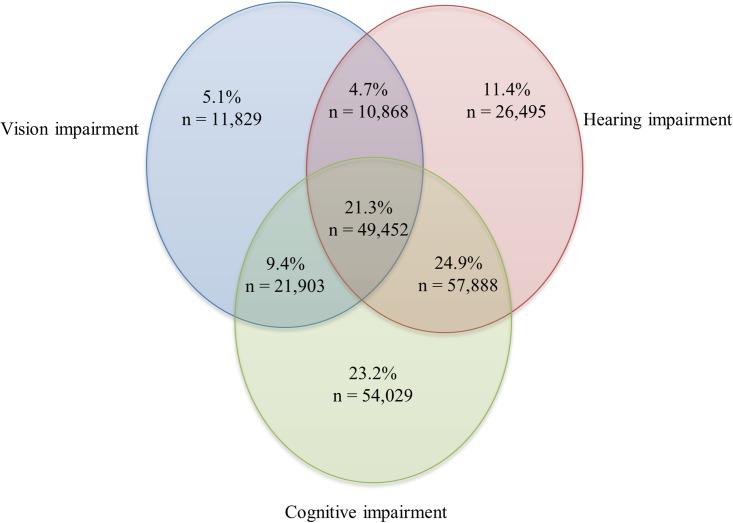
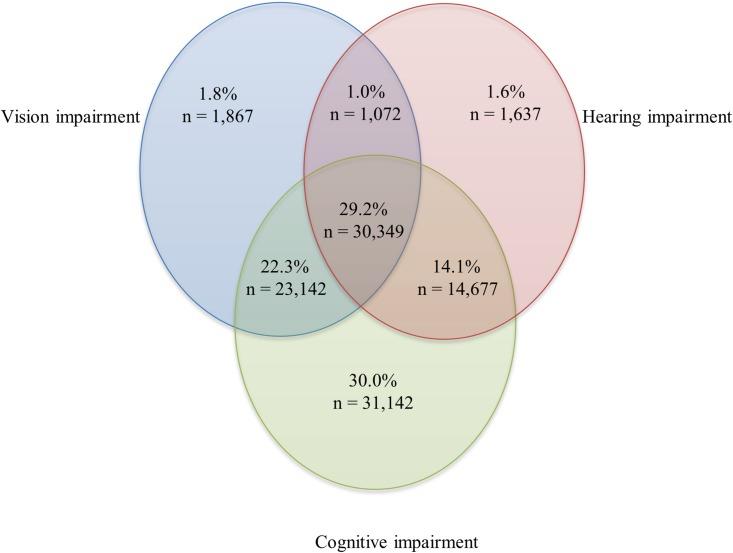
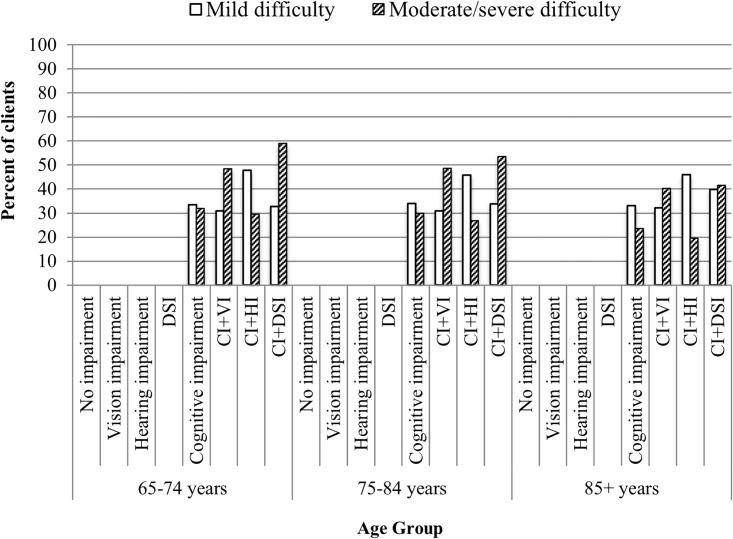
The rate of people having all three impairments (i.e., CI+DSI) was 21.3% in home care and 29.2% in LTC. Across the seven groups, individuals with all three impairments were the most likely to report loneliness, to have a reduction in social engagement, and to experience reduced independence in their activities of daily living (ADLs) and instrumental ADLs (IADLs). Communication challenges were highly prevalent in this group, at 38.0% in home care and 49.2% in LTC. In both care settings, communication difficulties were more common in the CI+DSI group versus the CI-alone group.
CONCLUSIONS
The presence of combined sensory and cognitive impairments is high among older adults in these two care settings and having all three impairments is associated with higher rates of negative outcomes than the rates for those having CI alone. There is a rising imperative for all health care professionals to recognize the potential presence of hearing, vision and cognitive impairments in those for whom they provide care, to ensure that basic screening occurs and to use those results to inform care plans.
目的
本研究的目的是了解在加拿大安大略省接受家庭护理或居住在长期护理(LTC)机构中的老年人(65岁及以上)中,感觉障碍(视力和/或听力障碍)与认知障碍相结合对健康相关结局的附加影响。
方法
使用通过两种相互间标准化评估之一收集的现有数据进行横断面分析,其中一种用于家庭护理(n = 291,824),另一种用于长期护理(n = 110,578)。评估中的项目用于识别患有单一感觉障碍(例如,仅视力障碍[VI]、仅听力障碍[HI])、双重感觉障碍(DSI;即视力和听力)以及认知障碍(CI)的客户。我们根据单一或合并障碍的存在定义了七个相互排斥的组。
结果
在家庭护理中,患有所有三种障碍(即CI + DSI)的人的比例为21.3%,在长期护理中为29.2%。在这七个组中,患有所有三种障碍的个体最有可能报告孤独感、社交参与度降低,并且在日常生活活动(ADL)和工具性日常生活活动(IADL)中独立性降低。沟通挑战在该组中非常普遍,在家庭护理中为38.0%,在长期护理中为49.2%。在两种护理环境中,CI + DSI组的沟通困难比仅患有CI的组更常见。
结论
在这两种护理环境中的老年人中,感觉和认知障碍合并存在的情况很普遍,并且患有所有三种障碍与负面结局的发生率高于仅患有CI的人。所有医疗保健专业人员都迫切需要认识到他们所护理的人群中可能存在听力、视力和认知障碍,确保进行基本筛查并利用这些结果为护理计划提供信息。

 Zotero 插件