
冷适应活流感疫苗初免-加强免疫对小鼠模型中泛流感 A 的保护作用。
Pan-Influenza A Protection by Prime-Boost Vaccination with Cold-Adapted Live-Attenuated Influenza Vaccine in a Mouse Model.
机构信息
Department of Biotechnology, College of Life Science and Biotechnology, Yonsei University, Seoul, South Korea.
Graduate School of Pharmaceutical Sciences, Ewha Womans University, Seoul, South Korea.
出版信息
Front Immunol. 2018 Feb 1;9:116. doi: 10.3389/fimmu.2018.00116. eCollection 2018.
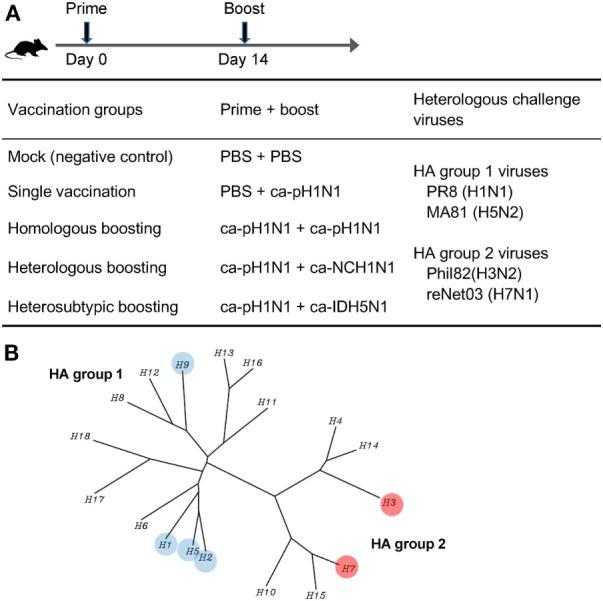
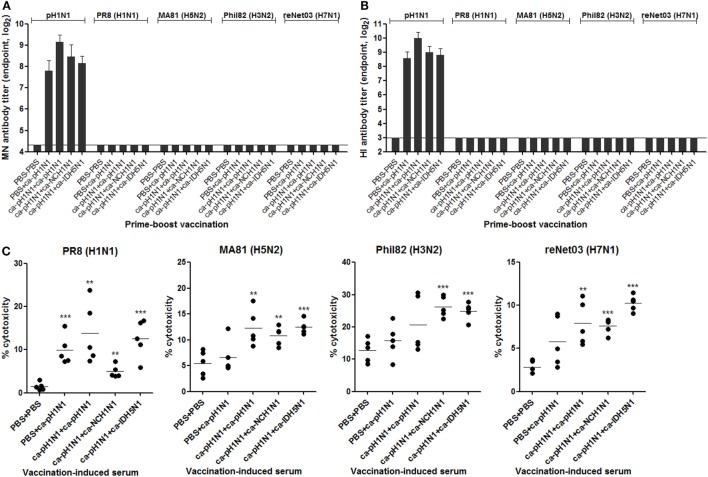
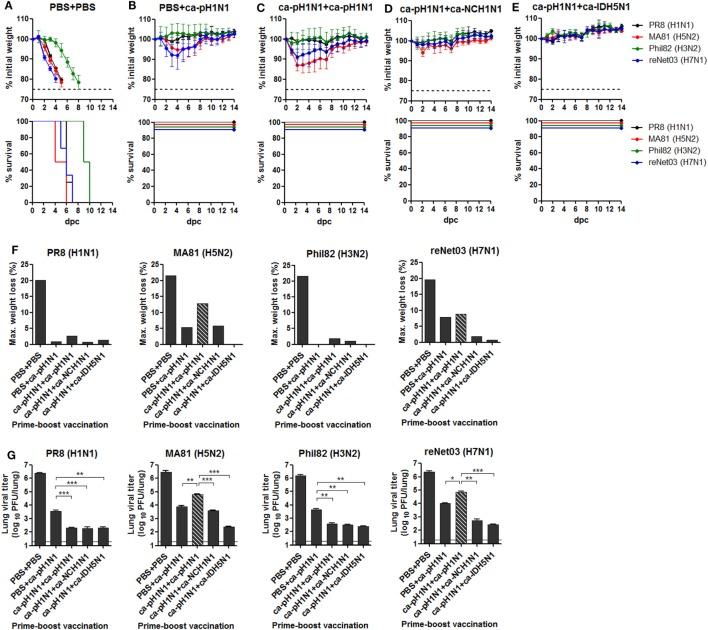
Influenza virus infections continually pose a major public health threat with seasonal epidemics and sporadic pandemics worldwide. While currently licensed influenza vaccines provide only strain-specific protection, antigenic drift and shift occasionally render the viruses resistant to the host immune responses, which highlight the need for a vaccine that provides broad protection against multiple subtypes. In this study, we suggest a vaccination strategy using cold-adapted, live attenuated influenza vaccines (CAIVs) to provide a broad, potent, and safe cross-protection covering antigenically distinct hemagglutinin (HA) groups 1 and 2 influenza viruses. Using a mouse model, we tested different prime-boost combinations of CAIVs for their ability to induce humoral and T-cell responses, and protective efficacy against H1 and H5 (HA group 1) as well as H3 and H7 (HA group 2) influenza viruses. Notably, even in the absence of antibody-mediated neutralizing activity or HA inhibitory activity , CAIVs provided a potent protection against heterologous and heterosubtypic lethal challenges . Heterologous combination of prime (H1)-boost (H5) vaccine strains showed the most potent cross-protection efficacy. depletion experiments demonstrated not only that T cells and natural killer cells contributed to the cross-protection, but also the involvement of antibody-dependent mechanisms for the cross-protection. Vaccination-induced antibodies did not enhance the infectivity of heterologous viruses, and prime vaccination did not interfere with neutralizing antibody generation by the boost vaccination, allaying vaccine safety concerns associated with heterogeneity between the vaccines and challenge strains. Our data show that CAIV-based strategy can serve as a simple but powerful option for developing a "truly" universal influenza vaccine providing pan-influenza A protection, which has not been achieved yet by other vaccine strategies. The promising results of potency, breadth, and safety demonstrated in the mouse model support further studies in higher animal models for clinical relevance.
流感病毒感染不断构成重大公共卫生威胁,在全球范围内引发季节性流行和偶发性大流行。虽然目前许可的流感疫苗仅提供针对特定毒株的保护,但抗原漂移和转变偶尔会使病毒对宿主免疫反应产生抗性,这凸显了需要一种能够提供针对多种亚型广泛保护的疫苗。在这项研究中,我们提出了一种使用冷适应、活减毒流感疫苗(CAIV)的接种策略,以提供针对抗原上不同的血凝素(HA)组 1 和 2 流感病毒的广泛、有效和安全的交叉保护。我们使用小鼠模型测试了 CAIV 的不同初免-加强组合,以评估它们诱导体液和 T 细胞反应以及针对 H1 和 H5(HA 组 1)以及 H3 和 H7(HA 组 2)流感病毒的保护效力的能力。值得注意的是,即使在缺乏抗体介导的中和活性或血凝抑制活性的情况下,CAIV 也能提供针对异源和异亚型致死性挑战的有效保护。初免(H1)-加强(H5)疫苗株的异源组合显示出最强的交叉保护效力。耗竭实验不仅表明 T 细胞和自然杀伤细胞有助于交叉保护,而且还涉及抗体依赖性机制的交叉保护。接种诱导的抗体不会增强异源病毒的感染性,初免接种也不会干扰加强接种产生的中和抗体,减轻了与疫苗和挑战株之间的异质性相关的疫苗安全性问题。我们的数据表明,基于 CAIV 的策略可以作为开发“真正”通用流感疫苗的简单而强大的选择,提供泛流感 A 保护,这是其他疫苗策略尚未实现的。在小鼠模型中显示出的效力、广度和安全性的有前途结果支持在更高的动物模型中进行更深入的研究以评估其临床相关性。




 Zotero 插件